
Ridgid Scroll Saw: A Guide for Owners and Buyers
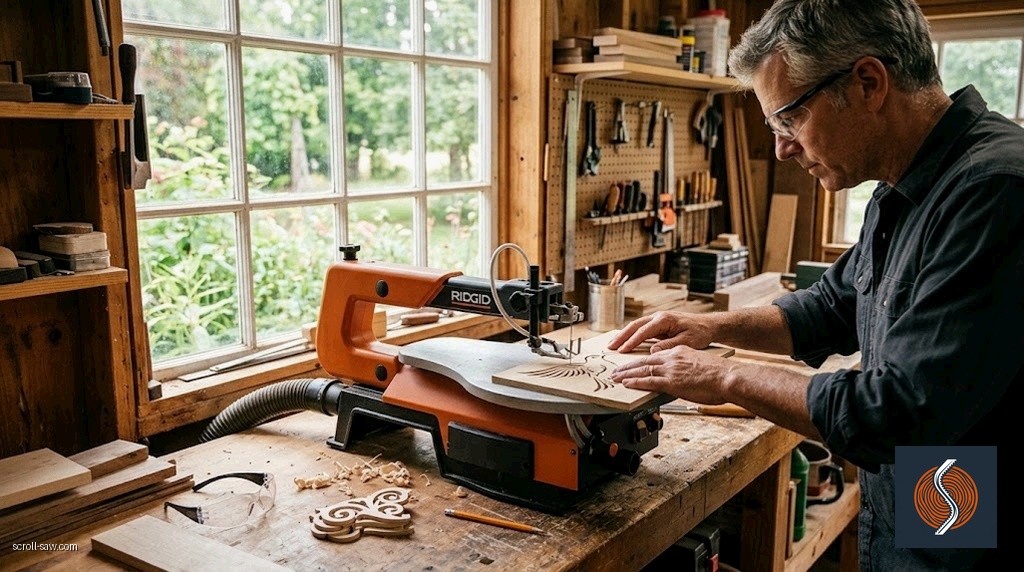
Ridgid Scroll Saw: A Guide for Owners and Buyers
Ridgid, the plumbing-and-power-tool brand sold at Home Depot in the U.S., made a scroll saw for a stretch of the mid-2000s and then discontinued it. The model most owners remember is the Ridgid SS16001 16-inch variable-speed scroll saw. It is a machine you will not find new anymore, but it turns up regularly on the used market, and it has a loyal following among owners who tuned one up and kept it running.
If you already own one, this article covers keeping it useful. If you are considering one on the used market, this article covers what to check and what to expect. If you are searching “Ridgid scroll saw” hoping to buy new, the honest answer is that you will need to consider a different brand.
What the Ridgid scroll saw actually was
The Ridgid SS16001 is a benchtop variable-speed scroll saw with a 16-inch throat depth. Key specifications from the original documentation and owner reports:
-
Throat depth: 16 inches.
-
Cut capacity: about 2 inches at 90 degrees, less at tilt.
-
Speed range: roughly 550 to 1,700 SPM.
-
Motor: universal motor, approximately 1.2 amps.
-
Blade type: accepts both pin-end and plain-end blades.
-
Table tilt: 45 degrees left, less right depending on the model.
-
Weight: approximately 35 pounds.
-
Original list price at retail: comparable to a WEN 3921 today, adjusted for time.
The saw was assembled in Taiwan for Emerson Tool Company (the licensed Ridgid brand manufacturer at the time). It was pitched as a mid-range hobby saw, positioned between low-cost imports and premium DeWalt or Delta machines.
The direct answer: is a used Ridgid scroll saw worth buying?
Worth considering under three conditions:
The price is well below a comparable used WEN, Delta, or Rikon in similar condition. In practical terms, that usually means under $150. Above that, a used Delta 40-694 or WEN 3921 is a safer choice because parts are still available.
The saw’s clamps and arm are visibly in good condition. Cracked plastic clamps or a bent arm are dealbreakers. Parts are hard to source; you cannot count on replacing them.
You are comfortable maintaining a discontinued tool. Ridgid’s scroll saw parts pipeline is thin. Common wear items like blade clamps, arm bearings, and speed control potentiometers may require creative substitutes. If you enjoy tinkering, this is fine. If you want a saw that just works, the discontinued status is a risk.
Not worth considering if the seller wants full retail-era pricing, or if the saw shows signs of heavy use with cosmetic issues. There are better used options at any comparable price point.
What to check before buying a used Ridgid scroll saw
Run this check with the saw powered up if possible.
Blade clamps. Open and close each clamp. The mechanism should move smoothly. Cracked, chipped, or missing hardware is a walk-away sign.
Arm motion. With the saw off, rotate the arm by hand through a full stroke. Motion should be smooth without side-to-side deflection or grinding.
Table square. Set a small engineer’s square against the blade at zero tilt. The table should reach true zero and hold there.
Variable speed. With the saw on, run through the full speed range. The motor should respond smoothly without cutting out or holding at one speed.
Bearing noise. Listen with the saw at moderate speed. A smooth hum is normal. Grinding or rasping means bearing wear.
Dust blower. The stock flexible tube is often missing or damaged. Not a critical issue but tells you how the previous owner treated the saw.
Motor housing temperature after five minutes. Run the saw for five minutes at moderate speed. The housing should be warm but not hot. Hot after five minutes means motor issues.
Foot pads. All four should be intact and compress evenly. Missing pads are a $2 fix from any hardware store.
A used Ridgid scroll saw that passes all these checks is worth the buying price if it is reasonable.
Setup and tuning: making a Ridgid scroll saw cut well
A used Ridgid scroll saw responds well to the same tuning any mid-range scroll saw benefits from.
Anchor it firmly. The Ridgid at 35 pounds is on the light side for standalone bench use. Bolt it to a heavy plywood plate that you can then clamp to a bench.
Square the table. Set the tilt stop screw so the blade sits true at zero. Mark the position on the trunnion with a permanent marker.
Aim the dust nozzle. The stock nozzle is often bent from years of use. Straighten it, or replace with a scrap of aquarium airline hose held to the arm.
Add task lighting. The Ridgid does not come with an integrated work light. A magnetic-base LED lamp aimed at the blade entry is the single most useful upgrade.
Use quality blades. Olson, Flying Dutchman, and Pégas all fit. The saw’s clamps hold plain-end blades reliably when in good condition.
Verify blade tension. The Ridgid uses a lever-style tensioner. Learn the correct pitch by ear and check at the start of each session.
Common problems and their fixes
Blade clamps do not hold plain-end blades
Usually the clamp shoulder is dirty or worn. Clean with alcohol and a small brass brush. If the internal grip surface is glazed or worn smooth, aftermarket replacement clamps are difficult to find but a machinist can fabricate an equivalent from small stock.
Variable speed control fails
The potentiometer is a general-purpose electronics part. A replacement from any electronics supplier of the correct resistance range works. Requires basic soldering.
Arm bearings develop noise
Most of the bearings in the arm assembly are standard sizes available from bearing suppliers. Replacement is not simple but is possible for someone comfortable with mechanical repair.
Motor brushes wear out
Universal-motor brushes are consumable parts. Original Ridgid replacement brushes are hard to find. General-purpose motor brushes in the correct size and shape often fit or can be filed to fit.
Motor stops running
Common culprits: reset switch (circuit breaker) failed open, brushes worn to the end, or motor windings failed. First two are repairable. The third usually ends the saw’s useful life.
Table tilt drifts off zero
Stop screw has loosened over years of vibration. Retighten with low-strength thread locker. Do not use high-strength thread locker; the stop needs occasional adjustment.
Vibration on a light bench
Anchor to a heavier plate. All 30–35 pound scroll saws vibrate on light benches.
Blade broke during a cut
Normal wear at end of blade life. Verify tension is not over-set. Verify feed rate is not too aggressive.
What happens to the Ridgid line today
Ridgid still sells power tools through Home Depot but no longer carries a scroll saw in the lineup as of the mid-2020s. Current Ridgid corded and cordless tools focus on job-site tools like drills, saws, and utility equipment. The scroll saw was a hobby-market tool that did not fit the direction the brand went.
Assuming the Ridgid brand does not re-enter the scroll saw category, current buyers looking for a new saw at the Ridgid SS16001 price point should consider:
-
WEN 3921 16-inch two-direction variable-speed scroll saw as the direct equivalent.
-
Delta 40-694 20-inch variable-speed as a step up.
-
A used DeWalt DW788 in the $250–$400 range for the mid-market that Ridgid used to fill.
Each of these is a well-supported machine with active parts availability. The Ridgid used market remains a place to buy from, not to expect long-term parts support.
Comparison of used-market alternatives
| Machine | Used price range | Parts availability | Best for |
| Ridgid SS16001 (used only) | $75–$150 | Thin | Bargain hunter, tinkerer |
| WEN 3921 (new or used) | $100–$140 new | Good | Beginner or light hobby |
| Delta 40-694 (used) | $200–$350 | Good | Beginner planning to scale up |
| DeWalt DW788 (used) | $250–$450 | Excellent | Long-term serious hobby |
| Craftsman variable-speed 16" (used) | $75–$200 | Fair | Casual weekend use |
Who might consider one: a bargain hunter with mechanical skills who finds a well-maintained example under $150 and understands what discontinued tool ownership means.
Note on the spelling of the brand name
The brand is spelled Ridgid (not Rigid), and the Ridgid SS16001 is the model most owners searching for a “Rigid scroll saw” are actually thinking of. Both spellings show up in online listings and search queries, which is why this article uses both.
FAQ
Is Ridgid still making scroll saws?
As of the mid-2020s, no. The Ridgid scroll saw was discontinued years ago, and the brand’s current lineup focuses on job-site tools like drills, saws, and utility equipment.
Where do I find parts for a Ridgid scroll saw?
Official Ridgid parts through the manufacturer are limited. Common wear items sometimes appear on used marketplaces or through general electronics and bearing suppliers. Motor brushes and potentiometers are the easiest to substitute. Blade clamps are the hardest.
Can I use standard scroll saw blades in a Ridgid?
Yes. The Ridgid SS16001 accepts both pin-end and plain-end blades in standard sizes. Olson, Flying Dutchman, and Pégas all fit.
Is the Ridgid scroll saw comparable to a DeWalt DW788?
Not really. The DW788 has better clamps, better arm bearings, and a longer duty cycle. The Ridgid is closer to a WEN 3921 in overall capability.
What is the maximum stock thickness for a Ridgid scroll saw?
Rated capacity is about 2 inches at 90 degrees. Practical clean-cut capacity is somewhat less, especially in dense hardwoods.
Does the Ridgid come with a stand?
A stand was offered as a separate accessory. Most used units come without the original stand. Any sturdy bench works fine.
Can I sell my Ridgid scroll saw?
Used prices for a working Ridgid SS16001 typically fall in the $75–$150 range depending on condition and included accessories. Include original documentation and the stand (if you have it) to increase asking price.
Is a Ridgid scroll saw worth restoring?
Depends on your interest. If the saw runs and only needs a task light, dust nozzle, and setup work, the restoration is quick and worthwhile. If the arm bearings, motor, or clamps are failing, the parts hunt may exceed the value of the finished saw.
References
-
Ridgid SS16001 owner’s manual and product documentation, Emerson Tool Company era.
-
Scroll Saw Village community threads on Ridgid scroll saws. scrollsawvillage.com
-
Scroll Saw Woodworking and Crafts Magazine coverage of the Ridgid SS16001. Fox Chapel Publishing.
-
Ridgid brand product catalog (current). ridgid.com
Title tag: Ridgid Scroll Saw: A Guide for Owners and Buyers
Meta description: What the Ridgid SS16001 scroll saw was, how to tune a used one to cut well, and what current alternatives to consider now that the model is discontinued.
URL slug: ridgid-scroll-saw
Excerpt: Ridgid made a scroll saw for a stretch and discontinued it. If you own one or are looking at a used one, here is how to check the condition, tune it, and decide whether the used-market example in front of you is worth taking home.


