
Before You Use a High Quality Scroll Saw: Setup Checks
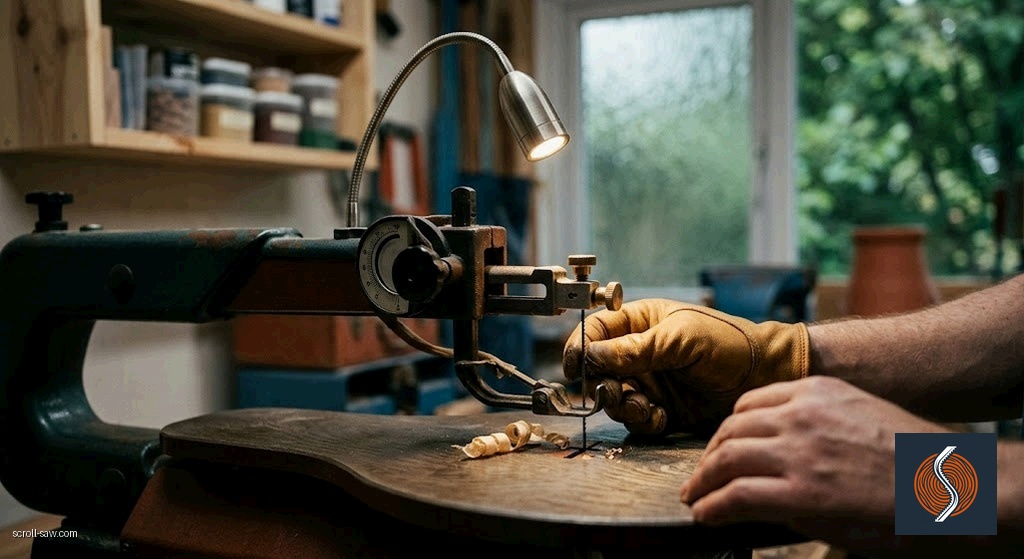
Before You Use a High Quality Scroll Saw: Setup Checks
High quality scroll saws promise better cuts, longer life, and less frustration. What they cannot promise is that the operator will get any of those benefits without doing the setup and checking work that a high quality saw still requires. Buying a Hegner or an Excalibur and running it straight out of the box on a light bench with cheap blades produces cuts no better than a well-tuned WEN.
The checks before running a high quality scroll saw are largely the same as before running any scroll saw. The difference is that on a high quality saw, the machine is not the limitation. The operator’s setup work is. Do the checks well, and the saw will cut to its ceiling. Skip them, and you paid for capability you will never see.
What separates high quality from ordinary scroll saws
High quality scroll saws share features that ordinary saws lack.
-
Induction motors instead of universal motors. Longer duty cycle, quieter, less brush maintenance.
-
Heavier arm castings that resist deflection.
-
Better arm bearings that hold true over years of use.
-
Precision blade clamps that grip plain-end blades reliably at all sizes.
-
Machined tables that stay flat and square.
-
Adjustable trunnion stops that hold zero over hundreds of cutting hours.
-
Effective dust management with proper air aim and vacuum ports.
-
Vibration damping at the base and in the arm.
Saws that fall into this category include Hegner (the reference standard for many decades), later Excalibur models, Pegas 21-inch scroll saws, and older DeWalt DW788 units in excellent condition. Each has a specific character. All meet the high quality bar.
Buying one of these saws is only the start. The bench setup, the blade choice, and the operator’s technique are what turn the saw’s capability into finished work.
The direct answer: checks to run before you cut
Before starting any project on a high quality scroll saw:
-
Verify the saw is bolted to a bench heavy enough to resist vibration. On a high quality saw, this is the single biggest setup factor.
-
Set the table square to the blade at zero tilt with an engineer’s square. Adjust the tilt stop.
-
Check blade tension by plucking. High quality saws hold higher tension without stress; use it.
-
Verify the arm bearings are quiet at working speed.
-
Aim the dust blower directly at the blade entry.
-
Check that task lighting removes shadow from the cut line.
-
Confirm the correct blade is installed for the specific project.
-
Verify the workpiece is prepared: pattern adhered, entry holes drilled, sequence planned.
-
Confirm safety gear: safety glasses on, dust extraction running, hair tied back, sleeves rolled.
-
Do a test cut on scrap of the same species and thickness as the project.
Skip any step and you introduce a variable that the saw’s quality will not compensate for.
Fit: matching the saw to the operator
A high quality scroll saw asks the operator to work at its level. The fit between operator and machine matters.
Height. The blade at elbow height when standing, or at a comfortable seated position. A Hegner arm at bench height wrong for the operator is uncomfortable within an hour.
Reach. The operator’s arms should reach the front controls without leaning forward. Most high quality saws position controls sensibly, but bench depth can defeat good design.
Foot position. If using a foot pedal, the foot should reach the pedal with the operator standing comfortably. On a high bench, a taller foot pedal riser helps.
Lighting angle. The task light angle should suit the operator’s eye position. Right-handed operators typically prefer the light from the left; left-handed operators the reverse.
Dust extraction air path. The extraction port should be behind the operator, not blowing dust in the face.
Bench clearance. Space to the sides of the saw for workpiece rotation. Space in front for pattern preparation. Space behind for storage.
A high quality saw poorly fit to the operator produces mediocre work. A moderate saw well fit to the operator often produces work as clean as a poorly fit high quality saw.
Blade selection on a high quality saw
Blade choice on a high quality saw matters even more than on a moderate saw, because the saw’s precision reveals every blade defect.
Skip-tooth for general work. Standard skip-tooth blades in the appropriate size for the stock. Olson, Flying Dutchman, or the saw manufacturer’s blade line.
Reverse-tooth for plywood. The reverse teeth clean the bottom face and eliminate most chip-out. Essential on Baltic birch and similar plywoods.
Modified-geometry for hardwood. Pégas modified-geometry blades cut cherry, maple, and walnut with less burning than standard skip-tooth. Pair with a high quality saw and clean cuts are within reach without extended sanding.
Spiral for full-360 cutting. Spiral blades cut in every direction, useful for portrait work where the operator does not want to constantly rotate the workpiece. Slightly rougher edge than skip-tooth.
Double-reverse for premium plywood work. Reverse teeth at both top and bottom of the blade. Highest possible cut quality on plywood at the cost of slower cutting speed.
Crown-tooth for softwood. Cuts on both up and down strokes. Fast in softwood; less refined edge than skip-tooth.
Fine sizes for detail work. #2/0 to #3 for portrait and fine fretwork. High quality clamps hold these blades reliably; ordinary clamps often slip.
Buying premium blades to match a premium saw is not extravagance. It is the way to see what the saw is actually capable of.
Safety on a high quality scroll saw
High quality scroll saws are safer than most because their arms track true and their blades break less often. Standard safety rules still apply.
Eye protection at every cut. Fine dust and blade fragments come off at eye level. Safety glasses with side shields, or over-glasses if you wear prescription lenses.
Dust extraction running. High quality saws produce cleaner cuts and less dust, but the dust that does come off is fine and stays airborne. A shop vac at the port and a ceiling filter for long sessions handle it.
Loose clothing away from the arm. Even on the smoothest arm, sleeves and jewelry can catch. Roll sleeves. Remove strings. Tie back hair.
Foot off the pedal during setup. A foot pedal makes accidental start-up easy. Keep the foot off until the hands are clear of the blade.
Hearing protection for long sessions. Even a quiet induction motor produces ambient noise. Over an hour is a reasonable threshold for ear protection.
Respirator for extended fine-dust exposure. Scroll saw dust is fine. Long sessions or repetitive production runs benefit from a light respirator. Not strictly necessary for occasional use.
Performance checks before a project
Every project starts with a short performance check. On a high quality saw, this takes three minutes.
Table square. Engineer’s square against the blade. Adjust if off.
Blade tension. Pluck test. Retension if the pitch is wrong.
Arm motion. Short run at moderate speed. Listen for bearing noise. Watch for arm deflection.
Dust airflow. Confirm the air blower is aimed at the blade entry.
Work light. Verify no shadow on the cut line.
Test cut on scrap. A short cut in scrap of the project’s species and thickness confirms the blade, speed, and tension are right before you commit to the actual workpiece.
On a high quality saw, all six checks pass in three minutes because the saw is designed to hold its setup. On a moderate saw, one or two of these checks might require attention every session.
Common problems and their fixes
Cuts wander despite the high quality saw
Not the saw. Check blade tension, blade sharpness, and feed rate. Verify the table is square. A high quality saw exposes operator technique that moderate saws hide.
Burning on hardwood cuts
Speed too high or blade dull. Drop the SPM to 700–900 on dense hardwoods. Replace the blade.
Blade breaks frequently
Over-tension, over-feed, or a blade near the end of its life. High quality saws can hold high tension, but pushing near the maximum shortens blade life. Back off slightly.
Motor housing hot after long session
Surprising on an induction motor. Check ventilation. Confirm the motor is not being loaded beyond its rating.
Table trueness drifts
On a high quality saw this is rare. Check the tilt stop screw. Check for damage to the trunnion. If the table itself has warped, factory service is often necessary.
Vibration on a heavy bench
Also rare on a high quality saw. Check foot pads. Check the bolts through the saw’s mounting holes. Confirm the bench itself is not resonating at the saw’s operating frequency (unusual but possible).
Dust extraction ineffective
Saw’s built-in port may need a larger-diameter shop vac hose than the standard 1-1/4” fitting. High quality saws sometimes have 2” or larger ports.
Comparison of high quality scroll saws
| Brand | Throat | Motor | Best known for |
| Hegner Multimax | 14–22" | Induction | Precision and long life |
| Excalibur (older) | 16–30" | Induction | Tilting head design |
| Pegas 21-inch | 21" | Induction | Blade clamps and vibration control |
| DeWalt DW788 (well-maintained) | 20" | Universal (better than most) | Wide availability, active user base |
| Rikon 21-inch | 21" | Induction | Value in the high quality tier |
Who benefits from a high quality scroll saw: hobbyists with serious weekly or daily use, semi-pro custom-work shops, and operators whose projects are limited by their current moderate saw’s precision or duty cycle.
FAQ
What is the highest quality scroll saw available?
Hegner Multimax is the reference for many serious scroll sawyers. Excalibur (in its older, higher-quality production years) and Pegas 21-inch are also in the top tier. Each has passionate advocates.
Is a DeWalt DW788 a high quality scroll saw?
Yes for its price class. It has a universal motor rather than induction, which is a real limit, but its arm, clamps, and reliability put it in the high quality tier at its price point.
How much should I spend on a high quality scroll saw?
Entry to the high quality tier is around $1,000 for a new Hegner Multimax or comparable machine. Used DeWalt DW788 examples run $250–$450 and represent excellent value. Pegas 21-inch new is in the $1,200–$1,500 range.
What is the best blade brand for a high quality scroll saw?
Pégas is a common answer, along with Flying Dutchman and Olson. Try a variety on your specific saw and settle on the blade family that works best for your typical projects.
Does a high quality scroll saw need special maintenance?
Less than a moderate saw, because the components are built to last. Basic maintenance is arm-bearing checks annually, blade clamp cleaning quarterly, and general lubrication per the manufacturer’s schedule.
Can a high quality scroll saw pay for itself?
In commercial production, yes. In hobby use, only through longevity. A Hegner running for 30 years costs about the same per year as a WEN replaced every three years.
Are induction motors always better than universal motors?
For duty cycle and noise, yes. For light weight and low cost, no. Induction motors are heavier and more expensive. High quality saws use them because the benefits align with the price class.
How do I know when to upgrade from a moderate to a high quality saw?
When the moderate saw becomes the limitation on your work rather than your skill. Signs: blade clamps slip repeatedly at the fine end, motor cannot sustain the session lengths you want to run, table will not stay square through multiple projects, or vibration limits cut quality even with good mounting.
References
-
Hegner USA. hegnerusa.com
-
Pegas scroll saws and blades. pegasusa.com
-
Fine Woodworking scroll saw reviews. finewoodworking.com
-
Scroll Saw Village long-term ownership threads on high quality saws. scrollsawvillage.com
Title tag: Before You Use a High Quality Scroll Saw: Setup Checks
Meta description: What separates a high quality scroll saw from an ordinary one, and the setup checks that let you actually see the difference in cut quality and life.
URL slug: high-quality-scroll-saw-checks
Excerpt: A high quality scroll saw does not produce high quality cuts on its own. Here are the fit, safety, and performance checks that turn the saw’s capability into finished work on the bench.


