
Is Scroll Saw Wood Art Useful? Applications and Setup
Is Scroll Saw Wood Art Useful? Applications and Setup
Scroll saw wood art is the category most people picture when they first see a finished scroll saw piece. A framed silhouette portrait. An intarsia landscape mounted on a wall. A fretwork clock face. Pieces that clearly exist as decorative art rather than functional objects.
The question is whether scroll saw wood art is a useful pursuit, either as a hobby practice or as a saleable specialty. The honest answer is that it can be either, and choosing which depends on how you want to work.
What scroll saw wood art actually is
Scroll saw wood art is decorative work where the scroll saw’s precision curved cutting is the defining production step. The category includes:
Silhouette wall art. Single-piece silhouettes of animals, scenes, or figures, mounted on contrasting backboards.
Two-tone portraits. Faces or figures cut from dark wood or paper, mounted on light backing. The classic “scroll saw portrait.”
Fretwork art panels. Delicate decorative panels with hundreds of interior cuts. Victorian-inspired designs, Celtic knotwork, geometric patterns.
Intarsia. Assembled pictures where each shape is a separate piece of contrasting wood, fitted together like a mosaic.
Marquetry. Similar to intarsia but using veneer rather than solid wood.
Compound-cut sculpture. Small three-dimensional figures cut from flat blanks in two orthogonal directions.
Named-scene wall art. Landscape scenes, cityscapes, and thematic compositions in fretwork or intarsia.
What distinguishes wood art from scroll saw crafts is the intended audience and the price point. Scroll saw crafts (ornaments, gift plaques, small silhouettes) sell at craft-fair prices. Scroll saw wood art sells at gallery prices, or is created without commercial intent as fine hobby work.
The direct answer: is scroll saw wood art useful?
Useful in three ways.
As a serious hobby practice. The technique ceiling is high. Portrait and intarsia work take years to master. For hobbyists who want a long-term specialty that rewards deep skill development, scroll saw wood art delivers.
As gallery-priced product. Portraits, intarsia panels, and detailed fretwork sell at $200 to $2,000 depending on complexity and reputation. Volume is low, but per-piece income is meaningful.
As custom commission work. Custom portraits from client-supplied photographs, family scenes rendered in wood, memorial pieces. This market is served by relatively few scroll saw artists and can support a part-time or hobby-adjacent income.
Where scroll saw wood art is not useful is if you want quick, high-volume, low-effort production. Craft-fair economics do not work at wood-art time investments. A piece that takes 20 hours cannot sell at craft-fair prices.
What separates wood art from craft work
Three factors separate wood art from craft work.
Time investment per piece. Craft-fair pieces finish in 30 to 90 minutes. Wood art pieces take 4 to 40 hours or more.
Material selection. Craft work uses standard plywood and inexpensive hardwood. Wood art often uses select-grade hardwoods with specific grain and color for intarsia, or specialty imported veneers for marquetry.
Finishing effort. Craft pieces get a wipe-on oil finish. Wood art pieces often get multi-coat oil finishes with hand-rubbed between coats, or shellac finishes built up over days.
A scroll saw wood art piece represents a much larger investment of time, material, and finishing effort than a craft piece.
Setup for scroll saw wood art
Serious wood art work benefits from a stronger setup than craft work.
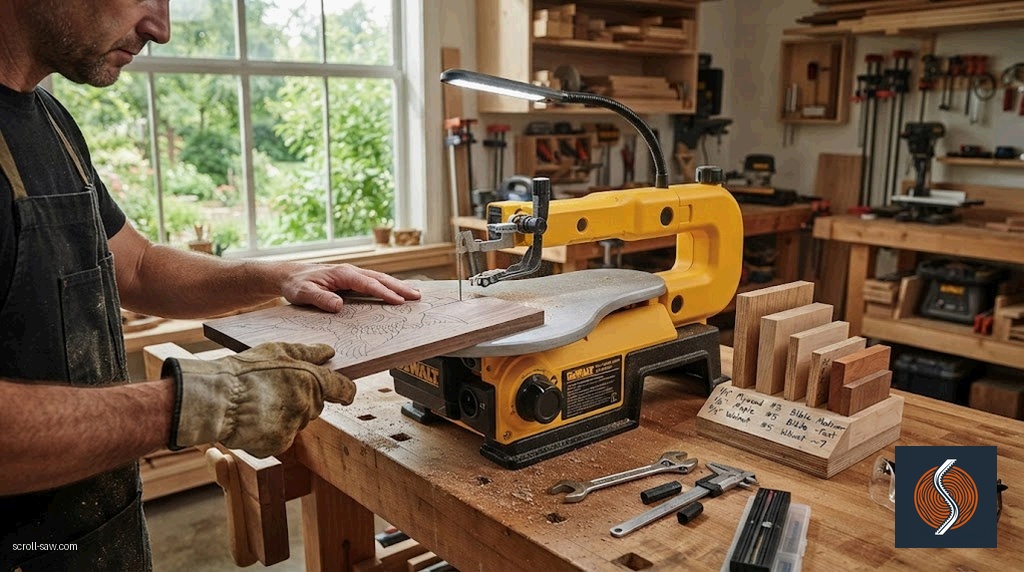
A high quality scroll saw. Wood art often requires blade sizes at the fine end (#3 down to #2/0) that expose weaknesses in blade clamps. A DeWalt DW788, Rikon 21-inch, Pegas 21-inch, or Hegner Multimax provides the precision to work at this level.
Excellent task lighting. Two light sources are better than one for wood art. A magnetic-base LED at the cut line and a swing-arm lamp for general illumination.
Magnification. For very fine portrait and fretwork detail, a swing-arm magnifier lamp helps track the cut line at fine blade sizes.
Precision drilling. A small drill press or precise handheld drill for entry holes. On fretwork, dozens or hundreds of entry holes must be positioned accurately.
Quality blades in fine sizes. Pégas, Flying Dutchman, or similar premium blades. Cheap blades wander at fine sizes and produce visibly worse cuts on art pieces.
Wood selection. Baltic birch plywood in 1/4” or thinner is the workhorse for silhouettes and portraits. Hardwoods in matched thicknesses for intarsia. Veneers for marquetry.
Finishing setup. A dedicated finishing area away from the sawing bench. Dust in a sawing environment ruins finish coats.
Portfolio storage. Finished pieces need archival storage or display until sold or given.
Time management for wood art projects
Wood art projects require project management that craft work does not.
Plan the project scope realistically. Estimate hours, add 50 percent for surprises, and be honest about whether the timeline fits your available session time.
Break the project into stages. Pattern preparation, entry-hole drilling, main cutting, detail cutting, sanding, finishing, mounting. Each stage has natural stopping points.
Store work in progress safely. A partially completed portrait or fretwork panel is fragile. Between sessions, keep it in a padded folder or on a shelf where it will not be knocked.
Track progress. A short session log per project. Date, hours, what got done, what is next. Prevents the “where was I?” cost at the start of the next session.
Photograph stages. Documentary photos of interim stages help if the piece will be sold or entered in competitions. Also useful for social media or a portfolio.
Set completion dates but avoid rushing. A wood art piece rushed shows the rush. Better to extend the timeline than to shortcut the finish.
Sources of wood art patterns and inspiration
Named designers publishing patterns for portraits and fretwork. Charles Dearing for portraits. Judy Gale Roberts for intarsia. Sue Mey for a wide variety of fretwork and portraits. Rick Hutcheson for named regional scenes. Search their pattern catalogs directly.
Sue Mey Scrollsaw Patterns and similar designer sites. Structured pattern libraries with wood-art-scale projects at intermediate to advanced skill levels.
Fox Chapel books. Great Book of Wildlife Projects and similar collections. Reference libraries for extended practice.
Custom pattern creation. For portrait work, converting a photograph to a pattern is a specific skill. Pattern-making software converts continuous-tone images to bitmap patterns suitable for cutting.
Historic pattern archives. Scroll saw magazines from the 1970s–2000s (which are frequently available on the used market) contain fretwork patterns and other decorative art suitable for reproduction.
Art references. Nature photography books, historical decorative design references, and public-domain image archives provide inspiration that can be converted to scroll saw patterns.
Common problems on wood art projects
Portrait faces look flat
Insufficient contrast between silhouette and background, or inaccurate cutting of small features. Study your source photograph. Cut the eye areas and mouth line with a fine blade to keep detail crisp.
Fretwork bridges break during cutting
Cut sequence. Save delicate bridges for last, after they are still supported by surrounding structure. Once cut through, the bridge becomes fragile.
Intarsia pieces do not fit together
Most common cause is small deviation from the pattern in individual pieces. Cut slightly outside the line and hand-fit each piece with sandpaper. Alternatively, use a slightly narrower blade (thinner kerf) so small deviations do not create gaps.
Portrait cut lines have burrs
Blade near end of useful life. Replace. Fresh blades cut cleaner at fine sizes.
Finish comes out uneven on complex pieces
Dust remaining in intricate interior cuts. Air-blow the piece before applying finish, or use a small brush to remove dust from deep pockets.
Marquetry veneers split during cutting
Use fresh sharp blades, feed slowly, and consider paper-backing the veneer with wood-glue-and-paper laminate to reinforce it.
Fatigue in long sessions
Wood art work is more mentally demanding than craft cutting. Take 5-minute breaks every 30 minutes. Cut one hour, break, resume, and stop when concentration fades.
Selling scroll saw wood art
Marketplaces and price expectations.
Craft fairs. Wood art pieces can appear at higher-end craft fairs but typically underperform against craft-priced items. Better at juried art fairs than at general craft fairs.
Etsy and online craft marketplaces. Portraits and intarsia sell steadily to buyers seeking custom or unique wood art. Photography quality of the listing matters enormously.
Custom commission work. Portrait commissions from family photographs. Typically $150–$400 for a single portrait in the 8x10 to 11x14 range.
Galleries and gift shops. Regional galleries occasionally take scroll saw wood art on consignment. Approach with a portfolio and expect a slow process.
Direct client work. Word of mouth from existing clients often produces the most sustainable custom-work stream.
Building a wood art practice is slow. A first-year artist rarely covers material costs, let alone time. A fifth-year artist with a portfolio and repeat clients can produce meaningful part-time income.
Comparison of scroll saw wood art specialties
| Specialty | Time per piece | Material cost | Market price |
| Small silhouette portraits | 2–5 hours | $5–$15 | $50–$150 |
| Detailed portraits | 8–20 hours | $10–$40 | $200–$600 |
| Fretwork art panels | 10–30 hours | $15–$50 | $150–$600 |
| Intarsia (small) | 15–40 hours | $40–$120 | $300–$900 |
| Intarsia (large) | 40–100 hours | $100–$400 | $800–$3,000 |
Who benefits most: hobbyists who enjoy deep skill development, artists interested in a wood medium, and craft producers looking to diversify into higher-price, lower-volume work.
FAQ
Is scroll saw wood art the same as scroll saw art?
Essentially yes. “Wood art” emphasizes the medium; “scroll saw art” emphasizes the tool. Both refer to decorative pieces where the scroll saw’s cutting is the defining production step.
What is the hardest form of scroll saw wood art?
Opinions vary. Portrait work at very fine blade sizes is demanding. Large intarsia panels with many pieces demand extreme accuracy. Marquetry with rare veneers demands both skill and material knowledge.
Can I sell scroll saw wood art from my home?
Yes. Home-based sales through online marketplaces, custom commissions from local clients, and consignment at galleries are all workable. Some jurisdictions require a small-business registration; check local regulations.
What is the best wood for scroll saw wood art?
Depends on the piece. Baltic birch plywood is the workhorse for portraits and silhouettes. Contrasting hardwoods (walnut, maple, cherry, purpleheart) for intarsia. Specialty veneers for marquetry.
Do I need a Hegner or Excalibur to make wood art?
No, but a high quality scroll saw makes the fine-blade work more reliable. A DeWalt DW788 in good condition handles almost all wood art work. Advanced portrait work benefits from a Hegner or Pegas.
How do I learn portrait cutting?
Start with published portrait patterns from named designers. Cut them exactly. Then convert your own photographs to patterns using pattern-making software, cut those, and iterate. Portrait cutting takes years to master.
What finishes work best on scroll saw wood art?
Wipe-on oil finishes (Danish oil, tung oil) for hardwood and intarsia. Clear spray sealers for plywood portraits. Multi-coat shellac for high-end fretwork.
Can I display scroll saw wood art outdoors?
Generally no. Scroll saw wood art is indoor decorative work. Outdoor exposure damages the fine detail through moisture cycling.
References
-
Mey, Sue. Sue Mey Scrollsaw Patterns. sue-mey.co.za
-
Roberts, Judy Gale. Intarsia Times. intarsia.com
-
Fox Chapel Publishing wood art book catalog. foxchapelpublishing.com
-
Scroll Saw Woodworking and Crafts Magazine artist profiles. scrollsawer.com
-
Scroll Saw Association of the World gallery. saw-online.com
Title tag: Is Scroll Saw Wood Art Useful? Applications and Setup
Meta description: Scroll saw wood art from portraits to intarsia to fretwork. What makes wood art different from craft work, what setup produces it, and where the honest limits sit.
URL slug: scroll-saw-wood-art
Excerpt: Scroll saw wood art is a decorative specialty distinct from craft-fair work. Here is what the category includes, the setup it demands, and the market and time realities for anyone considering it seriously.


