
Antique Scroll Saw: Identification and Restoration
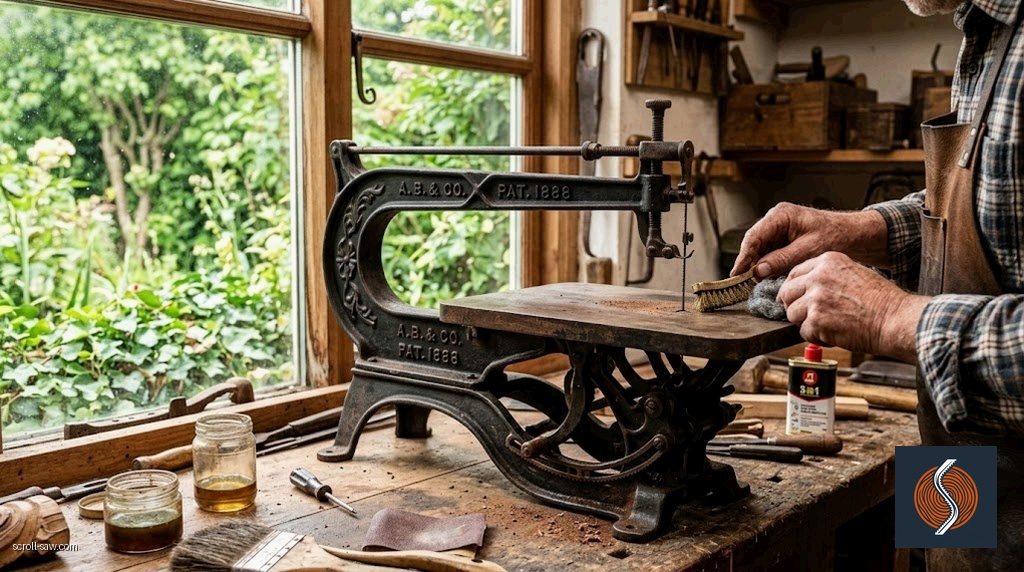
Antique Scroll Saw: Identification and Restoration
Antique scroll saws show up at estate sales, in old workshops, and occasionally at auctions. Names like Beede, Dunlap, and Rockwell were made decades ago by companies that are now either gone or transformed beyond recognition. Antique Craftsman and antique Delta saws are more recent but still date to eras when the machines were designed and manufactured differently.
The question when facing an antique scroll saw is not “is it any good?” A good antique saw well maintained can outcut many modern machines. The question is “what is this specific saw, what condition is it in, and can I keep it running?”
What counts as antique in scroll saws
There is no formal cutoff. As practical categories:
Pre-war and early post-war. Beede foot-treadle saws from the late 1800s. Small hand-cranked and treadle saws from various small manufacturers through about 1930.
Post-war household. Dunlap and other Sears sub-brands from the 1930s through the 1960s. Small motorized benchtop saws sold as household woodworking tools.
Rockwell and pre-Delta era. Rockwell scroll saws from the 1950s through the 1970s. Rockwell was later acquired by Pentair and rebranded to Delta.
Vintage Craftsman. Sears Craftsman scroll saws from the 1950s through the 1980s. Various manufacturers built for Sears under the Craftsman name.
Vintage Delta. Delta scroll saws from the 1960s through 1990s, including the 40-560 and other models before the current 40-series.
Vintage DeWalt (pre-DW788). DeWalt scroll saws from before the introduction of the DW788 in the 1990s.
Vintage import saws. Various imported scroll saws from the 1970s and 1980s under private labels for hardware stores.
Any of these can appear as an “antique scroll saw” listing. Recognizing what you are actually looking at is the first step.
The direct answer: is an antique scroll saw worth buying?
Worth considering in three specific cases.
Under $75 in working condition with clear identification. At that price, even a saw that lasts a few years is an inexpensive introduction to scroll sawing.
A known good model (Rockwell, older Delta) at a reasonable price with parts availability. Rockwell and pre-Pentair Delta saws have strong reputations and community support for parts sourcing.
A rare or historically interesting saw for a collector. Beede treadle saws and other very early machines have appeal beyond their working utility.
Not worth considering:
Unknown brand with unclear condition at any significant price. Without knowing what you are looking at, evaluation is impossible.
Saws with obvious major damage. Bent arms, cracked castings, missing motors. Repair costs exceed the saw’s value.
Saws priced like modern equivalents. A $300 Rockwell in unknown condition competes against a $300 new WEN or a $300 used DeWalt DW788. The modern options usually win on that comparison.
Identification: what am I actually looking at?
Steps to identify an unknown antique scroll saw.
Nameplate and casting marks. Check the base, arm, and motor housing for manufacturer names, model numbers, and date codes. Photograph everything before touching.
Manufacturer research. Search vintage tool community sites and forums. ManualsLib sometimes has older manuals. Rockwell, Delta, DeWalt, Craftsman, and Dunlap all have collector interest and community documentation.
Motor label. Motor type and specifications often narrow down the era. Induction motors were more common in higher-quality saws even in older eras.
Blade type and clamps. Pin-end versus plain-end clamps. Older saws often use pin-end blades exclusively.
Table casting and trunnion design. Distinctive to specific manufacturers and eras. Community reference photos can confirm identification.
Overall design. Foot-treadle, hand-crank, or motor-driven. Belt-driven from a separate motor or direct-drive. Each design corresponds to specific historical eras.
Once identified, look for the manual, parts diagrams, and community threads on the specific model. Rockwell saws have particularly strong community documentation.
Condition assessment
With identification in hand, assess condition before buying.
Casting integrity. Cracks in the base, arm, or trunnion are dealbreakers. Small cosmetic issues (chipped paint, surface rust) are not.
Arm motion. With the saw off, rotate through a full stroke by hand. Smooth motion is fine. Grinding or looseness means bearings.
Table trueness. Engineer’s square against the blade at zero tilt. Should be within a small tolerance; adjustable if not.
Blade clamps. Open and close. Look for cracks, chips, or missing hardware. Vintage clamps are often specific to the model and difficult to replace.
Motor condition. Universal or induction? Runs smoothly under load? Brushes visible for inspection?
Variable speed if present. Older variable-speed circuits often use potentiometers that degrade over decades.
Cord and switch. Old cords are often brittle. Old switches sometimes fail. Both are replaceable.
Vibration. Under load, listen and feel. Excessive vibration on old saws sometimes reveals bearing or arm assembly wear.
Bench mounting condition. Original saws often came with dedicated stands that may or may not be present.
A saw that passes casting integrity, arm motion, table trueness, and motor condition is a candidate for restoration or immediate use. Missing any of the four requires careful thought before proceeding.
Parts availability by brand
Rockwell. Strong community support. Many parts still available through vintage tool suppliers. Some parts interchange with early Delta.
Delta (pre-2000s). Good parts availability. Delta has been sold and reorganized several times but core parts remain available.
Craftsman. Depends on the specific manufacturer. Sears Craftsman scroll saws were made by various companies; identifying the actual manufacturer is often the key to finding parts.
DeWalt (pre-DW788). Older DeWalt scroll saws had a strong following. Some parts through DeWalt directly; some through specialty vintage suppliers.
Dunlap. Sears sub-brand. Parts are generally not available except through cannibalizing other units.
Beede. Very old, small manufacturer. Parts are essentially unavailable. Working saws exist only through very careful maintenance.
Antique Craftsman (very old). Case by case. Some models have community support; others do not.
Antique Delta (1960s–70s). Reasonable community support. Motor bearings and switches typically replaceable with generic parts.
Setup for antique scroll saws
A well-set-up antique scroll saw can be a working tool for decades more.
Bolt to a heavy bench or use original stand. Original stands, when present, are often engineered for the specific saw and worth preserving. Absent one, a heavy modern bench with through-bolts works.
Clean and lubricate. Decades of accumulated grease and dust in the arm mechanism. Disassemble carefully, clean with mineral spirits, and reassemble with fresh lubricant per the manual.
Replace worn bearings. Standard bearing sizes for many older saws. Measure with calipers and source through general bearing suppliers.
Replace cord and switch if age-brittle. Both are safety issues. Generic replacements work in most cases.
Square the table. Engineer’s square. Adjust the tilt stop.
Test the blade clamps. Vintage clamps often need cleaning to work reliably. If a clamp is damaged, options are limited to community sources or machined replacements.
Fit modern blades. Most vintage scroll saws accept modern pin-end blades. Some accept plain-end with appropriate clamps. Verify with the manual.
Add task lighting. Even the highest-quality vintage saws did not have good integrated task lighting. A magnetic-base LED lamp is a low-impact addition.
Add dust extraction. Vintage saws rarely have dust ports. Position a shop vac wand near the cut line, or add a small hood if the saw has flat surfaces to mount to.
Common problems on antique scroll saws
Blade clamps fail
Most frequent end-of-life issue on antique saws. If community sources cannot supply, consider machining a replacement or converting to plain-end blades with modern clamps if the saw’s design allows.
Motor bearings develop noise
Standard bearing replacements from general bearing suppliers. Requires motor disassembly.
Variable speed unreliable
Potentiometer degradation. Modern replacements are generic electronic parts.
Belt-driven arm slips
On belt-driven saws, replace the belt. Sizes are typically standard.
Excessive vibration under load
Usually mounting or bearing wear. Confirm mounting first. If unresolved, arm bearings need inspection.
Table casting damage
Most saws with cracked or warped table castings cannot be economically repaired. Sometimes replacement tables are available through vintage tool suppliers.
Cord or switch failure
Generic replacements. Standard electrical work.
Original manual missing
Community sources (Vintage Machinery, OWWM, ManualsLib) have scanned manuals for many vintage saws. Some are still available from the manufacturer.
Comparison of antique scroll saw options
| Brand / era | Working reliability | Parts pipeline | Collector interest |
| Rockwell (1950s–70s) | High | Good | Moderate |
| Vintage Delta (1970s–90s) | High | Good | Low-moderate |
| Vintage Craftsman | Variable | Variable | Low |
| Dunlap (Sears) | Moderate | Thin | Moderate |
| Vintage DeWalt (pre-DW788) | High | Moderate | Moderate |
| Beede (foot-treadle) | Low working use today | Very thin | High for collectors |
Who benefits most: hobbyists with shop skills who enjoy restoration work, collectors of vintage woodworking tools, and buyers finding a specific known-good model (Rockwell, older Delta) at a reasonable price.
Where to find antique scroll saws
Estate sales. Common source. Prices often reasonable when the seller does not know the market.
Local classifieds and marketplaces. Craigslist, Facebook Marketplace, local newspapers. Check under “scroll saw,” “jigsaw,” and “woodworking tools.”
Auction houses. Regional auctions occasionally have woodworking tool lots. Prices variable.
Vintage tool dealers. Higher prices but better condition and more information.
Woodworking club members. Members of local woodworking clubs often have older saws they no longer use.
Auction sites. Online auctions carry vintage scroll saws. Shipping cost limits practicality for larger models.
Inspecting in person is strongly preferred. Photographs on remote sales rarely show the condition issues that matter.
FAQ
How old does a scroll saw have to be to be antique?
No formal cutoff. Practically, saws from before about 1980 are often called antique in the hobbyist market.
Are antique scroll saws collectible?
Some, yes. Beede treadle saws, very old cast-iron machines, and some early motorized models have collector interest. Common vintage Craftsman and Delta saws are working tools rather than collector items.
Can I still get blades for an antique scroll saw?
Most accept modern pin-end blades. Some accept plain-end. A few very old saws use uncommon blade formats that require sourcing through specialty suppliers or vintage-parts communities.
Where do I find manuals for antique scroll saws?
ManualsLib has many. Vintage Machinery hosts scanned older documentation. Community forums often share PDFs.
Should I restore or replace?
Depends on the saw and your intent. A Rockwell in reasonable condition often deserves restoration. An unknown-brand saw with major damage is better replaced.
Is a restored antique scroll saw better than a new entry class saw?
Often yes for cast-iron era saws with induction motors. A restored Rockwell with a fresh cord and bearings can outperform a new plastic-cased entry class saw.
How much should I pay for an antique scroll saw?
Under $75 for unknown condition. Up to $150–$200 for confirmed good working condition on a known-good model. Beyond that, the modern used market (used DeWalt DW788, used Rikon) offers better value.
Are antique scroll saws safe?
Generally yes, once cords, switches, and any brittle plastic are replaced. Modern safety features (blade guards, hold-down feet) may need to be added; some vintage saws lack them.
References
-
Vintage Machinery reference archive. vintagemachinery.org
-
Old Wood-Working Machines (OWWM) community. owwm.org
-
ManualsLib vintage tool archive. manualslib.com
-
Scroll Saw Village vintage tool threads. scrollsawvillage.com
Title tag: Antique Scroll Saw: Identification and Restoration
Meta description: How to identify, evaluate, and maintain antique scroll saws from Beede, Rockwell, Dunlap, and vintage Craftsman and Delta lines. What to buy and what to walk away from.
URL slug: antique-scroll-saw
Excerpt: Antique scroll saws range from Beede treadle saws to vintage Delta and Rockwell benchtops. Here is how to identify what you are looking at, assess condition, and keep the working ones running.


