
Vintage Scroll Saw: Identification and Parts
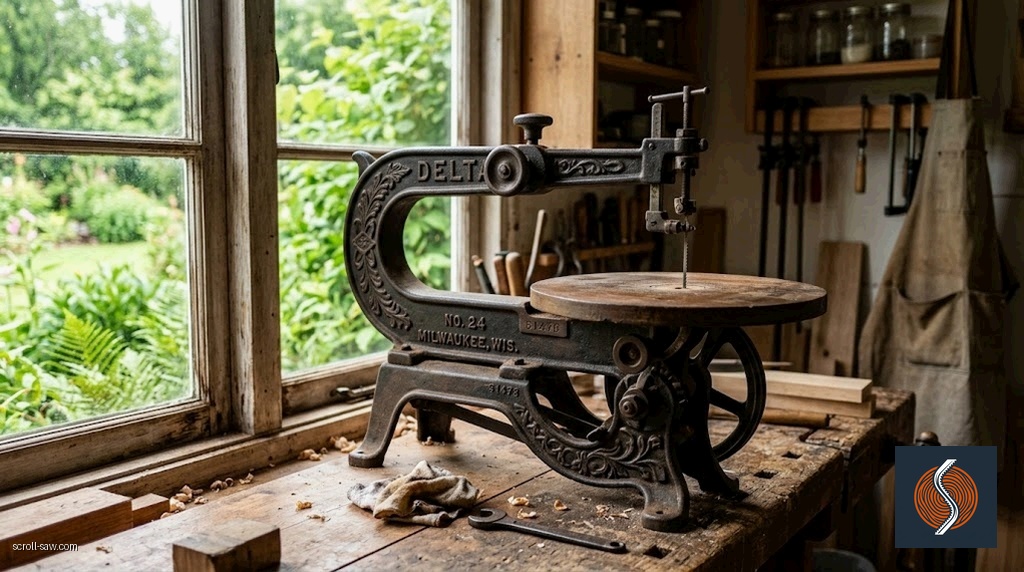
Vintage Scroll Saw: Identification and Parts
Vintage scroll saws appear at estate sales, in old workshops, and in listings under vague descriptions like “antique jigsaw” or “old benchtop scroll saw.” Some are working tools with decades of life left. Some are curiosities that will never cut cleanly again. Telling one from the other before buying is the difference between a bargain and a dust collector.
This piece covers the general vintage scroll saw category. For very early hand-cranked and treadle saws, see the antique scroll saw treatment. This piece focuses on motorized bench scroll saws from roughly the 1950s through the 1990s.
What counts as a vintage scroll saw
A practical working definition:
Vintage (roughly 1950s–1990s). Motorized bench scroll saws from the pre-DW788 era. Common brands: Delta, Rockwell (later folded into Delta), Craftsman (various manufacturers), Dunlap (Sears sub-brand), Hegner (early models), Excalibur (early), Powermatic, older WEN.
Antique (pre-1950s). Treadle saws, hand-cranked saws, very early motorized machines. Different considerations; more collector interest than working tool.
Modern (post-1990s). Current production saws. Not vintage.
The vintage category is where most estate-sale scroll saws fall. A specific model’s era can usually be identified from casting marks and design features.
The direct answer: is a vintage scroll saw worth buying?
Worth considering when four conditions align:
Known good brand. Delta, Rockwell, older Powermatic, older Hegner, older Excalibur, older DeWalt. These have community support and reasonable parts pipelines.
Working or near-working condition. Motor runs, arm moves smoothly, table is not damaged. Minor issues (worn brushes, brittle cords, potentiometer failures) are fixable. Major issues (cracked castings, damaged arms, missing blade clamps) usually are not.
Reasonable price. Under $200 for a known good model in working condition. Under $75 for a restoration project.
Buyer’s skills match the maintenance needs. Comfortable with basic electrical repair, bearing replacement, and general mechanical work.
Worth avoiding when unknown brand, unclear condition, and a price similar to modern used market saws (used DeWalt DW788 at $250–$450 is often better value than an unknown vintage saw at similar price).
Identification: what am I looking at?
Systematic identification steps.
Nameplate and casting marks. Base, arm, and motor housing. Photograph everything.
Model number. Search for the specific model number online. Community documentation exists for many vintage models.
Manufacturer research. Vintage Machinery and OWWM have databases of vintage tools with photographs and specifications.
Design features. Belt-driven versus direct-drive. Cast iron versus cast aluminum. Blade clamp design. Table trunnion design. Each corresponds to specific eras and manufacturers.
Motor type. Induction motors were more common in higher-quality vintage saws. Universal motors were used in lower-tier saws.
Blade clamp type. Pin-end, plain-end, or both. Design of the clamp itself often indicates the manufacturer.
Manual match. If a manual is available, verify that the manual matches the physical saw. Some vintage saws were repainted or relabeled.
A proper identification takes 15–30 minutes with online references. Skipping the identification often leads to buying a saw with unavailable parts.
Condition assessment
With identification in hand:
Casting integrity. Cracks, chips, or repairs in the base, arm, or trunnion. Cracks are usually dealbreakers.
Arm motion. Smooth stroke without deflection or noise. Grinding indicates bearing wear.
Table trueness. Engineer’s square against the blade at zero tilt. Should be within a small tolerance; adjustable if not.
Blade clamps. Open and close. Cracks, chips, or missing hardware in the clamp are difficult to repair on discontinued brands.
Motor operation. Runs smoothly under no load. Continues to run smoothly under moderate load. No unusual smells or noises.
Variable speed if present. Full range operation. Intermittent behavior suggests potentiometer failure.
Cord and switch. Brittle cord, cracked switch, or exposed wiring are safety issues that require replacement.
Vibration. With the saw running at working speed on a bench, vibration should be manageable. Excessive vibration suggests bearing or arm wear.
Overall completeness. Missing accessories, guards, or hardware may not be replaceable.
A saw that passes casting integrity, arm motion, table trueness, motor operation, and cord/switch checks is a candidate. Failing any raises the restoration cost significantly.
Parts availability by brand
Delta (1970s–90s). Strong. Many parts still available through Delta or aftermarket. Community support extensive.
Rockwell. Strong for the era. Many parts interchange with early Delta since Rockwell became Delta.
Powermatic (older). Moderate. Community support exists but parts are less common than Delta.
Hegner (older models). Good. Hegner USA continues to support older Multimax models.
Excalibur (older). Variable. The brand has changed hands; older parts sometimes available through Seyco or independent dealers.
Craftsman (Sears). Depends on the actual manufacturer. Sears Craftsman scroll saws were made by various companies. Identifying the actual manufacturer is often the key to parts.
Dunlap (Sears). Poor. Sears sub-brand. Parts generally not available except through cannibalizing other units.
DeWalt (pre-DW788). Moderate. Some community support and generic parts. Model-specific parts often unavailable.
Miscellaneous private-label saws. Variable. Generally poor parts availability.
Pattern and pricing sources for vintage scroll saws
Vintage tool dealers. Higher prices, better information, condition often verified.
Estate sales. Common source, prices variable, condition unverified. Best when you can inspect in person.
Local classifieds (Craigslist, Facebook Marketplace). Regional variation. Inspection possible.
Auction sites. Wide selection, shipping can be difficult for larger saws.
Community forums. OWWM, Vintage Machinery, Scroll Saw Village. Members occasionally sell.
Woodworking club members. Often have older saws they no longer use.
Prices for known good vintage saws in working condition:
-
Delta scroll saws (1970s–90s): $100–$300 depending on model and condition.
-
Rockwell scroll saws: $150–$400 depending on model and condition.
-
Powermatic scroll saws: $200–$500 depending on model.
-
Hegner older Multimax: $500–$1,200 depending on model.
-
Older Excalibur: $300–$800 depending on model and condition.
-
Craftsman scroll saws: $50–$200 depending on manufacturer and condition.
Setup: making a vintage scroll saw usable
Deep clean. Disassemble accessible components. Clean with mineral spirits. Reassemble with fresh lubrication per the manual.
Replace bearings if noisy. Standard bearing replacements. Measure with calipers before ordering.
Replace belt if belt-driven. Standard V-belt sizes on most vintage saws.
Replace cord and switch if brittle. Safety-critical.
Replace brushes on universal motors. Simple replacement.
Replace potentiometer on variable-speed saws. Standard electronic part.
Square the table. Engineer’s square. Adjust the tilt stop.
Verify blade clamps. Clean, test, replace if damaged (if replacements are available).
Bolt to a heavy bench. Original stands preferred when available.
Add task lighting. Most vintage saws lack integrated lighting.
Add dust extraction. Most vintage saws lack dust ports. Position a shop vac wand near the cut line.
Fit modern blades. Most vintage saws accept modern pin-end blades. Some accept plain-end. Verify with the manual.
Common problems on vintage scroll saws
Blade clamps fail
Most frequent end-of-life issue. Community sources for known brands. Machining a replacement is a fallback.
Motor bearings develop noise
Standard bearing replacements. Requires motor disassembly on some designs.
Belt slips
Belt wear or tension. Replace and adjust.
Variable speed unreliable
Potentiometer degradation. Generic electronic part.
Cord or switch fails
Generic replacements. Standard electrical work.
Table trueness drifts
Stop screw loose. Retighten with low-strength thread locker.
Excessive vibration
Bench mounting or bearing wear. Confirm mounting first.
Original manual missing
Community sources have scanned documentation for many vintage saws.
Comparison of vintage scroll saw brands
| Brand | Era | Parts availability | Value proposition |
| Delta (1970s–90s) | Long production | Good | Reliable working saw at moderate price |
| Rockwell | 1950s–70s | Good | Excellent precision if fully restored |
| Powermatic (older) | 1970s–90s | Moderate | Heavy-duty for the era |
| Hegner Multimax (older) | 1980s–90s | Good | Premium precision at used prices |
| Excalibur (older) | 1980s–90s | Variable | Tilting head design; parts pipeline uncertain |
| Craftsman (Sears) | Long production | Variable by maker | Bargain if maker is known |
| DeWalt (pre-DW788) | Pre-1990s | Moderate | Interesting collector saws |
Who benefits from vintage scroll saws: hobbyists with shop skills, buyers finding a known-good brand at reasonable price, and shops where restoration work is part of the enjoyment.
Vintage patterns and vintage saw pairing
Vintage scroll saws pair naturally with vintage patterns. Fox Chapel’s reprints of vintage pattern books and scanned collections from Popular Mechanics and Popular Woodworking from the 1950s–80s offer patterns of the era. A restored Delta from 1975 cutting a 1975 pattern for a decorative wall clock has a specific appeal that combining new equipment and new patterns does not.
Many vintage-tool hobbyists eventually combine tool and pattern collection into a period-appropriate practice.
FAQ
What is the best vintage scroll saw?
Within its era, Rockwell scroll saws are frequently cited as excellent precision tools. Hegner and older Excalibur are premium options. Delta scroll saws from the 1970s–90s are the most common working vintage saws.
Where do I find vintage scroll saw patterns?
Fox Chapel Publishing reprints, Popular Mechanics archives, vintage woodworking magazine back issues, and community pattern archives.
Can I still buy blades for a vintage scroll saw?
Most accept modern pin-end blades. Some use plain-end. Very few use uncommon blade formats that require specialty sourcing.
How much should I pay for a vintage scroll saw?
Depends heavily on brand and condition. See the pricing overview above.
Should I restore a vintage scroll saw or buy modern?
Restore if you enjoy the process and the specific saw is a known-good brand. Buy modern if you want a working tool without restoration work.
Is a restored vintage scroll saw as good as a modern one?
Often better for cast-iron era saws with induction motors. Modern saws have better dust management, better lighting integration, and better ergonomics.
What is the biggest risk of buying vintage?
Blade clamp failure on a discontinued brand with no parts pipeline.
Where do I find manuals for vintage scroll saws?
Vintage Machinery, OWWM, and ManualsLib host scanned documentation.
References
-
Vintage Machinery. vintagemachinery.org
-
Old Wood-Working Machines (OWWM). owwm.org
-
ManualsLib. manualslib.com
-
Scroll Saw Village vintage tool threads. scrollsawvillage.com
-
Fox Chapel Publishing vintage pattern reprints. foxchapelpublishing.com
Title tag: Vintage Scroll Saw: Identification and Parts
Meta description: How to identify, evaluate, and maintain a vintage scroll saw from the 1950s through 1990s. Parts availability by brand, common problems, and where to source what you need.
URL slug: scroll-saw-vintage
Excerpt: Vintage scroll saws from Delta, Rockwell, Powermatic, Hegner, and Craftsman appear at estate sales and online. Here is how to identify what you are looking at, evaluate condition, and keep working ones running.


