
What Do You Use a Scroll Saw For? Fit and Safety
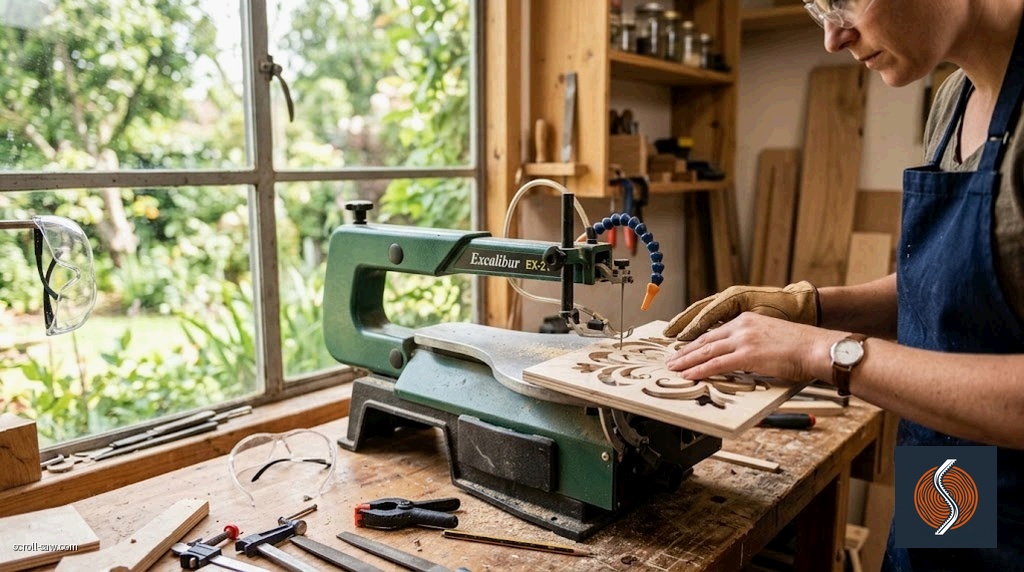
What Do You Use a Scroll Saw For? Fit and Safety
“What do you use a scroll saw for?” is one of the first questions a new woodworker asks. The honest answer is that a scroll saw fills a specific niche in the shop: curved and interior cuts in thin stock, at a level of precision that most other saws cannot match. The tool is not for every cut. When it is right, it is the best option available for that cut.
This piece answers the question directly, then covers the fit, safety, and performance checks that make every scroll saw project a productive one.
What a scroll saw is actually for
Six primary uses.
Curved cuts in thin stock. Any curve in wood, plywood, or thin plastic that a straight-cutting tool cannot handle.
Interior cuts. Cuts that start inside a workpiece and never break to an outside edge. A drill and a scroll saw are the only shop tools that can make interior cuts without cutting through the outside.
Decorative cutting. Silhouettes, ornaments, wall art, fretwork, and intarsia. Detail work that requires precision and small blade footprint.
Precision work. Portrait cutting, inlay, marquetry. Work where cut accuracy matters within fractions of a millimeter.
Thin stock. Materials 1/8” through 3/4” primarily. Some scroll saws handle up to 2” but performance drops.
Small workpiece control. Small pieces that would be hazardous or impractical on a band saw or table saw.
The scroll saw is a specialty tool. It does not replace a table saw for ripping, a band saw for resawing, or a jigsaw for portable work. It complements them.
The direct answer: when should I use a scroll saw?
Use a scroll saw when the cut is curved and the material is thin. This is the default answer. Any curved cut in wood 1” or thinner is a good candidate for scroll saw work.
Use a scroll saw when the cut is interior. Interior cuts require a threaded blade, which only a scroll saw provides in a bench tool.
Use a scroll saw when the workpiece is small. Fingers, small stock, and dust management all favor the scroll saw over other saws.
Use a scroll saw when the piece is delicate. Fretwork, portraits, and intarsia benefit from the scroll saw’s precision.
Do not use a scroll saw for. Straight ripping (use a table saw). Resawing (use a band saw). Rough cutting large stock (use a track saw or circular saw). Cutting metal beyond thin sheet (use metalworking tools).
Fit: what materials work on a scroll saw
Softwood (pine, cedar, spruce). Cuts easily. Skip-tooth blades. Watch for chip-out.
Hardwood (oak, maple, walnut, cherry). Standard scroll saw work. Fresh blades. Skip-tooth blades.
Baltic birch plywood. The workhorse of scroll saw work. Reverse-tooth blades reduce bottom-face chip-out.
MDF. Cuts cleanly but dust is dense and problematic. Respirator recommended.
Acrylic and plastic. Blades for plastic, or fine standard blades at slower feed. Feed slowly to avoid melting.
Laminate and veneer. Fine blades. Reverse-tooth for chip-out control.
Soft metal (brass, aluminum, copper). Spring steel or high-speed steel blades. Lubricant. Slow feed.
Thin metal sheet. Possible with metal-cutting blades. Not a scroll saw specialty.
Paper, cardboard, foam. Possible for craft work. Very fine blades.
Hard metals (steel, iron). Not suitable. Use metalworking tools.
Ceramic or stone. Not suitable.
Very thick hardwood (2” or thicker). Some scroll saws handle it, most struggle. A band saw is usually better.
Fit: what projects work on a scroll saw
Decorative silhouettes. Ornaments, wall art, name plaques.
Puzzles. Jigsaw puzzles, letter puzzles, geometric puzzles.
Small toys and figures. Wooden animals, alphabet blocks, small vehicles.
Fretwork. Delicate interior-cut decorative panels.
Portraits. Two-tone detailed portraits from photographs.
Intarsia. Multi-piece assembled art from contrasting hardwoods.
Marquetry. Thin veneer inlay work.
Boxes. Small keepsake boxes with decorative details.
Cutting boards. With decorative inlay or profiled edges.
Jewelry and accessories. Small wooden pendants, earrings, hair barrettes.
Clock cases and faces. With fretwork and decorative detail.
Shop jigs. Custom small jigs for other tools.
Compound-cut figurines. Three-dimensional figures from flat blanks.
Projects that do not fit a scroll saw: large panel work, structural furniture components, rough carpentry, dimensional lumber cutting.
Safety: standard scroll saw safety
Safety glasses at every cut. Blade breakage and fine dust.
Dust extraction running. Shop vac at the built-in port.
Fingers away from the blade. Both hands on the workpiece, at least an inch from the blade.
Foot off pedal during setup. If using a foot pedal, foot completely off while hands are near the blade.
No loose sleeves, jewelry, or long hair. Nothing hanging over the table.
Task lighting on the cut line. No shadow.
Hearing protection for extended sessions. Foam plugs or earmuffs.
Respirator for exotic hardwoods or MDF. N95 or better.
Grounded outlet. Three-prong plug into proper wall outlet.
Unplug for blade changes. Not just power off; unplugged.
Performance checks
Before starting a project, verify the saw’s setup.
Blade tracks true. A blade that pulls to one side wastes stock and produces poor cuts. Verify with a test cut on scrap.
Tension appropriate. Blade pings at higher pitch when plucked. Sag under tension indicates too little; snapping indicates too much.
Table squared. Engineer’s square at zero tilt.
Blade fresh. Old blades cut poorly and break more often. Change more often than seems necessary.
Speed matches material. Faster for softwood, slower for hardwood and plastic.
Feed rate appropriate. Slow enough that the blade cuts cleanly without wandering.
Dust extraction pulling. Verify with a visual check at the blade entry.
Task lighting positioned. No shadow on the cut line.
A saw that passes these checks produces predictable results. A saw that fails any of them wastes stock and time.
Setup: making the scroll saw useful
Bolt saw to bench. Vibration reduces cut quality.
Squared table. Engineer’s square adjustment.
Quality blades stocked. Pégas or Flying Dutchman in size range from #2/0 to #12.
Task lighting. Positioned to eliminate shadow.
Dust extraction. Shop vac plumbed to the built-in port.
Small drill for entry holes. 1/32” and 1/16” bits.
Sanding station. Small sanding drum on rotary tool, 220-grit paper.
Finishing supplies. Wipe-on oil, clear spray sealer.
Pattern preparation. Printer, spray adhesive, painter’s tape.
Stock organized. Plywood and hardwood in accessible storage.
Ergonomic bench height and chair. Elbow at 90 degrees when seated.
Cutting workflow for any project
Read the pattern. Understand what interior and exterior cuts are needed.
Select stock. Match the material to the project.
Prepare the pattern. Print at exact scale. Adhere with spray adhesive.
Cover delicate patterns with clear packaging tape. Reduces friction, protects the pattern.
Drill entry holes. All interior cuts get holes before sawing.
Choose blade size. Coarse for exterior contours; fine for interior detail.
Test on scrap. Verify feed rate and cut quality before starting the actual piece.
Cut interior first. From delicate to structural. Save fragile bridges for last within each area.
Cut exterior last. Once the interior is complete.
Sand. 220-grit paper. Small sanding drum on interior curves.
Finish. Wipe-on oil or clear spray sealer.
Photograph the finished piece. For your record and portfolio.
Common problems on scroll saw projects
Blade wanders during cut
Dull blade, incorrect tension, too-fast feed. Fresh blade. Correct tension. Slower feed.
Cut edges chip out
Reverse-tooth blades. Painter’s tape over the cut line on delicate patterns.
Pattern lifts during cutting
Insufficient adhesive. Press firmly. Wait for adhesive to set.
Interior cuts require awkward threading
Drill entry holes before starting. Adequate size for the blade.
Delicate bridges break during cutting
Cut sequence. Save fragile bridges for last within each area.
Blade breaks frequently
Over-tension, dull blade, or too-fast feed. Verify tension. Fresh blade. Slower feed.
Piece burns during cutting
Dull blade, or feed rate too slow for the material. Fresh blade. Adjust feed.
Cut quality varies within a single piece
Inconsistent feed rate. Slow down on curves; steadier feed on straight sections.
Comparison: scroll saw versus alternative tools
| Tool | Best for | Not for |
| Scroll saw | Curved cuts, interior cuts, thin stock, precision | Ripping, resawing, thick stock, straight cuts |
| Band saw | Thicker curves, resawing, larger stock | Interior cuts, delicate detail |
| Jigsaw (handheld) | Portable curve cutting, large workpieces | Precision detail, small stock |
| Coping saw | Small hand-cut curves, tight interior work | Speed and volume |
| Fret saw | Hand-cut delicate fretwork | Speed and volume |
| Table saw | Straight rips and cross-cuts | Curves, interior cuts |
| Laser cutter | Fine detail in thin stock, mass production | Thick hardwood, tactile hand-cut quality |
Who should choose a band saw instead: woodworkers whose curves are in thicker stock or larger workpieces.
Who benefits from having both: most serious hobby shops. Band saw for the thick cuts; scroll saw for the precision.
FAQ
What do you use a scroll saw for the most?
Curved cuts in thin stock, interior cuts, and precision decorative work.
Can a scroll saw replace a jigsaw?
For bench work, yes. For portable work, no. A handheld jigsaw remains valuable for on-site curve cutting.
Can a scroll saw cut metal?
Thin soft metal (brass, aluminum, copper) with appropriate blades. Not hard metals.
Can a scroll saw cut acrylic?
Yes, with blades for plastic and slow feed. Feed too fast and the plastic melts.
What is the thickest wood a scroll saw can cut?
Depends on the saw. Most bench scroll saws handle 1–2” hardwood. Performance drops as thickness increases.
Do I need a scroll saw if I have a band saw?
For interior cuts and fine detail, yes. A band saw cannot make interior cuts and does not match a scroll saw’s precision.
Is a scroll saw good for beginners?
Yes. Among the safest power tools in a home shop, forgiving of feed rate errors, and produces satisfying results quickly.
What is the biggest limit of a scroll saw?
Stock thickness and workpiece size. Beyond about 1” hardwood or 22” of workpiece length past the throat, other tools become more practical.
References
-
Fine Woodworking scroll saw fundamentals. finewoodworking.com
-
Scroll Saw Woodworking and Crafts Magazine. scrollsawer.com
-
Good, Steve. Scrollsaw Workshop. scrollsawworkshop.blogspot.com
-
Fox Chapel Publishing. foxchapelpublishing.com
Title tag: What Do You Use a Scroll Saw For? Fit and Safety
Meta description: The direct answer to what a scroll saw is actually for, with fit guidance by material and project, safety rules, and performance checks that every project shares.
URL slug: what-do-you-use-a-scroll-saw-for
Excerpt: A scroll saw fills a specific niche: curved and interior cuts in thin stock with high precision. Here is what it does well, where it does not fit, and the checks that make every project productive.


