
Turning a Jigsaw Into a Scroll Saw: Setup and Limits
Turning a Jigsaw Into a Scroll Saw: Setup and Limits
The idea of converting a handheld jigsaw into a bench scroll saw appears in DIY forums, YouTube videos, and old woodworking magazines. The premise is appealing. Buy a cheap jigsaw, mount it upside down under a wooden platform, and cut curves like a scroll saw. Total cost under $50 for the whole rig.
The honest answer is that this conversion produces a tool that works for some things and fails at others. Understanding what it can and cannot do saves the disappointment of expecting a real scroll saw at bargain price.
What a jigsaw-to-scroll-saw conversion actually is
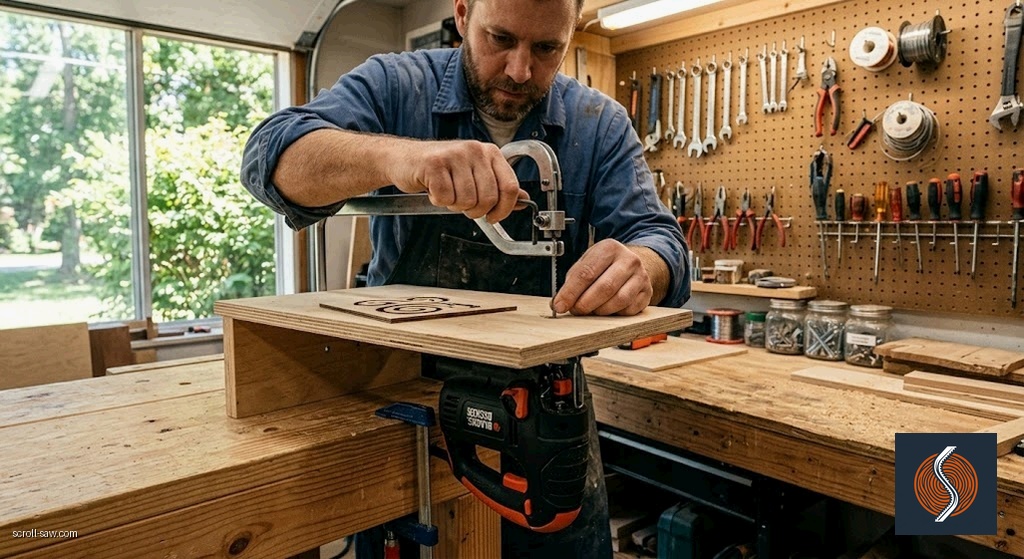
A handheld jigsaw mounted upside down beneath a wooden or MDF platform, with a slot cut in the platform for the blade to pass through.
The setup. Jigsaw clamped or bolted to a bracket underneath the platform. Blade projects upward through the slot.
Operation. Workpiece rests on the platform. Operator pushes the workpiece past the blade to make cuts. Similar in principle to a bench scroll saw.
Materials. Any 1/2” or 3/4” plywood or MDF for the platform, dimensional lumber for the bracket, C-clamps or bolts for mounting.
Blade options. Standard T-shank jigsaw blades. Wide selection.
Result. Functional benchtop curve cutting on a scroll-saw-like setup, at bargain price.
The DIY community has published dozens of variations. Some use a simple platform; others add speed control, dust extraction, and blade tension adjustment.
The direct answer: is this conversion worth doing?
Worth doing when three conditions align:
You already own the jigsaw. Making the platform is nearly free. Buying a jigsaw specifically for this conversion is not a bargain.
Your cutting needs are simple. Exterior contours in plywood. Simple curved cuts. Not fine detail, not interior cuts, not fretwork.
You have a workbench where the setup can live semi-permanently. Setting up and tearing down each session wastes the value.
Not worth doing when:
You want to do actual scroll saw work. Portraits, fretwork, intarsia, or precision detail. Buy a real bench scroll saw.
You need interior cuts. Jigsaw blades cannot be threaded through interior cuts easily. Bench scroll saws with plain-end blades solve this.
You expect the cut quality of a real scroll saw. Handheld jigsaws produce coarser cuts than bench scroll saws.
What a jigsaw-to-scroll-saw conversion can do
Cut exterior contours in plywood. Simple silhouettes, exterior outlines, decorative shapes.
Cut sheet plastic and thin metal. With appropriate blades.
Cut moderate-radius curves. Curves that would be tedious with a coping saw or handheld jigsaw held freehand.
Cut thicker stock than a bench scroll saw. A powerful jigsaw handles 1–2” hardwood more easily than most bench scroll saws.
Serve as a temporary or occasional shop tool. For hobbyists whose curve-cutting needs are infrequent.
What a jigsaw-to-scroll-saw conversion cannot do
Interior cuts. No plain-end blade. Interior cuts require removing the workpiece, drilling an entry hole, and threading the blade through, which is impractical without a proper scroll saw clamp.
Fine detail. Jigsaw blades are thicker than scroll saw blades. Minimum radius is larger.
Consistent cut quality. Jigsaws are designed for handheld use with different considerations. Upside-down mounting introduces vibration and quality issues.
Variable speed with fine control. Some jigsaws have variable speed; not all. Fine feed control at low speed is limited compared to bench scroll saws.
Long-duration continuous cutting. Jigsaws are designed for shorter duty cycles than bench scroll saws.
Dust management at the blade. The jigsaw’s built-in dust management is designed for handheld use. Upside-down operation makes it less effective.
Precision. Cut lines wander more than on a real scroll saw. Fine work is difficult.
Craft-fair quality. Pieces made on this setup are usually distinguishable from pieces made on a real scroll saw. Presentation quality suffers.
Setup: building the conversion
A basic conversion.
Platform. 3/4” plywood or MDF, at least 24” by 24”. Larger is more stable.
Support. 2×4 or 2×6 lumber cross-braces underneath. Bolt the platform to the cross-braces.
Jigsaw mounting. The specific method depends on the jigsaw model. Most jigsaws have a flat base that can be bolted to a wooden bracket. The bracket bolts to the underside of the platform.
Blade slot. Cut a slot in the platform for the blade to pass through. The slot should be tight enough to reduce blade wander but not so tight that the blade rubs.
Zero clearance insert. Optional. A small MDF insert with a laser-cut slot for the specific blade reduces chip-out.
Foot pedal wiring. Wire the jigsaw’s power switch to a foot pedal for hands-free operation. Not required but improves ergonomics.
Fence. T-track or aluminum extrusion along one edge of the platform. Useful for repeat straight cuts.
Dust extraction. Shop vac aimed at the slot from below. Reduces dust accumulation but does not eliminate it.
Task lighting. Positioned to eliminate shadow on the cut line.
Bench mounting. The whole conversion sits on a shop bench. Bolts or heavy weight prevent shifting.
Cutting technique
Cutting on a jigsaw-to-scroll-saw conversion.
Match blade to material. Standard T-shank jigsaw blade in the appropriate TPI. Reverse-tooth for plywood.
Set jigsaw speed. Match to material. Slower for hardwood; faster for softwood.
Feed slowly. Slower than a real scroll saw. The conversion produces cleaner cuts at slow feed than it does at any other speed.
Support the workpiece. Both hands on the workpiece, away from the blade.
Test on scrap. Verify feed rate and blade quality before starting the actual piece.
Pilot holes for interior cuts. Drill a hole large enough for the jigsaw blade. Remove the blade from the jigsaw, thread through the hole, and reattach. This is awkward and one of the main reasons the conversion is not a substitute for a real scroll saw.
Painter’s tape for chip-out. Reduces chip-out on delicate faces.
Cut sequence. Interior cuts first (with all the caveats about awkward threading). Delicate bridges last within each area. Exterior last.
Sand after cutting. More sanding required than a real scroll saw would need.
Common problems on the conversion
Blade wanders during cut
Inherent to the design. Reduce feed rate. Use narrower blades if possible.
Cut edges chip out on plywood
Zero clearance insert. Painter’s tape. Reverse-tooth blades.
Jigsaw vibrates the whole platform
Heavier platform, better bench mounting, mass at the base. Some conversion designs add sandbags or weights.
Blade breaks frequently
Wrong TPI or too-fast feed. Match blade to material. Slow the feed.
Interior cuts too difficult
Inherent to the design. The conversion is not for interior cuts.
Dust accumulates on the platform
Inherent to the design. Wipe the platform between cuts. Shop vac at the slot.
Cut quality does not match expectations
Expectations calibration. The conversion is a substitute for a bench scroll saw at bargain price, not an equal.
Jigsaw duty cycle limit reached
Jigsaws are designed for shorter runs than bench scroll saws. Rest 5–10 minutes after every 30 minutes of continuous cutting.
Comparison: DIY conversion versus real scroll saw
| Aspect | Jigsaw conversion | Real bench scroll saw |
| Cost | $0–$50 (if jigsaw owned) | $150–$800+ new |
| Cut quality | Coarser | Fine |
| Interior cuts | Very difficult | Standard |
| Detail work | Not suitable | Standard |
| Portability | Semi-permanent setup | Semi-permanent setup |
| Duty cycle | Shorter | Longer |
| Blade selection | Standard jigsaw blades | Scroll saw blades in many sizes |
| Precision | Moderate | High |
Who should skip the conversion: anyone who plans to do serious scroll saw work. Buy a real bench scroll saw.
Where the conversion actually helps
Occasional shop use. Cut a curve once every few months. Setup pays for itself in eventual convenience.
Space-constrained shops. The platform can be stored vertically when not in use.
Bargain-conscious start. Test whether curved cutting is something you want to do before investing in a real scroll saw.
Backup tool. Alongside a real bench scroll saw, the conversion handles rough work while keeping the scroll saw for fine cuts.
Educational use. In a shop class where multiple students need curve-cutting capability, several jigsaw conversions cost less than several bench scroll saws.
When to upgrade to a real scroll saw
Signs that the conversion has reached its limit.
You are fighting the tool more than cutting. More time spent adjusting the setup than making progress.
Interior cuts are becoming common. Threading blades through pilot holes gets old quickly.
Cut quality is limiting the project. Sanding time exceeds cutting time.
Duty cycle is limiting session length. Extended cutting sessions cause jigsaw overheating.
You want to do portrait or fretwork. The conversion cannot deliver the required precision.
At this point, a used DeWalt DW788, Rikon 10-600VS, or WEN 3921 is the natural next step.
FAQ
Can I really turn a jigsaw into a scroll saw?
Yes, for some purposes. It produces a functional curve-cutting bench setup at low cost. It is not a substitute for a real bench scroll saw for precision work.
How much does it cost to convert a jigsaw?
$0 if you already own the jigsaw and have scrap plywood. Up to $50 if buying materials new.
What jigsaws work best for conversion?
Any with a flat base that can be bolted to a bracket. Variable speed is helpful but not required. Corded jigsaws generally work better than cordless for continuous cutting.
Can I do interior cuts with a jigsaw conversion?
Yes, but awkwardly. Requires drilling entry holes and removing the blade from the jigsaw to thread through, then reattaching.
Is a jigsaw conversion safe?
With proper mounting and careful hand position, yes. The blade is small and the stroke is short. Standard scroll saw safety rules apply.
What is the biggest limit of a jigsaw conversion?
Interior cuts, cut quality, and duty cycle. Any of the three is a dealbreaker for serious scroll saw work.
Can I sell pieces made on a jigsaw conversion?
At low price points and for exterior-contour work, yes. Fine detail pieces are usually distinguishable from real scroll saw work.
How long does the conversion take to build?
An afternoon for a basic version. Longer for one with foot pedal, fence, and dust extraction.
References
-
Popular Mechanics DIY conversion articles (archival).
-
YouTube conversion tutorials from various DIY channels.
-
Scroll Saw Village discussion threads on conversions.
-
Instructables jigsaw conversion projects. instructables.com
Title tag: Turning a Jigsaw Into a Scroll Saw: Setup and Limits
Meta description: How to turn a handheld jigsaw into a bench scroll saw with a wooden platform, what the conversion can and cannot do, and when to upgrade to a real scroll saw.
URL slug: jigsaw-into-scroll-saw
Excerpt: A jigsaw mounted upside down under a wooden platform can cut curves at bargain price. Here is what the conversion actually does well, where it falls short of a real scroll saw, and when to move on.


