
Cardboard Scroll Saw: Fit and Applications
Cardboard Scroll Saw: Fit and Applications
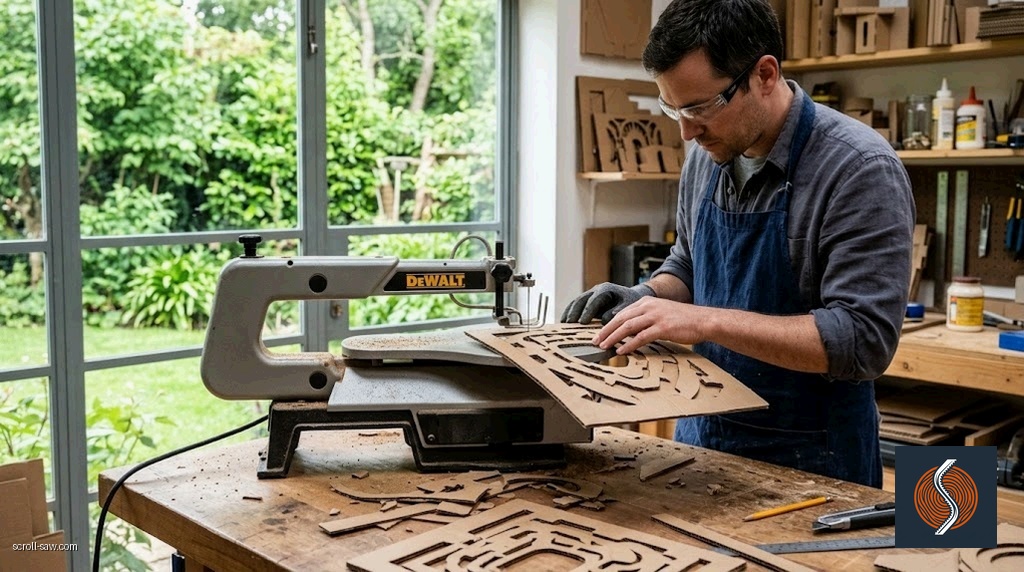
Cardboard cutting on a scroll saw comes up in three contexts. Classroom and youth-group projects where cardboard is safer and cheaper than wood. Hobby crafters making prototypes before committing to wood. Model makers and diorama builders using cardboard as a primary material. All three are legitimate uses, and the scroll saw handles cardboard well when set up correctly.
This piece covers what cardboard cutting on a scroll saw actually is, where it fits, and how to make it work cleanly.
What cardboard scroll saw work actually is
Cutting corrugated cardboard, chipboard, and thin cardstock on a bench scroll saw. The stock is thinner than typical scroll saw work and behaves differently from wood.
Corrugated cardboard. Two paper faces sandwiching a fluted middle layer. Common thicknesses 1/8” (single-wall) to 1/4” (double-wall).
Chipboard. Solid dense paper board. Thicknesses from 1/32” to 1/8”. Book covers and stiff packaging.
Cardstock and paper. Thin (0.01”–0.03”). Craft applications.
Foam board (Foamcore). Foam sandwiched between paper faces. 3/16” or 1/2” thicknesses common.
Chipboard-backed illustration board. Used in model making. Similar to chipboard but with a face layer.
All can be cut on a scroll saw with appropriate blade and technique.
The direct answer: is cardboard scroll saw useful?
Yes, for four uses.
Educational and youth-group projects. Safer than wood. Cheaper. Faster to cut. Beginners can practice without expensive materials.
Prototypes before wood cutting. Test a pattern in cardboard before committing to hardwood. Especially valuable for intarsia and complex patterns.
Model making and dioramas. Cardboard is a primary model-making material. Scroll saw cuts it cleanly and quickly.
Craft applications. Templates, stencils, backing boards for other work.
Not useful for structural work. Cardboard is not a substitute for wood in finished pieces.
Where cardboard fits in a workflow
Skill development. Beginners cutting cardboard patterns build feed rate control and blade tracking skills at very low material cost.
Youth education. Scout troops, after-school programs, shop classes for younger students. Cardboard is safer if a hand slips, and mistakes cost nothing.
Prototype pattern testing. A cardboard cut of a complex pattern reveals problems (delicate bridges too thin, interior cuts hard to thread) before committing to expensive stock.
Model-making primary material. Diorama walls, model building components, small structural forms.
Template making. Cardboard templates used to trace patterns onto wood or metal.
Craft-fair samples. Small giveaway items or sale demonstrations.
Stencils and pattern transfers. Cardboard stencils used to spray-paint or trace patterns.
Fit: what kinds of cardboard work well?
Standard corrugated (single-wall). Cuts cleanly with fine blades. Edges are somewhat rough because of the fluted middle layer.
Chipboard. Cuts very cleanly. Standard scroll saw blades work well.
Cardstock. Very fine blades. Slow feed. Stack multiple sheets for stability.
Foam board. Cuts cleanly but the foam middle sometimes tears. Slow feed and fresh blades reduce this.
Double-wall corrugated. Cuts but is thick enough that scroll saw blade wear is significant. Consider whether the project needs the extra thickness.
Waxed or coated cardboard. Coating gums the blade quickly. Requires more frequent blade changes.
Cardboard with adhesive backing. Adhesive gums the blade. Not ideal for scroll saw work.
Safety considerations
Cardboard cutting has some unique safety considerations.
Fire risk. Cardboard dust is flammable. Scroll saws produce heat during cutting. Rare but possible ignition. Keep the dust extraction running.
Dust volume. Cardboard produces significant dust for its bulk. Respirator or good extraction.
Small pieces flying. Cardboard scraps sometimes lift off the table if not held down. Safety glasses essential.
Slip potential. Cardboard on a saw table can shift more than wood. Firm hand pressure.
Adhesive residue. If any cardboard has adhesive backing, it can gum the blade. Change blades if this happens.
Youth-supervision context. In educational settings, cardboard is safer than wood in general but standard scroll saw supervision rules still apply.
Setup: making cardboard scroll saw work productive
Fine blades. Skip-tooth #5 or finer works well for most cardboard. Reverse-tooth for cleaner face finishes.
Dust extraction running. Cardboard dust volume is significant.
Task lighting. Cardboard can be low-contrast; good lighting helps.
Squared table. Standard scroll saw squaring.
Backer board. Sometimes helpful for very thin cardstock to prevent flexing.
Stack for thin cardboard. Multiple sheets stacked with double-sided tape produce cleaner cuts on very thin stock.
Fresh blades. Cardboard dulls blades faster than wood in some cases, especially with waxed or coated stock. Change more often.
Slow feed. Cardboard cuts fast; slow feed prevents tearing.
Adhesion for pattern. Standard spray adhesive. Pattern lifts easily off cardboard after cutting.
Fire safety. Extinguisher nearby (standard shop practice).
Cutting workflow
Select cardboard. Match to project. Corrugated for structural. Chipboard for detail. Foam board for model building.
Prepare pattern. Print at exact scale. Adhere with spray adhesive.
Choose blade. Fine for cardstock and chipboard. Standard for corrugated.
Test cut on scrap. Verify feed rate and blade quality.
Drill entry holes if needed. For interior cuts. Cardboard needs smaller holes than wood.
Cut interior first. Delicate bridges last within each area.
Cut exterior last.
Peel pattern. Comes off cleanly.
Sand or trim. Cardboard cuts often need light edge trimming. A hobby knife handles this.
Finish. For finished pieces, apply spray sealer or paint. Prevents moisture damage.
Applications for cardboard scroll saw work
Youth education. Simple silhouettes, alphabet letters, small toys.
Prototype patterns. Test complex patterns before wood cutting.
Diorama and model components. Building walls, terrain features, structural elements.
Stencils. For spray painting or pattern transfer.
Templates. For tracing patterns onto wood or metal.
Craft-fair samples. Small giveaways or demonstration items.
Puzzle prototypes. Cardboard puzzles for children.
Custom packaging inserts. Fitted supports for shipping delicate items.
Halloween and holiday decorations. Temporary decorations at low cost.
Signage prototypes. Test signage designs before committing to wood or foam.
Common problems on cardboard scroll saw work
Cardboard edges tear on cutting
Blade too coarse or feed too fast. Fine blade, slow feed.
Foam middle of foam board tears
Fresh blade at slow feed. Painter’s tape over the cut line if tearing persists.
Cardboard pattern lifts during cutting
Adhesion issue. Press pattern firmly. Repositionable spray adhesive.
Dust accumulates rapidly on the table
Standard scroll saw dust. Extraction running. Wipe the table between cuts.
Blade dulls quickly
Waxed or coated cardboard, or adhesive residue. Change blades more often.
Cut edges are rough
Corrugated cardboard leaves rough edges because of the fluted middle. Sand lightly, or use finer stock (chipboard) for cleaner edges.
Very thin cardstock flexes during cutting
Stack multiple sheets. Support with a backer.
Cutting scrap pieces flying off table
Hold small pieces with a hand. Very small cutoffs sometimes fly with the blade motion.
Comparison of cardboard types for scroll saw work
| Type | Thickness | Cut quality | Best use |
| Corrugated (single-wall) | 1/8" | Rough edges from flutes | Structural craft, dioramas |
| Corrugated (double-wall) | 1/4" | Rougher edges | Heavier structural work |
| Chipboard | 1/32"–1/8" | Very clean | Detail cutting, templates |
| Cardstock | 0.01"–0.03" | Clean with fine blade | Fine detail, stencils |
| Foam board | 3/16"–1/2" | Clean face, foam can tear | Model building, signage |
| Illustration board | 1/16"–1/8" | Clean | Presentation, prototypes |
Who should skip cardboard scroll saw work: anyone whose primary goal is finished wood pieces. Cardboard is a step along the way, not a destination.
Cardboard scroll saw work for kids
Specific considerations for youth education.
Simpler patterns. Simple silhouettes, alphabet letters, basic shapes.
Adult supervision. Direct adult supervision throughout.
Safety equipment. Small safety glasses, respirator for extended cutting.
Pattern preparation help. Adults typically prepare patterns; kids do the cutting.
Success emphasis. Simple patterns produce successful pieces quickly, building confidence.
Cost consideration. Cardboard is nearly free. Kids can practice extensively without material cost pressure.
Follow-up wood work. After cardboard success, transition to wood for finished pieces.
FAQ
Can a scroll saw cut cardboard?
Yes, cleanly. Fine blades, slow feed, and dust extraction produce good results.
Is a scroll saw good for cutting cardboard?
Yes, especially for detailed patterns and interior cuts. Faster and cleaner than a hobby knife for complex work.
What blade for cutting cardboard on a scroll saw?
Fine blade (#5 or finer). Skip-tooth for standard corrugated. Reverse-tooth for cleaner face finishes.
Can I use a scroll saw for cardboard with kids?
Yes, with adult supervision. Cardboard is safer than wood for young learners.
What is the best cardboard for scroll saw work?
Chipboard for detail. Corrugated for structural. Foam board for model building. Depends on the project.
Can I do interior cuts in cardboard?
Yes. Drill small entry holes. Standard scroll saw interior cut technique.
Does cardboard dust from a scroll saw pose any risk?
Cardboard dust is flammable. Standard scroll saw dust extraction eliminates the fire risk. Respirator for extended cutting reduces respiratory exposure.
Can I sell scroll saw cardboard pieces?
At low price points, yes. Cardboard pieces do not have the value or presentation of wood, so pricing is limited.
References
-
Fox Chapel Publishing scroll saw books with cardboard patterns. foxchapelpublishing.com
-
Scroll Saw Village youth education threads. scrollsawvillage.com
-
Good, Steve. Scrollsaw Workshop simple patterns. scrollsawworkshop.blogspot.com
-
Model making community forums.
Title tag: Cardboard Scroll Saw: Fit and Applications
Meta description: How to cut cardboard on a scroll saw, what types work best, and where cardboard scroll saw work fits in youth education, prototyping, and model making.
URL slug: cardboard-scroll-saw
Excerpt: A scroll saw cuts cardboard cleanly with fine blades and slow feed. Here is what types work best, where cardboard scroll saw work fits, and how to make it productive.


