
Porter-Cable Scroll Saw Blades: Guide
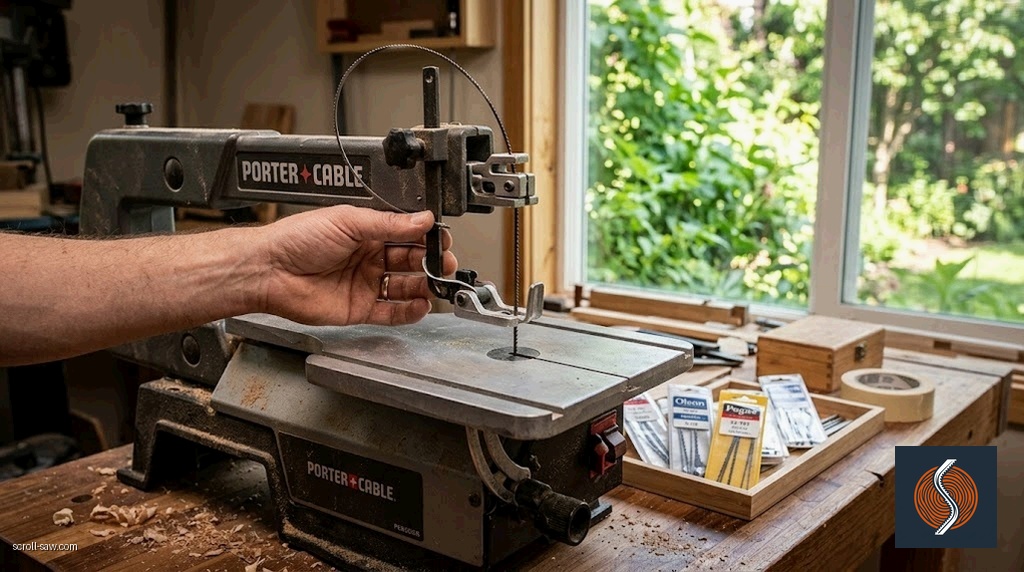
Porter-Cable Scroll Saw Blades: Guide
A scroll saw is only as good as the blade in the clamps. This is especially true for the Porter-Cable PCB375SS and other Porter-Cable scroll saws, which are competent mid-tier machines that reveal their capability most clearly with quality blades. Cheap blades produce rough cuts, dull quickly, and mask what the saw can actually do. Quality blades produce clean cuts, last longer, and let the saw perform at its capability.
This piece covers Porter-Cable scroll saw blade selection through TPI, kerf, radius, and finish, and how these characteristics interact with material and technique.
What matters in a scroll saw blade
Five characteristics.
TPI (teeth per inch). Higher TPI = finer cut with cleaner edge; slower feed. Lower TPI = rougher cut with faster feed.
Kerf. The width of the cut. Wider kerf = more material removed per pass; more forgiving. Narrower kerf = tighter turns; less material waste.
Tooth radius (or cutting radius). The tightest curve the blade can cut without wandering. Depends on blade width and tooth geometry.
Finish quality. How clean the cut edge is. Depends on tooth geometry, TPI, and manufacturing precision.
Blade material and hardness. High-carbon steel is standard. Some premium blades use specialized alloys.
Each of these varies with blade size number and tooth pattern.
The direct answer: which Porter-Cable scroll saw blade should I buy?
For general work, three blades cover most needs.
#5 skip-tooth. Standard hobby work. 1/4 to 3/4 inch stock. 14–16 TPI. 0.038” width. Handles most silhouettes, standard patterns, and general cutting.
#3 skip-tooth or #3 reverse-tooth. Detail work. 1/4 to 1/2 inch stock. 19–22 TPI. 0.032” width. Handles portrait work and fine detail.
#7 skip-tooth. Thick stock. 3/4 to 1 inch. 10–12 TPI. 0.045” width. Handles thicker cuts without stalling.
Add #2/0 for very fine detail and #9 for very thick cutting.
Brand recommendation. Pégas or Flying Dutchman.
Skip Hercules and other budget blades. Cut quality is noticeably worse; blade life is shorter.
TPI (teeth per inch) explained
TPI represents cutting speed and finish quality.
Low TPI (6–12). Fast cutting; rough finish. #7, #9, #12.
Medium TPI (12–22). Balance of speed and finish. #3, #5.
High TPI (22–33+). Slow cutting; fine finish. #2/0, #1.
The relationship is inverse: as TPI goes up, cutting speed goes down and edge quality goes up.
Rule of thumb: at least 3 teeth engaged in the workpiece at all times. Too few teeth = rough cutting; too many teeth = clogging.
For 1/4 inch stock, minimum ~12 TPI (#5). For 1/2 inch stock, minimum ~6–8 TPI (#5 or #7). For 3/4 inch stock, minimum ~4 TPI (#7 or coarser). For 1 inch stock, minimum ~3 TPI (#9 or coarser).
Kerf explained
Kerf is the width of the cut. Standard scroll saw blade kerfs.
#2/0 kerf: approximately 0.024”.
#3 kerf: approximately 0.032”.
#5 kerf: approximately 0.038”.
#7 kerf: approximately 0.045”.
#9 kerf: approximately 0.053”.
#12 kerf: approximately 0.062”.
Practical implications.
Narrow kerf (low blade size number). Tight turns possible. Less material waste. Better for fine detail. Blade more prone to breakage in thick stock.
Wide kerf (high blade size number). Straighter tracking. Better for thick stock. More material removed per pass. Turns less tight.
For most hobby work, medium kerf (#5). Balance of tight-turn capability and stability.
Cutting radius explained
Cutting radius is the tightest curve the blade cuts cleanly.
#2/0 minimum radius: approximately 1/32” (0.031”).
#3 minimum radius: approximately 1/16” (0.062”).
#5 minimum radius: approximately 3/32” (0.094”).
#7 minimum radius: approximately 1/8” (0.125”).
#9 minimum radius: approximately 3/16” (0.187”).
#12 minimum radius: approximately 1/4” (0.25”).
Attempting a tighter turn than the blade’s minimum radius causes wander, breakage, or rough cuts.
Pattern implication. Design patterns with radii larger than the blade’s minimum. Or select a smaller blade for the pattern’s tightest curves.
Cutting technique implication. Tight interior detail requires small blade (#2/0, #3). Broad exterior contour tolerates larger blade (#7, #9).
Finish quality explained
Edge finish depends on:
Tooth geometry. Precision-ground teeth produce cleaner cuts than stamped teeth.
TPI. More teeth per inch = cleaner cut, slower cut.
Tooth pattern. Reverse-tooth reduces bottom-face chip-out.
Blade material. High-quality steel maintains sharpness longer.
Blade manufacturing precision. Better-manufactured blades have consistent geometry.
Feed rate. Slow feed = cleaner cut. Fast feed = rough cut.
Fresh vs. worn. Fresh blade cuts clean. Worn blade cuts rough.
Modified geometry. Pégas Modified Geometry blades produce cleaner cuts in hardwood than standard skip-tooth.
Practical finish grades.
Fine finish (portrait, fretwork). #2/0 or #3 fine blade. Reverse-tooth on plywood.
Standard finish (general hobby). #5 skip-tooth. Reverse-tooth on plywood.
Rough finish (utility cutting). #7 or #9 skip-tooth. Suitable for hidden or sanded edges.
Blade material considerations
High-carbon steel. Standard. Most quality blades.
Precision-ground. Premium. Cleaner cuts and longer life.
Hardened. Extended life; more brittle. For very fine detail.
Metal-cutting. Fine tooth pattern and hardened teeth for cutting soft metal.
Plastic-cutting. Special tooth geometry to reduce melting.
Diamond-coated. For very hard materials (rare in scroll saw use).
For most wood cutting, precision-ground high-carbon steel is the standard quality level.
Setup: blade selection workflow
Match blade to material. Species and thickness (see general guidance above).
Match blade to detail level. Fine blades for detail; coarser blades for contour.
Match tooth pattern to material. Reverse-tooth on plywood; standard on solid wood.
Match speed to blade. Faster speed for finer blades; slower for coarser.
Match feed rate to blade. Slower feed for finer blades; faster for coarser.
Test cut on scrap. Verify tracking before starting the pattern.
Stock a range of sizes. #2/0, #3, #5, #7, #9 covers most scenarios.
Replace blades regularly. 30–45 minutes on detail; 1–2 hours on general work.
Track blade performance. Note which blades work well for which materials.
Buy in bulk after finding preferences. Reduces cost per blade.
Common problems traced to blade selection
Rough cut edges
Wrong blade for the material, or blade too coarse for the finish desired. Finer blade.
Blade wanders in the cut
Wrong blade for the cut radius, or blade too fine for the material thickness. Verify blade radius vs. pattern radius.
Blade burns the workpiece
Dull blade, wrong blade for material, or too-fast feed. Fresh blade; slow feed.
Detailed pattern not cutting cleanly
Blade too coarse for the detail. Finer blade (#2/0 or #3).
Blade breaks quickly on thick cuts
Blade too fine for the thickness. Coarser blade.
Cannot achieve tight interior turns
Blade radius too large. Smaller blade (#2/0 or #3) or spiral blade.
Bottom face has heavy chip-out on plywood
Standard skip-tooth cutting plywood. Switch to reverse-tooth or double-reverse.
Cutting hardwood cleaner than expected
Good modified-geometry blades produce cleaner hardwood cuts than standard.
Comparison of scroll saw blade brands
| Brand | Price range | Quality | Best for |
| Pégas | Higher | Excellent | Precision work, portrait, hardwood |
| Flying Dutchman | Higher | Excellent | Same as above |
| Olson | Moderate | Good | Standard hobby work |
| Delta | Moderate | Good | Standard hobby work |
| Hercules (Harbor Freight) | Lower | Variable | Budget, learning curve |
| Big Horn (Amazon) | Lower | Variable | Budget, general use |
| OEM Porter-Cable branded | Moderate | Good | Convenience, standard work |
Who can use budget blades: beginners learning the tool; occasional utility cutting.
Advanced blade selection
Spiral blades. Cut in all directions. Useful for intricate interior patterns. Rougher edges.
Modified geometry. Pégas modified geometry, Flying Dutchman Ultra Reverse, and similar produce cleaner cuts than standard skip-tooth in specific applications.
Double-reverse. Cleaner cuts on both faces of plywood.
Precision-ground. For portrait work where edge quality is paramount.
Fine-tooth metal blades. For soft metal cutting.
Plastic blades. For acrylic and plastic without melting.
Experiment with modified-geometry blades once standard work is mastered.
FAQ
What blades fit a Porter-Cable scroll saw?
Standard 5-inch scroll saw blades, both pin-end and plain-end. All quality brands (Pégas, Flying Dutchman, Olson) fit.
What is the best blade for a Porter-Cable scroll saw?
For detail: Pégas #3 skip-tooth. For general: Pégas #5. For thick: Pégas #7 modified geometry.
How do I choose the right TPI?
At least 3 teeth in the workpiece. Higher TPI for finer finish; lower for faster cutting.
How narrow can my scroll saw cut?
Depends on blade. #2/0 cuts approximately 0.024” wide; #12 cuts approximately 0.062”.
What is the tightest turn a scroll saw blade will cut?
Depends on blade. #2/0 cuts approximately 1/32” radius; #12 cuts approximately 1/4” radius.
Which blade cuts cleanest?
Fine blade (#2/0 or #3) at slow feed. Modified-geometry blades cleaner than standard skip-tooth.
Can I use one blade for all scroll saw work?
One blade is a compromise. #5 skip-tooth covers a lot of ground. But different materials and details benefit from different blades.
How often should I replace scroll saw blades?
30–45 minutes on detail work; 1–2 hours on general work.
References
-
Pégas scroll saw blades. pegasusa.com
-
Flying Dutchman blades. mikesworkshop.com
-
Olson scroll saw blades. olsonsaw.net
-
Fine Woodworking blade reviews. finewoodworking.com
Title tag: Porter-Cable Scroll Saw Blades: Guide
Meta description: Porter-Cable scroll saw blade selection through TPI, kerf, radius, and finish. Which blade matches your material and what quality brands are worth the price.
URL slug: porter-cable-scroll-saw-blades
Excerpt: Porter-Cable scroll saws are only as good as the blade in the clamps. Here is how TPI, kerf, radius, and finish quality determine which blade fits your material and detail level.


