
RBI Scroll Saw Blades: TPI and Radius
RBI Scroll Saw Blades: TPI and Radius
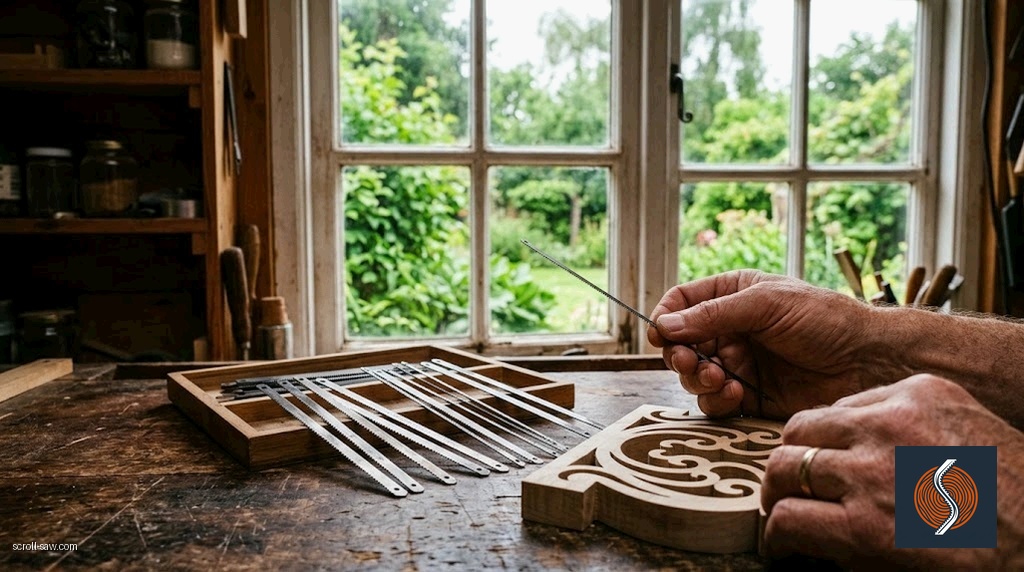
RBI Hawk scroll saws use standard 5-inch scroll saw blades. Any quality third-party brand fits (Pégas, Flying Dutchman, Olson). This is one of the practical advantages of Hawk ownership: blade supply is not RBI-specific and depends on standard scroll saw blade supply, which is well-supported by multiple manufacturers.
This piece covers RBI Hawk blade selection through TPI, kerf, radius, and finish, and how the Hawk’s smooth operation reveals differences in blade quality.
What matters in an RBI scroll saw blade
Standard scroll saw blade characteristics.
TPI (teeth per inch). Higher TPI = finer cut, slower feed.
Kerf. The cut width. Wider kerf = more stable tracking; narrower = tighter turns.
Cutting radius. The tightest curve the blade cuts cleanly.
Finish quality. How clean the cut edge is.
Tooth pattern. Skip-tooth, reverse-tooth, spiral, or modified geometry.
Blade material. High-carbon steel, precision-ground, or hardened.
The Hawk’s smooth operation reveals differences in blade quality more clearly than a rougher saw. Premium blades (Pégas, Flying Dutchman) show their value on a Hawk.
The direct answer: which blades work best on an RBI Hawk?
For a smooth-tracking Hawk, quality blades reward the machine’s precision.
Standard hobby work: Pégas #5 skip-tooth. Precision-ground.
Detail work: Pégas #3 skip-tooth or Pégas Modified Geometry #3.
Thick hardwood: Pégas Modified Geometry #9.
Plywood: Flying Dutchman Ultra Reverse #5 or #7.
General purpose: Olson #5 skip-tooth for solid mainstream quality.
Portrait work: Pégas Modified Geometry in #2/0 or #3.
Metal cutting: Metal-cutting blade in appropriate size.
TPI in detail
Higher TPI means finer teeth, slower cutting, and finer finish.
#2/0 (approximately 28–33 TPI). Very fine. Portrait detail.
#3 (approximately 19–22 TPI). Fine. Standard detail.
#5 (approximately 14–16 TPI). Medium. Standard hobby work.
#7 (approximately 10–12 TPI). Medium coarse. Thicker stock.
#9 (approximately 8–10 TPI). Coarse. Thick stock.
#12 (approximately 6–8 TPI). Very coarse. Very thick stock.
Rule of thumb. At least 3 teeth engaged in the workpiece at all times. Too few teeth = rough cutting; too many teeth = clogging.
For 1/4 inch: #5 (16 TPI).
For 1/2 inch: #5 or #7 (12–16 TPI).
For 3/4 inch: #7 (10 TPI).
For 1 inch: #7 or #9 (8–12 TPI).
For 1.5 inches: #9 or #12 (6–10 TPI).
Kerf and cutting radius
These two properties define the physical capability of the blade in terms of tightness of cut.
Kerf (approximate).
-
#2/0: 0.024”
-
#3: 0.032”
-
#5: 0.038”
-
#7: 0.045”
-
#9: 0.053”
-
#12: 0.062”
Cutting radius (approximate minimum).
-
#2/0: 1/32”
-
#3: 1/16”
-
#5: 3/32”
-
#7: 1/8”
-
#9: 3/16”
-
#12: 1/4”
Attempting a tighter turn than the blade’s minimum radius causes wander or breakage.
Pattern implications. Design for the tightest radius the pattern requires; select blade with minimum radius smaller than that.
Cutting technique implications. Fine detail = small blade. Broad contour = larger blade.
Finish quality
The Hawk’s smooth operation shows blade finish differences clearly.
Fine finish (portrait, marquetry). #2/0 or #3 precision-ground.
Standard finish (general hobby). #5 skip-tooth or #5 modified geometry.
Rough finish (utility). #7 or #9 skip-tooth.
Best hardwood finish. Pégas Modified Geometry.
Best plywood finish. Reverse-tooth or double-reverse.
Best acrylic finish. Plastic-cutting blade.
Best metal finish. Metal-cutting blade with cutting fluid.
Setup: getting best cuts on a Hawk
Bench-mounted stably. Hawk saws vibrate less than most, but stable mounting matters.
Table squared. Engineer’s square to blade.
Quality blade. Pégas or Flying Dutchman.
Correct blade for material and thickness.
Correct speed. Variable-speed Hawks let you match speed to material.
Correct feed. Slow steady, not forced.
Correct tension. Pluck-test the blade.
Fresh blade regularly. 30–45 minutes detail; 1–2 hours general.
Zero-clearance insert for detail work. Custom for the specific blade.
Task lighting. Multiple angles.
Dust extraction. Shop vac at built-in port.
Foot pedal. Hands-free start/stop.
Common cut-quality issues on RBI Hawk
Cut quality dropped over time
Blade dulling. Fresh blade first.
Cannot achieve as tight curves as before
Blade width too large for current curve. Smaller blade.
Edges rougher on hardwood than expected
Standard skip-tooth. Try modified geometry.
Bottom-face chip-out on plywood
Standard skip-tooth. Switch to reverse-tooth.
Blade breaks quickly on thick stock
Blade too fine. Coarser blade.
Blade wanders side-to-side
Over-tension, dull blade, or blade width too small for cut.
Speed matters more than expected
Hawk’s smooth operation lets speed effects show clearly. Adjust speed to material.
Cut edges have burn marks
Dull blade or too-fast feed. Fresh blade, slower feed.
Blade selection by application
Silhouette cutting
#5 skip-tooth for standard silhouettes. #3 for finer detail.
Portrait cutting
#2/0 or #3 precision-ground. Fresh blade every 30–45 minutes.
Fretwork
#3 or #5 reverse-tooth (if on plywood) or standard skip-tooth (if on solid wood).
Intarsia
#3 to #5 skip-tooth or modified geometry.
Marquetry
Very fine blade for veneer stacking. #2/0 or smaller.
Puzzles
#3 or #5 skip-tooth for standard interlocking.
Thick decorative work
#7 or #9 skip-tooth. Modified geometry for hardwood.
Compound scroll saw work
#5 to #7 depending on stock thickness.
Ornaments
#3 to #5 based on detail level.
Signs and letters
#5 skip-tooth for standard letters. #3 for detailed script.
Comparison of blade brands compatible with RBI Hawk
| Brand | Price | Quality | Best for |
| Pégas | Higher | Excellent | Precision, portrait, hardwood |
| Flying Dutchman | Higher | Excellent | Same as Pégas |
| Olson | Moderate | Good | Standard hobby work |
| Delta | Moderate | Good | Mainstream hobby work |
| RBI-branded (when available) | Moderate | Good | Continuity with original saw |
| Hercules (Harbor Freight) | Lower | Variable | Budget only |
Who can use standard-quality blades: hobbyists on general work; beginners.
Advanced blade choices
Spiral blades. Cut in all directions. Useful for intricate interior patterns. Rougher edges.
Ultra-reverse. Flying Dutchman line. Cleaner both faces on plywood.
Modified geometry. Pégas. Cleaner hardwood cuts.
Precision-ground. Higher-quality manufacturing.
Metal-cutting. For soft metal.
Plastic-cutting. For acrylic and plastic without melting.
Micro-fine. Below #2/0 for jewelry-level detail.
FAQ
What blades fit an RBI scroll saw?
Standard 5-inch scroll saw blades. Pin-end for older models; plain-end for 220-3, 220vs, 226.
Where do I buy RBI scroll saw blades?
Any scroll saw blade retailer. Pégas, Flying Dutchman, Olson are quality options. RBI-branded blades sometimes available.
What is the best blade for an RBI Hawk?
For detail: Pégas #3. For general: Pégas #5 skip-tooth. For thick: Pégas Modified Geometry #7 or #9.
How do I match blade TPI to material?
At least 3 teeth in the workpiece. Higher TPI for finer finish; lower for faster cutting.
How do I choose the right blade radius?
Blade minimum radius should be smaller than the tightest curve in the pattern.
Which blade cuts hardwood cleanest?
Pégas Modified Geometry or Flying Dutchman Ultra Reverse in the appropriate size.
How often should I replace scroll saw blades?
Every 30–45 minutes on detail; 1–2 hours on general.
Can I use spiral blades on my Hawk?
Yes. Standard spiral blades fit. Useful for specific pattern approaches.
References
-
Pégas scroll saw blades. pegasusa.com
-
Flying Dutchman blades. mikesworkshop.com
-
Olson scroll saw blades. olsonsaw.net
-
Scroll Saw Village blade threads. scrollsawvillage.com
-
Fine Woodworking blade reviews. finewoodworking.com
Title tag: RBI Scroll Saw Blades: TPI and Radius
Meta description: RBI Hawk scroll saw blade selection through TPI, kerf, radius, and finish. Which quality brands work best on a smooth-tracking Hawk.
URL slug: rbi-scroll-saw-blades
Excerpt: The RBI Hawk uses standard 5-inch scroll saw blades, and its smooth operation reveals blade quality clearly. Here is how to select blades by TPI, kerf, radius, and finish.


