
Scroll Saw Safety Rules Guide
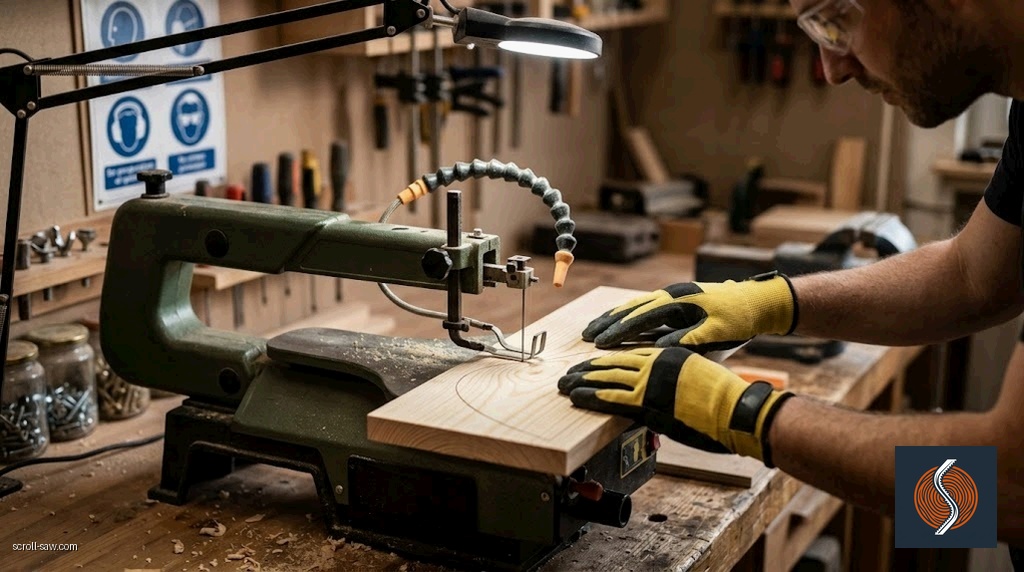
Scroll Saw Safety Rules Guide
Scroll saws are among the safest power tools in the workshop when used correctly. The blade cuts at low aggression, and the risk of severe injury is lower than with table saws, band saws, or routers. But scroll saws still cut, and a lapse in technique can cause blade injury, blade breakage, dust exposure, or hearing loss. Safety rules exist to keep those low-probability events even lower.
This piece covers scroll saw safety rules with practical setup and technique guidance.
What scroll saw safety covers
The practices that keep the operator safe.
Blade handling. Installation, tension, disposal.
Cutting technique. Feed rate, hand position, hold-down use.
PPE. Eye protection, hearing protection, dust management.
Machine condition. Guards in place, wiring intact.
Environment. Ventilation, lighting, workspace.
Shop practice. Cleanup, blade storage, first aid.
Emergency response. Injury, fire, electrical.
The direct answer: essential safety rules
1. Wear safety glasses. Every cut.
2. Wear hearing protection. On longer sessions.
3. Manage dust. Extraction, respirator on toxic species (walnut, some exotics).
4. Blade guard in place when the design provides one that is compatible with the work.
5. Hold-down foot in use when cutting.
6. Hands away from blade line at all times.
7. Unplug for blade change. Every time.
8. Feed slowly. Let the blade cut.
9. Fresh blade regularly. Dull blades wander and require force.
10. Verify blade tension before starting a cut.
11. Verify workpiece flat on table.
12. Never reach across the blade while running.
13. Never leave saw running unattended.
14. Adequate task lighting.
15. Keep the workspace clean. Sawdust accumulates.
16. Emergency stop accessible. Foot pedal or hand switch.
17. First aid kit nearby.
18. Know how to reset the electrical breaker for your saw’s circuit.
Setup: safety in the shop workspace
Adequate ventilation.
Task lighting from multiple angles.
Non-slip floor. Anti-fatigue mat is a plus.
Bench-mounted stably.
Electrical grounding. Three-prong plug on a grounded circuit.
GFCI protection in damp environments.
Adequate circuit capacity.
Fire extinguisher nearby.
First aid kit nearby.
Emergency contact information posted.
Children and pets kept out during operation.
Loose clothing and jewelry removed.
Long hair tied back.
Adequate breaks.
Not operating tired or impaired.
Setup: safety in blade handling
Unplug the saw before blade change.
Release tension before removing the blade.
Blade teeth pointed down and forward when installing.
Fully seat blade in both clamps.
Tighten clamps firmly.
Apply tension.
Verify tension by pluck-test.
Verify blade is not damaged before starting the cut.
Broken blade disposal. In a puncture-resistant container, not the general waste.
Dull blade disposal. Same container.
Blade storage. In compartmented case, teeth-down or in sleeves.
Handle blade by the ends or with pliers when hot.
Verify no cuts on hands before every cut.
Setup: safety in cutting technique
Both hands on the workpiece. Not on the machine.
Hands positioned away from blade line. Behind the blade.
Feed rate slow. Faster feed does not cut faster; slower is safer.
Guide by the pattern. Not by force.
Turn the workpiece for curves. Not the blade.
Sharp corners with pivot. Slow to near-stop; pivot; resume.
Do not force the blade. Wandering means dull blade or wrong choice.
Small workpieces held with pusher or clamp if too small for hands.
Stack cutting. Verify all pieces flat and pinned/taped.
Interior cuts. Drill entry hole; thread blade; secure both clamps; tension; cut.
Blade breakage response. Turn off; wait for arm to stop; remove broken blade with pliers or wait to cool.
Blade selection and safety
Wrong blade for material can cause blade breakage, wandering, and injury.
Softwood: #5 skip-tooth or higher.
Hardwood: #3 to #7 depending on thickness; modified geometry preferred.
Plywood: #5 reverse-tooth.
Acrylic: Plastic-cutting blade at slow speed.
Soft metal: Metal-cutting blade with cutting fluid.
Amazon-verified blades:
Dust and respiratory safety
Sawdust is a documented respiratory hazard.
Regularly cut species: softwoods, common hardwoods.
Sensitizing or toxic species: walnut, cedar (some people), teak, exotics.
Reference: Wood Database wood allergies and toxicity. wood-database.com
Dust extraction at the saw. 1-1/2 to 2-1/2 inch port.
Ambient air filtration in the shop.
Respirator. N95 or better on toxic species.
Sweep and mop regularly. Do not use compressed air (aerosolizes dust).
Adequate ventilation. Windows or dedicated exhaust.
Reference: CDC/NIOSH on hearing loss and respiratory (cdc.gov).
Hearing safety
Scroll saws are lower-noise than table saws or routers, but daily exposure over hours can contribute to hearing loss.
Hearing protection on long sessions. Foam plugs or muffs.
Reduce ambient shop noise. Turn off other machines.
OSHA guidance. osha.gov
Take breaks.
Watch for tinnitus. Ringing after exposure indicates over-exposure.
Electrical safety
Three-prong grounded plug.
GFCI protection in basements, garages, damp environments.
Circuit capacity adequate.
Cord in good condition. No cuts or exposed wire.
Plug in a dedicated outlet.
Do not run over cord with the workpiece or with feet.
Unplug for maintenance.
Electrical wiring by qualified electrician for repair.
Voltage rating matched to outlet.
Common safety issues and fixes
Blade breaks and flies
Lower risk than table saw kickback but real. Blade guard, eye protection, hold-down use.
Small piece pulled into blade
Saw sends small piece down. Use pusher or clamp for small pieces.
Blade wander causes finger contact
Hands positioned away from blade line at all times.
Loose sleeve or hair pulled in
Remove or secure before operating.
Dust irritates or triggers allergic response
Dust extraction and respirator.
Hearing ringing after session
Hearing protection needed.
Vibration causes hand fatigue
Bench mounting inadequate; take breaks.
Slow cut progress causes force
Dull blade or wrong blade. Replace.
Fatigue causes attention lapse
Take breaks. Do not operate tired.
Electrical short circuit
Unplug immediately. Qualified electrician.
Comparison of scroll saw safety to other saws
| Saw | Injury severity potential | Primary hazard |
| Scroll saw | Low to moderate | Blade nick, dust, hearing |
| Table saw | High | Kickback, blade contact |
| Band saw | Moderate to high | Blade contact, kickback |
| Router | High | Bit contact, kickback |
| Miter saw | High | Blade contact |
| Hand-held jigsaw | Moderate | Blade contact |
FAQ
What are the safety rules for a scroll saw?
Wear safety glasses. Manage dust. Blade guard in place. Hold-down in use. Hands away from blade line. Unplug for blade change. Feed slowly.
What are 5 safety rules for a scroll saw?
Safety glasses; hold-down in use; hands away from blade line; unplug for blade change; feed slowly.
What are 10 safety rules for a scroll saw?
All five above, plus: hearing protection; dust extraction; blade guard in place; fresh blade regularly; verify tension.
Is a scroll saw dangerous?
Less dangerous than table saw or band saw. Still cuts. Follow safety rules.
What PPE do I need for a scroll saw?
Safety glasses always. Hearing protection on longer sessions. Respirator on toxic wood species.
How do I make my scroll saw safer?
Blade guard in place; hold-down foot in use; task lighting; dust extraction; fresh blade; unplug for blade change.
What is the most common scroll saw injury?
Blade nick to fingers when hands drift into blade line, or eye irritation from sawdust.
Is Delta scroll saw safety same as other brands?
General safety rules apply to all scroll saws.
References
-
OSHA. osha.gov
-
CDC/NIOSH. cdc.gov
-
Wood Database wood allergies and toxicity. wood-database.com
-
Scroll Saw Village safety threads. scrollsawvillage.com
-
Fine Woodworking safety category. finewoodworking.com
Title tag: Scroll Saw Safety Rules Guide
Meta description: Scroll saw safety rules with practical setup and technique guidance. Blade handling, cutting technique, PPE, dust, hearing, and electrical safety.
URL slug: safety-rules-for-a-scroll-saw
Excerpt: Scroll saws are among the safest power tools when used correctly. Here are the essential safety rules with setup and technique guidance.


