
Is the Olson Scroll Saw Blade Chart a Practical Fit for Detailed Work?
Is the Olson Scroll Saw Blade Chart a Practical Fit for Detailed Work?
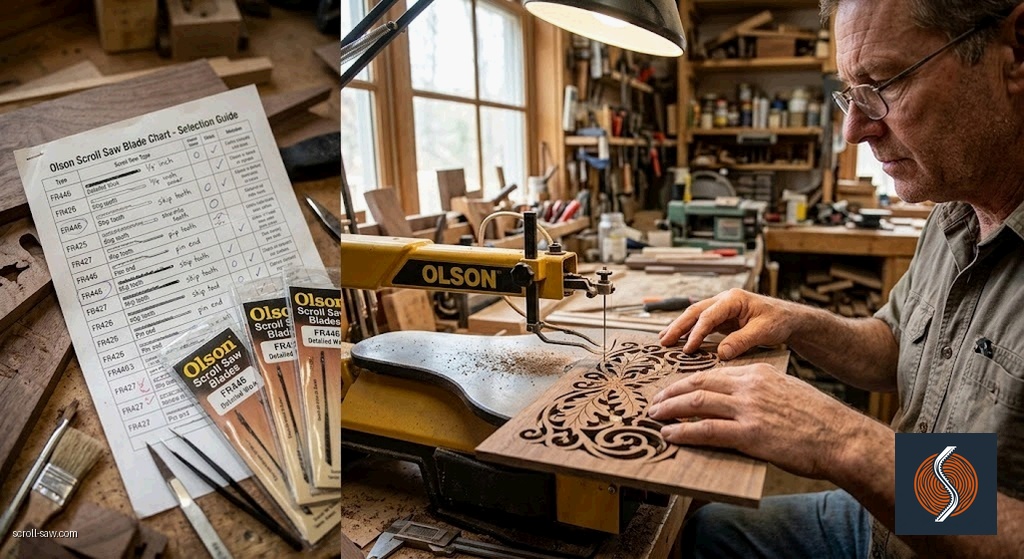
Olson publishes a scroll saw blade selection chart that matches blade sizes to material thickness and cut type. It’s useful as a starting point for beginners and a quick reference for anyone. For serious detailed work, the chart gets you close, but real technique and material-specific experience refine the answer.
What the Olson chart covers
The standard Olson chart usually organizes blades by:
-
Blade size number (typically #2/0 through #12) — higher number, larger blade, thicker cut
-
Teeth per inch (TPI) — higher TPI, smoother cut, slower speed
-
Material thickness range — recommended thickness for each blade
-
Blade format — reverse-tooth, skip-tooth, double-tooth, spiral, precision ground
-
Recommended use — general, hardwood, detail, plywood, plastic, etc.
How to read the chart
Match blade size to material thickness. Thicker material generally uses larger blade numbers (#5, #7, #9). Thinner material uses smaller (#2/0, #1, #3).
Match TPI to material hardness. Higher TPI (finer teeth) for hardwood and detail. Lower TPI (coarser teeth) for softwood and faster cuts.
Choose blade format for the cut type.
-
Reverse-tooth for cleaner bottom edge on plywood and general work
-
Skip-tooth for fast cuts in softwood
-
Double-tooth for smoother finish
-
Spiral for tight interior cuts
-
Precision ground for demanding detail
Where the chart works well
-
Choosing an initial blade for an unfamiliar material
-
Beginners building their blade collection
-
Quick reference when starting a new project
-
Cross-referencing between Olson sizes and generic scroll saw blade numbering
Where the chart hits limits
Real-world material variability. Different wood species and moisture content behave differently than a chart suggests. Ash cuts different from cherry cuts different from baltic birch plywood.
Cut speed vs. detail trade-off. Chart recommendations balance speed and quality, but your preference for one over the other shifts blade choice.
Technique matters more than blade number. A skilled scroll saw user with a mediocre blade choice often outperforms a beginner with the perfect blade.
Brand differences. Olson’s blade sizes and TPI don’t map exactly to Pégas or Flying Dutchman. A Pégas #5 may cut differently from an Olson #5.
Building blade experience beyond the chart
-
Buy a variety pack. Flying Dutchman variety or Olson variety packs let you try many sizes and formats.
-
Test cuts on scrap. Each new blade in each material tells you what it does.
-
Log results. Note which blade cut which material well.
-
Adjust chart recommendations to your work. After some months, your notebook is more useful than the chart.
Recommended Olson blade collection for a hobbyist
-
Olson FR49202 reverse-tooth — general work
-
Olson FR49400 skip-tooth — softwood fast cuts
-
Olson DT43300 double-tooth — hardwood detail
-
Olson SP46300 spiral — tight interior cuts
For pin-end scroll saws: Olson FR41001 pinned 7 TPI.
Upgrade path for detailed work: Pégas Modified Geometry or Flying Dutchman Ultra Reverse.
The verdict
The Olson blade chart is useful as a starting reference. Beginners benefit from following its recommendations closely. Intermediate and advanced users use it as a rough guide and refine choices with material-specific experience. For serious detailed work, the chart gets you 70-80% of the way to the right blade; the last 20-30% comes from test cuts and personal notes.
FAQ
Where can I find the Olson scroll saw blade chart? Olson Saw website and included with many Olson blade multi-packs.
Does the Olson chart apply to other brands? Approximately. Blade numbering conventions vary between brands.
What blade should I start with? Olson FR49202 reverse-tooth (#5, 12.5 TPI) covers most general hobbyist cutting.
How do I match TPI to material? Higher TPI for hardwood and thin material. Lower TPI for softwood and thick material.
Is the chart accurate for hardwood? Approximately. Species and moisture content affect real results.
Where does the chart fail? Very thin veneer work, exotic hardwoods, and highly specific pattern work benefit from experience beyond the chart.
Do I need every blade on the chart? No. Start with 3-4 blade types and expand as work demands.
Can I use one blade for everything? For casual hobby work, FR49202 covers most cases. Serious pattern work needs blade variety.


