
Pégas Scroll Saw Clamps: Specifications, Compatibility, and Parts Support
Pégas Scroll Saw Clamps: Specifications, Compatibility, and Parts Support
Every scroll-saw problem I have chased down over ten years of pattern work eventually traced back to one place: the blade clamps. On a Pégas, that is doubly true. The whole reason to buy a Pégas 16, 21, or 30 is the chuck-style head that lets you rethread interior cuts in seconds. When those chuck heads start slipping, drifting, or refusing to hold a #5 reverse-tooth blade square to the table, the saw stops being fun and starts being a machine you tolerate.
The good news is that Pégas clamps are rebuildable, replaceable, and largely model-specific. The less good news is that Pégas now covers three saw generations, at least two chuck variants sold under the SRP 13 DUAL and SRP 14 names, and a handful of aftermarket adapter kits that Bear Woods, Sloan’s, and Highland Woodworking have offered to convert older machines. Ordering the wrong clamp is not a fatal error, but it will cost you a week and a shipping fee.
This piece walks through the specifications you should read off your saw before you order, the compatibility notes that trip people up, and the parts channels that Pégas dealers have been honoring in 2025 and 2026.
What a Pégas blade clamp actually is
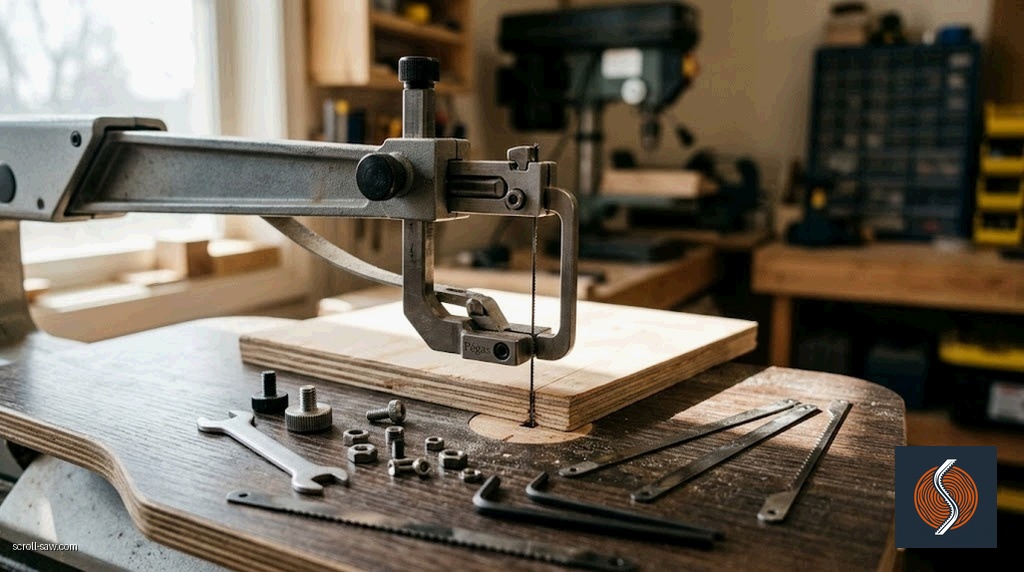
The clamp is the small mechanical assembly at the end of each arm that grips the pinless blade. Older scroll saws used set screws that you turned with a hex key. Pégas built its reputation by replacing that with a quick-release chuck head: a knurled thumb wheel that opens the jaws, seats the blade against a machined register, and torques it back down without tools. Two clamp assemblies per saw, one upper and one lower.
Inside each assembly you have a body, a pair of hardened jaws, a spring or preload washer, and the thumb wheel itself. The jaws are the wear item. They score, glaze, and eventually rock, and that is what most owners are actually replacing when they say the clamp is bad. The rest of the assembly usually outlasts the saw.
The three specifications you must read before ordering
Before you touch a website or a phone, get three things off the saw itself.
-
Model number. Look at the badge or the specification plate. You will see one of Pégas 16, Pégas 21, or Pégas 30, sometimes written as 400 mm, 530 mm, or 750 mm to describe throat depth. The earlier generation sold as the Scheppach Deco-Flex is not a Pégas and will not accept a Pégas clamp without an adapter kit.
-
Chuck designation. Newer machines carry an SRP 13 DUAL or SRP 14 chuck marking. Older Pégas 21 units used a first-generation chuck that Bear Woods lists separately. If your thumb wheel has a red anodized ring, you are on the DUAL system. If it is bare aluminum with no colored band, you are on the earlier revision. Do not assume based on the box; assume based on the saw.
-
Blade class you actually run. Pégas clamps hold pinless blades from about #2/0 up to #12. If you run Pégas modified geometry, Olson PGT, or Flying Dutchman skip-reverse blades, all fit. If you have somehow been feeding pin-end blades into a Pégas, the jaws are almost certainly damaged and you need both jaws and a body inspection.
Write those three items on a slip of paper. That paper is what the parts desk needs.
Compatibility notes that trip owners up
Three patterns show up in the forums every year.
The first is owners of the Pégas 21 who ordered a replacement thumb wheel and then discovered that the jaws were the actual problem. The thumb wheel almost never fails. Order jaws first, thumb wheel only if a visible thread or knurl is stripped.
The second is owners who bought a used Pégas 16 that had a mid-life chuck upgrade installed. The upgrade kit swaps the whole clamp assembly to the SRP 13 DUAL standard. If you order lower jaws by the machine’s original serial-era part number, they will not seat. Confirm which chuck is on the saw before you order jaws.
The third is anyone trying to run a Pégas clamp on a converted Delta or DeWalt DW788. Bear Woods used to sell a full head-swap kit for the DW788, but it is a full head, not a clamp. A Pégas clamp on its own has no interface to the DW788 arm.
Where to source parts in 2026
Pégas is a Swiss-designed brand distributed in North America primarily through Bear Woods (Nova Scotia) and Sloan’s Woodshop (Texas), with additional support from Highland Woodworking (Atlanta) for the pattern-cutting community. In Europe, Scheppach carries some interchangeable service parts. For most owners, the fastest path is Bear Woods for the Pégas 16 and 21 clamps and Sloan’s for the Pégas 30, because Sloan’s stocks the larger-throat inventory.
If you have a machine older than about 2015 and cannot find the exact clamp jaw listed, email the retailer with your model, chuck designation, and a photograph of the current clamp. Both dealers have quietly kept legacy jaw stock on the shelf for owners who send a clear photograph.
Aftermarket jaws sold as generic 16-inch scroll saw parts are not Pégas-compatible. The register geometry is different, and the blade will drift.
A short service routine that extends clamp life
If your Pégas is more than three years old and has never had a clamp service, plan an afternoon.
Remove both clamp assemblies with the hex key that lives under the base cover. Blow the jaws clean with compressed air, not solvent. Inspect the jaw faces under a bright light. If you can catch a fingernail on a score line perpendicular to the blade path, replace the jaw. If the face is glazed but flat, a light pass with a diamond card at 600 grit will restore grip; keep the pass square to the jaw face. Reassemble with a drop of light machine oil on the thumb-wheel thread, not on the jaws. Torque the wheel by hand only. Feel-tighten a new blade, then run a piece of scrap 3/4-inch poplar in a slow-swept curve. If the blade holds without walking, you are done.
Skip this routine and you will replace jaws twice as often.
Verdict and takeaways
Pégas clamps are not a mysterious part. They are a small, well-machined assembly that responds to correct identification and modest care.
-
Identify the saw’s chuck designation before you order anything.
-
Jaws are the wear item; thumb wheels almost never fail.
-
Bear Woods and Sloan’s are the honest sources; generic aftermarket jaws are not compatible.
-
A ten-minute cleaning every fifty hours will double jaw life.
Frequently asked questions
How long do Pégas clamp jaws last? For a hobbyist running one or two blades per session, five to seven years. For pattern professionals cutting daily, twelve to eighteen months.
Can I convert an older Pégas 21 to the SRP 13 DUAL chuck? Yes. Bear Woods sells a complete head-swap kit. It is a two-hour job and requires no permanent modification to the arm.
Are Pégas 16 and Pégas 21 clamps interchangeable? The DUAL clamps are physically compatible on both saws, but the arm-side mounting screws differ in length. Do not swap without ordering the correct hardware pack.
Do I need to remove the arm to service the clamps? No. The clamp assembly comes off with the hex key on the outside of the arm. Leave the arm alone.
Will Pégas ship parts internationally? Bear Woods ships worldwide. Sloan’s ships to North America and some EU addresses on request.
Can I clean sticky clamps with WD-40? No. Solvents carry sawdust into the mechanism and gum the springs. Compressed air only.
References
-
Pégas International product documentation, SRP 13 DUAL and SRP 14 chuck specifications.
-
Bear Woods Supply, Pégas scroll saw service parts catalog.
-
Sloan’s Woodshop parts guide for Pégas 30.
-
Owner reports, Scrollsaw Village and FinePatterns forums, 2023 to 2026.


