
A Closer Look at the Proxxon Dsh 2 Speed Scroll Saw
A Closer Look at the Proxxon Dsh 2 Speed Scroll Saw
Proxxon is the small-tool company most bench woodworkers meet through their miniature lathes and rotary tools. The DSH scroll saw sits in the same slot: a scaled-down, cast-body machine designed for the model builder, the marquetry cutter, and the small-scale pattern maker rather than the general workshop. The older two-speed version has been quietly out of production for a while, replaced by the DSH/E electronic variable-speed unit, but the two-speed still turns up in second-hand listings and remains a genuinely useful saw for certain work.
What this saw is
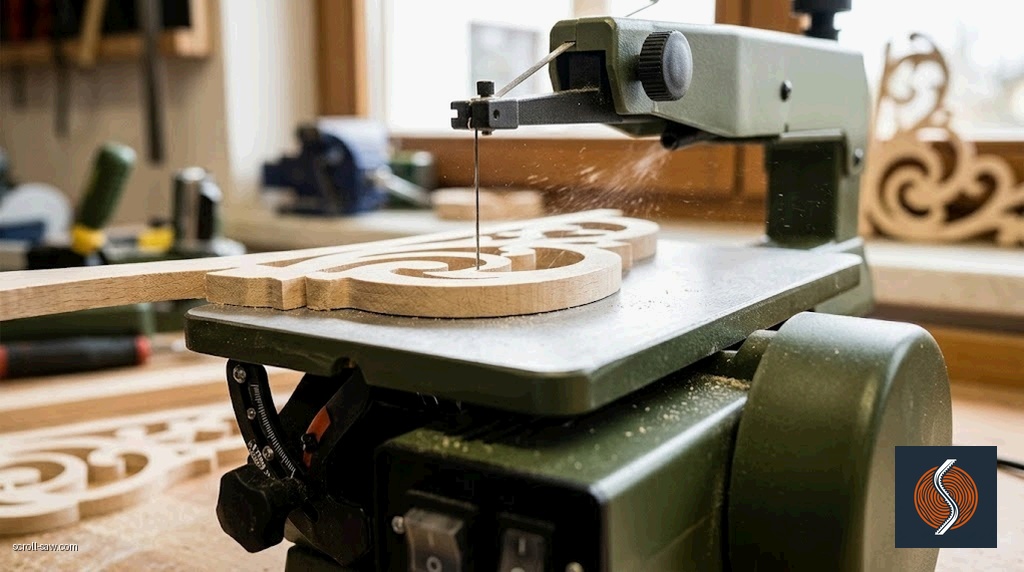
The Proxxon DSH 2-speed scroll saw has a small throat by scroll-saw standards, roughly 15 inches, and a cutting capacity of about 50 mm (2 inches) in softwood. The motor runs at two fixed speeds, typically around 900 and 1,400 strokes per minute, selected by a physical switch on the housing. Blade holding is a set-screw clamp system compatible with both pinless and pin-end blades of 5-inch length.
Weight is modest, around 20 kilograms. The table tilts left to 50 degrees and does not tilt right. Cast aluminum body throughout.
Direct answer
The DSH 2-speed is a good buy on the used market for anyone whose work is small: model building, marquetry, jewelry-scale wood cutting, and miniature ornament work. It handles thin plywood, veneer stacks, and softwoods up to about 3/4 inch cleanly.
It is not a good choice for anyone cutting fret patterns in hardwood over half-inch thickness, portrait work, or anything that requires wide throat depth. The 15-inch throat is limiting for larger pattern work, and the two fixed speeds are less flexible than a continuously variable saw.
If a DSH/E is available at a similar asking figure, choose the DSH/E. The electronic variable speed is genuinely useful.
Build and feel
The DSH is built like a small European bench tool. The cast aluminum body is stiff, the arms are balanced, and vibration at both speeds is low. The motor is quiet by scroll-saw standards, though not silent.
The set-screw clamps require the supplied hex key or a small screwdriver. Blade changes are not as fast as thumb-wheel systems, but the mechanism is precise and holds a blade square once tightened.
The 50-degree left tilt is generous. The lack of right tilt is inconvenient for compound work.
What it cuts well
Thin plywood up to 6 mm, all day. Veneer stacks for marquetry, cleanly. Softwoods to 20 mm, no complaint. Model boxwood, cherry, and maple in scale-model thicknesses, easily. Small ornaments and jewelry blanks, precisely.
What it does not cut well
Hardwoods over 20 mm, especially white oak and hard maple. The two fixed speeds are neither low enough for very slow controlled cuts in thick stock nor high enough for very thin veneer stacks that need speed for chatter control.
Wide pattern work is limited by the 15-inch throat.
What to check on used units
Rock the arms with the power off. Feel for pivot slop.
Open and close the set-screw clamps. Look for stripped threads.
Run the motor at both speeds. Listen for a growl at the high speed, which sometimes indicates a dry or worn bearing.
Check the tilt lock. The DSH tilt lock is a small knob and can strip if forced.
Ask about the manual and the original blade holders. Proxxon parts remain available through Proxxon’s US and European service networks.
Blades that work
Standard 5-inch pinless blades in #2/0 through #5 are the sweet spot. Olson PGT, Flying Dutchman, and Pégas modified-geometry blades all fit and cut well.
Pin-end blades work but the machine is happier with pinless.
Verdict and takeaways
-
The DSH 2-speed is a small-scale scroll saw, best for model, marquetry, and jewelry work.
-
Throat depth is 15 inches; cutting capacity is about 2 inches in softwood.
-
Two fixed speeds; if a variable-speed DSH/E is available, prefer it.
-
Cast aluminum body is stiff and quiet; parts remain available through Proxxon service.
Frequently asked questions
Is the Proxxon DSH 2-speed still in production? No. It has been replaced by the DSH/E electronic variable-speed model.
Where can I get parts for the DSH? Through Proxxon’s authorized service network in the US and Europe. Most consumable parts remain stocked.
Does the DSH accept pin-end blades? Yes, but pinless blades give better results.
What is the maximum cutting thickness? About 50 mm in softwood, less in hardwood.
Is the throat depth enough for pattern work? For small patterns, yes. For larger fret work above 15 inches wide, no.
Can I buy a new DSH 2-speed? Not new. Only used market.
References
-
Proxxon product documentation, DSH and DSH/E specifications.
-
Proxxon US service network, parts availability confirmations.
-
Owner reports, model-building and marquetry forums 2020-2025.


