
How to Cut a Scroll Saw Car Without Losing the Fine Details
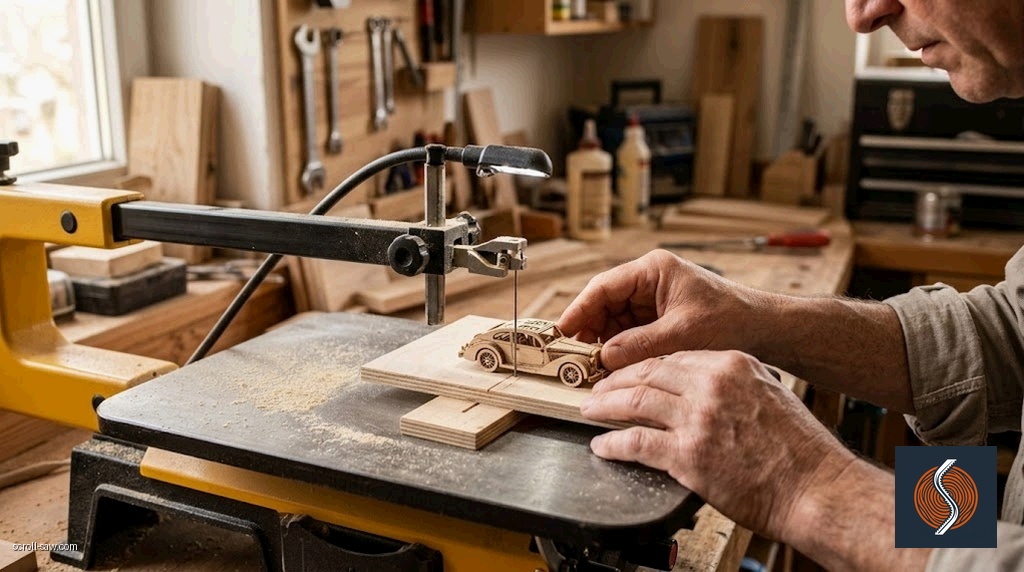
How to Cut a Scroll Saw Car Without Losing the Fine Details
A scroll saw car pattern lives in specific niches: classic muscle cars, vintage roadsters, sports coupes, and pickup trucks. Every hobbyist who cuts cars has a personal favorite (a 1969 Camaro, a 1957 Chevy, a modern Corvette, a Ford F-150), and the pattern library covers most of them.
What makes a car pattern hard is that everyone recognizes cars. A misplaced wheel arch, a missing badge, an incorrect grill design, and the piece stops reading as the intended car. Getting the details right is the whole point.
What car patterns typically show
Most scroll saw car patterns are side-view silhouettes with pierced elements for headlights, taillights, wheels, grill, and side badges. Common subjects: classic muscle cars (Mustang, Camaro, Charger), vintage classics (Model T, 1932 Ford, 1957 Chevy), sports cars (Corvette, Porsche 911), and pickup trucks (Ford F-150, Chevy C10, Dodge Ram).
Quick answer: cut from 1/2 inch quartersawn cherry, walnut, or basswood with grain running horizontally along the car’s length. Use a #5 skip-tooth for the outer perimeter and a #3 reverse for wheel pierces, grill detail, and window pierces. Drill entry holes first. Cut wheel interior first, then grill and window pierces, then the outer perimeter last. Finish with wipe-on oil or sealed color paint.
Wood choice
Half-inch quartersawn cherry for warm oiled car silhouettes. The default choice.
Half-inch walnut for darker, formal, or vintage classic patterns.
Half-inch basswood for painted cars in period-correct colors (Ferrari red, Porsche silver, Chevy Camaro Butternut Yellow).
Avoid pine (grain fights the smooth body lines) and Baltic birch for display pieces.
Blade choice
A #5 skip-tooth blade for the outer perimeter and larger openings.
A #3 reverse-tooth blade for wheel spoke pierces, grill detail, window pierces, and badge detail.
A #1 blade for the finest detail: individual wheel spokes on wire-wheel patterns, small badge text.
Grain orientation
Grain runs horizontally along the car’s length. This aligns with the car’s long axis and gives structural strength across the body.
Grain running vertically across the car makes the thin roof, hood, and trunk lid sections prone to cracking during cutting.
Cut sequence
-
Sand both faces of the panel to 220 grit before cutting.
-
Apply the pattern with painter’s tape and spray adhesive, oriented with grain running along the car’s length.
-
Drill every entry hole in one session.
-
Cut wheel interior detail first (spokes, hubcaps, or wheel wells). Working from innermost detail outward keeps the wheel supported.
-
Cut grill detail next.
-
Cut window pierces (windshield, side windows, rear window).
-
Cut headlight and taillight pierces.
-
Cut side badge detail if pierced.
-
Cut the outer perimeter last. Start at the front bumper base, cut down under the car, along the bottom, up over the rear bumper, along the trunk, up over the roof, and down the front hood to the starting point.
Where car patterns fail
Wheel spokes break. Spokes drawn thinner than 1/16 inch shear off. Thicken on pattern.
The roof cracks during cutting. Grain runs vertically across the roof line. Reorient the pattern.
Grill detail scorches. Blade dulled during the many pierced cuts. Change blades before starting the grill.
The car doesn’t read as the intended model. Pattern proportions are off (wrong wheel-to-body ratio, incorrect greenhouse shape). Verify against reference photos before cutting.
Finishing
Wipe-on boiled linseed oil for cherry, walnut, and oak cars. Two coats over two days.
Painted cars: shellac sanding sealer, acrylic craft paint in the period-correct color, matte water-based polyurethane top coat.
Two-tone painted cars (classic 1950s two-tone paint schemes): seal, paint the entire piece the primary color, mask the primary color areas, paint the secondary color on the unmasked areas, remove tape, seal.
Metallic-look painted cars: use metallic acrylic craft paint (silver, gold, copper), sealed with matte polyurethane.
Mounting for display
Wall-mounted cars: keyhole slot cut into the back before finishing.
Freestanding cars: cut a small rectangular base from the same stock, glue to the wheel bottoms with Titebond II, allow to cure before finishing.
Coffee-table display: freestanding cars often sit on their own wheels without a base for a natural look.
Backer fabric behind wheel and window pierces: dark blue felt reads well for classic American cars, red felt for Ferrari red cars, forest green for British racing green.
Comparing three car patterns
Simple side-view muscle car silhouette in 1/2 inch cherry, oiled, wall-mounted. The reliable first car project.
Detailed 1957 Chevy with pierced grill, chrome trim outlines, and side windows in 1/2 inch walnut, oiled, mounted on cream backer. The mid-range piece.
Custom-color 1969 Camaro with period-correct paint (Butternut Yellow, Rally Green, or Hugger Orange) in 1/2 inch basswood, sealed and painted. The signature piece.
Conclusion
A scroll saw car preserves its fine details when the grain runs along the car’s length, wheel and grill detail are cut before the outer perimeter releases the piece, and every wheel spoke drawn thinner than 1/16 inch is thickened before cutting. Half-inch cherry, walnut, or basswood. A #5 skip-tooth outline with #3 reverse for detail. Wipe-on oil or period-correct sealed paint. Fabric backer behind pierced areas. Do those and the finished car reads as the specific model it’s meant to represent, which is the whole point of cutting a specific make and model.
Frequently asked questions
What wood works best for a scroll saw car pattern? Half-inch quartersawn cherry for warm oiled silhouettes, walnut for darker classics, basswood for period-correct paint.
Which blade cuts wheel spokes cleanest? A fresh #3 reverse-tooth blade for most spokes, dropping to a #1 for wire-wheel patterns.
How thick should wheel spokes be? At least 1/16 inch on the pattern at final size. Thicken thinner spokes with a pencil.
How should the grain run on a car pattern? Horizontally along the car’s length. Grain crossing the roof causes cracking.
Should I cut wheels before the outline? Yes. Wheel interior detail first, then grill and window pierces, then the outer perimeter last so the wheels stay supported.
Paint or oil? Wipe-on oil for cherry, walnut, and oak silhouettes. Sealed period-correct acrylic paint for basswood.
How do I paint a two-tone classic car? Seal, paint primary color entirely, mask primary color areas, paint secondary color on unmasked areas, remove tape, seal.
References
-
Steve Good, Scrollsaw Workshop pattern archive: scrollsawworkshop.blogspot.com
-
Sue Mey, Scroll Saw Artist: scrollsawartist.com
-
Scroll Saw Woodworking & Crafts, Fox Chapel Publishing: foxchapelpublishing.com


