
Before Buying a Rockwell Scroll Saw Vintage, Check These Wear and Service Points
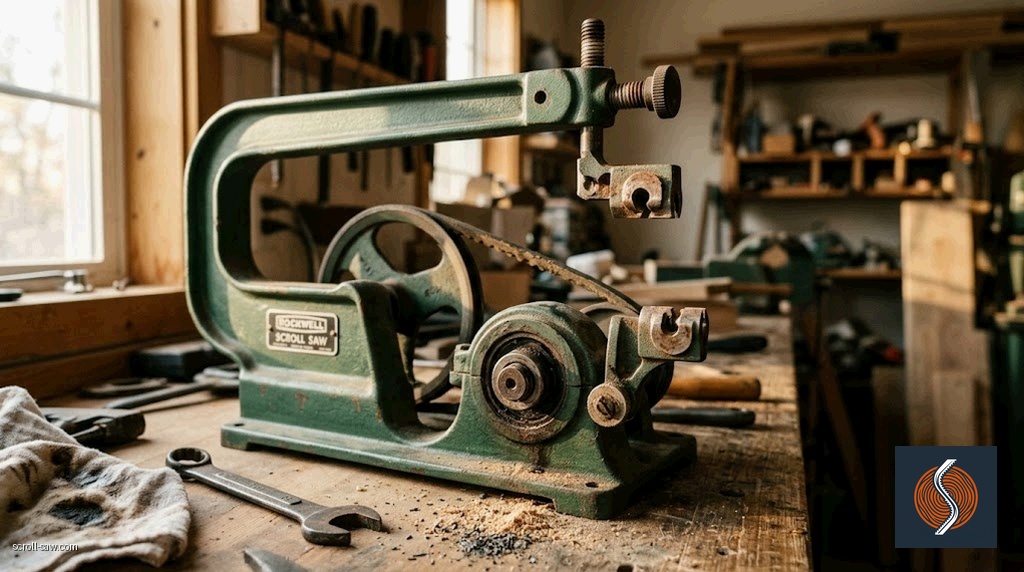
Before Buying a Rockwell Scroll Saw Vintage, Check These Wear and Service Points
A vintage Rockwell scroll saw in good condition is one of the best value propositions in the used woodworking machinery market. These machines were built to industrial standards in an era when cast iron, ground surfaces, and serviceable motors were the norm. Fifty years later, the ones that were treated well are still running. The ones that were not are usually repairable, provided you know what you are getting into.
This piece is the pre-purchase and pre-service inspection guide that saves you from buying a project that turns out to be a paperweight.
The vintage Rockwell lineup
The key models to know:
40-440. A 20-inch throat scroll saw from the transition era into Delta ownership. Cast iron, induction motor, single-lever tensioning on later revisions. Highly regarded.
24-inch industrial Rockwell. Larger throat with heavier build. Less common on the used market.
BR1004 and related 16-inch models. Smaller Rockwell benchtop machines from the mid-century.
Rockwell-Delta transition units. Machines badged with both names from the corporate transition period.
All share the same general design philosophy: cast iron, serviceable, and built to last.
Direct answer
Before committing to a vintage Rockwell, do these five checks in the seller’s shop.
One: rock the arms with power off and feel for pivot wear.
Two: inspect the blade clamps for stripped set-screw threads and scored jaw faces.
Three: test the motor at all speeds; listen for growls, feel for excess heat.
Four: check the table for flatness with a straight edge, and confirm the tilt mechanism holds without creep.
Five: cut a piece of scrap with a fresh blade and confirm the saw tracks straight.
If all five pass, the machine is worth taking home. Anything else is a project, and projects should be priced as projects.
Common wear items on vintage Rockwells
Blade clamp assemblies. After decades of service, set-screws are often stripped and jaw faces scored. Replacement clamps are available through Delta successor channels for the 40-440. Other models may require salvage.
Motor brushes on brushed variants. Standard carbon brushes, generally sourceable through industrial suppliers.
Drive belts. Standard V-belt profiles on most models. Available generically.
Pivot bushings. Wear develops slowly. On heavily used industrial machines, replacement is often needed. Sourcing varies by model.
Motor bearings. On induction motors, bearings can be replaced by a competent motor shop. Do not assume a noisy motor is dead; often it just needs bearings.
Switches and cord sets. Wear items on any machine of this age. Generic replacements fit most models.
Signs of a good buy
Original owner or documented history. Someone who can tell you what the machine has done.
Machine on its original stand, or one obviously purpose-built for it.
Manual and paperwork included.
Minimal rust beyond surface oxidation on the table.
Original cord and switch in good condition (not a sign of neglect, but a sign the electrics have not been butchered).
Smooth motor start and consistent speed control.
Signs to walk away
Cracked arm or body castings. Not repairable at reasonable cost.
Evidence of a fire, flood, or serious impact damage.
Motor that hums but does not start, or trips a breaker under load. Could be a simple capacitor or could be a burned winding; do not gamble unless the asking figure reflects the risk.
Stripped or missing blade clamp mounting hardware where replacement parts are not confirmed available for your specific model.
Seller unwilling to plug the saw in and run it.
The service plan for a good buy
Assume some baseline service on any vintage Rockwell you take home.
Clean the machine thoroughly. Remove decades of accumulated dust and grime.
Degrease and inspect all pivots. Re-lubricate with light machine oil.
Inspect and lubricate the motor. Grease fittings on induction motors, if present, take a small amount of proper motor grease.
Install new clamp jaws or set-screws if any wear is present.
Install a new drive belt as insurance.
Wax the table.
Run a test cut and adjust as needed.
Budget half a day for this on a machine in average condition.
Verdict and takeaways
-
Vintage Rockwell scroll saws are excellent value in good condition.
-
The 40-440 is the most sought-after vintage model.
-
Five inspection checks (arm pivots, clamps, motor, table, test cut) determine buy-or-walk.
-
Assume baseline service: clean, lubricate, replace clamps and belt, wax table.
Frequently asked questions
Is a vintage Rockwell better than a modern scroll saw? For cast-iron durability and long-term serviceability, often yes. For blade change speed and ergonomics, modern machines are ahead.
Where can I find a vintage Rockwell scroll saw? Estate sales, auctions, Craigslist, Facebook Marketplace, and OWWM community listings.
Are parts still available? For common items yes, through Delta successor channels and salvage. Rare items require patience.
Do vintage Rockwells take standard blades? Yes. Most take standard 5-inch pinless blades; some models also accept pin-end blades with adapters.
Is the 40-440 worth restoring? Generally yes, if the machine is complete and the castings are sound.
Can I convert a vintage Rockwell to variable speed? Not easily. Induction-motor Rockwells run at fixed speed; converting requires significant modification.
References
-
OWWM community documentation on Rockwell-Delta machines.
-
Historical Rockwell product literature.
-
Owner restoration reports, Sawmill Creek and Vintage Machinery forums 2020-2026.


