
A Practical Craftsman Professional 20 Variable Speed Scroll Saw Setup Guide by Material and Thickness
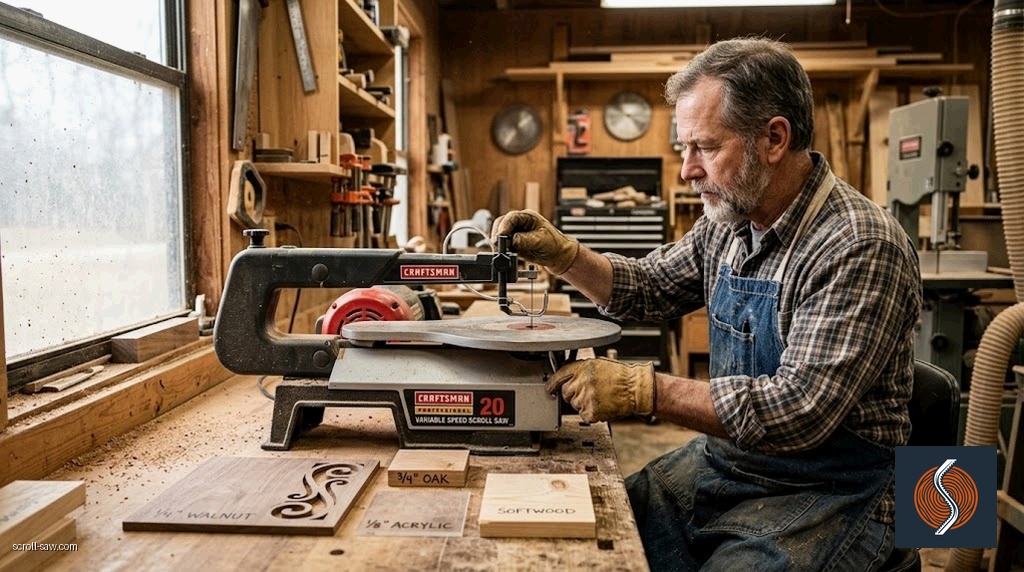
A Practical Craftsman Professional 20 Variable Speed Scroll Saw Setup Guide by Material and Thickness
The Craftsman Professional 20-inch variable-speed scroll saw is one of the more capable machines Sears sold under the Craftsman brand. Emerson-built, cast construction, 20-inch throat, electronic speed control across a useful range. Model numbers include 113.236400 and 113.286200c among related variants. On the used market these machines are prized when found in good condition and appropriately priced when found in average condition.
Getting the best cut from one is a matter of matching speed and blade to the material and thickness in front of you. This piece is the setup and material-specific reference.
What the machine can do
The Craftsman Professional 20-inch variable-speed scroll saw is a serious pattern-cutting machine. Twenty inches of throat gives generous project capacity. Variable speed lets you dial in behavior for the material at hand. Cast construction damps vibration well. Blade clamps are precision set-screw designs that hold securely once tightened.
Realistic capabilities include:
Portrait and detailed pattern work up to 20 inches wide.
Marquetry, ornaments, puzzles, and general fret cuts.
Stack cutting of several layers of thin stock.
Cutting wood up to about 50 mm thick without straining.
Cutting harder or thicker materials with appropriate blade and speed selection.
Direct answer: setup fundamentals
Bench-mount solidly. A 20-inch scroll saw benefits from a heavy stand or a solid bench. The Craftsman Professional does not need to be bolted through the bench but should be clamped or sit on rubber isolation pads on a heavy surface.
Square the blade to the table with a small engineer’s square before the first cut. Zero the table tilt.
Install a fresh 5-inch pinless blade appropriate for the material. Tension by lifting the upper arm until the blade produces a clear note when plucked.
Attach a shop-vac to the dust port with a rubber reducer, at low to moderate suction.
Supplement any existing work light with an external task light.
Speed and blade selection by material
Softwood (pine, cedar, poplar), 6 to 20 mm. Medium to high speed (1,000 to 1,500 SPM). Olson PGT #5 or #7 for general work; #3 for detail.
Softwood, 20 to 40 mm. Medium speed (800 to 1,200 SPM). Olson PGT #7 or #9 skip tooth.
Hardwood (oak, maple, walnut), 6 to 12 mm. Medium speed (900 to 1,300 SPM). Pégas modified geometry #5 for cleanest cuts.
Hardwood, 12 to 25 mm. Medium-low speed (700 to 1,100 SPM). Pégas modified geometry #7 or Olson PGT #9.
Hardwood, 25 to 50 mm. Low speed (500 to 900 SPM). Olson PGT #9 skip tooth or Pégas #11.
Plywood and MDF, up to 20 mm. Medium speed (900 to 1,300 SPM). Olson PGT #5.
Veneer for marquetry, under 3 mm. Medium-high speed (1,200 to 1,500 SPM). Very fine blade, #2/0 or #3.
Thin metal (brass, aluminum sheet under 2 mm). Low speed (400 to 700 SPM). Metal-cutting scroll saw blade, appropriate tooth count for metal thickness.
Acrylic and thin plastic, 3 to 10 mm. Medium speed (900 to 1,300 SPM). Standard PGT #5 or specialty plastic-cutting blade.
Speed guidance in one paragraph
As a general rule, lower speed for thicker stock, harder material, metal, and delicate detail work. Higher speed for thinner stock, softer material, and general pattern cutting. When in doubt, start medium and adjust based on how the cut feels: too fast produces burn marks and blade drift; too slow produces jaggy cuts and blade wandering.
Common setup mistakes
Wrong blade for the material. The single biggest cause of poor cuts. A #3 blade in thick oak fights the cut; a #9 blade in veneer tears it. Match blade to material.
Speed too high. Running high speed all the time is not faster or better. It just wears blades faster and produces worse cuts in harder material.
Under-tensioned blade. A slack blade wanders. Tension until the blade sings.
Table not square. Angled cuts on stock you meant to cut square are almost always a squaring problem.
Skipping the wax. A dry cast-iron table drags. Waxed, it lets the stock move freely.
Parts and service
The Craftsman Professional 20-inch is Emerson-built (113-prefix). Parts flow through Sears PartsDirect and eReplacement Parts. Consumables (motor brushes, belts, cord sets) are widely available generic.
Manuals are on Sears PartsDirect by model number. Community archives cover older documents.
Verdict and takeaways
-
The Craftsman Professional 20-inch variable-speed scroll saw is a capable pattern-cutting machine.
-
Match blade and speed to the material and thickness for best cuts.
-
Cast construction and 20-inch throat make it suitable for serious pattern work.
-
Parts and service through Sears PartsDirect and eReplacement Parts; consumables generic.
Frequently asked questions
What is the speed range on the Craftsman Professional 20? Approximately 400 to 1,700 SPM on most variants, varying by revision.
What blades fit? Standard 5-inch pinless blades from any major manufacturer.
Is the Craftsman Professional 20 a good machine for portrait cutting? Capable when set up correctly. Not at the level of a Hawk or Pégas premium, but respectable.
Where can I find the manual? Sears PartsDirect by model number (113.236400 or 113.286200c).
Are parts still available? Yes through Sears PartsDirect and eReplacement Parts for most items. Rare items require salvage.
Can I use metal-cutting blades? Yes, at appropriately low speeds for thin metal.
References
-
Sears PartsDirect Craftsman documentation.
-
eReplacement Parts diagrams for Craftsman scroll saws.
-
Blade manufacturer catalogs (Olson, Pégas, Flying Dutchman).


