
Craftsman Scroll Saw 572.247202 Blades: Size, Tooth Geometry, and Material Guide
Craftsman Scroll Saw 572.247202 Blades: Size, Tooth Geometry, and Material Guide
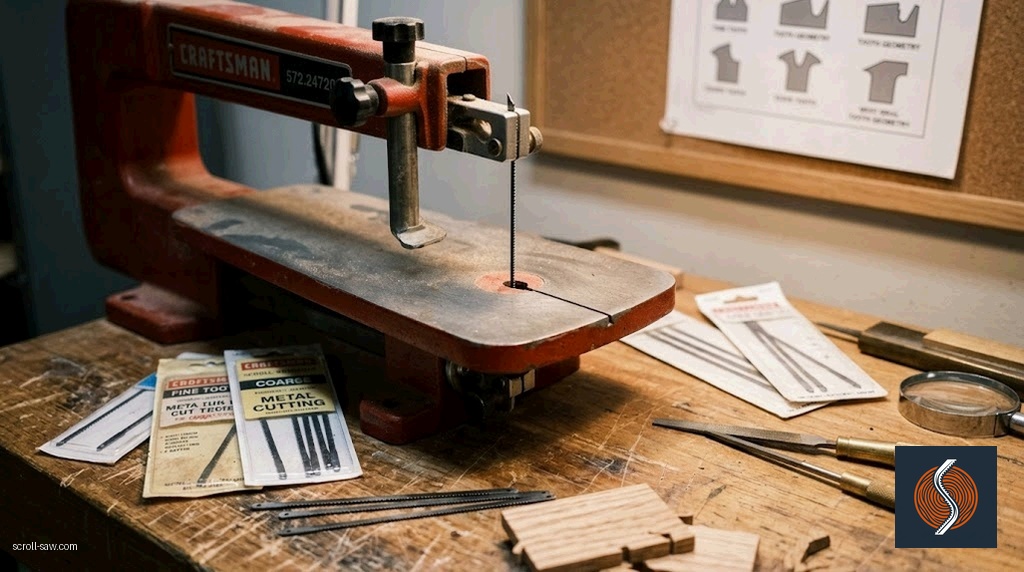
The Craftsman 572.247202 is a Ryobi-built 18-inch scroll saw sold under the Craftsman brand. Like other Craftsman scroll saws with the 572 prefix, it accepts standard 5-inch scroll saw blades in both pinless and pin-end configurations, with an included adapter for pin-end blades. Blade choice, not machine limitation, is what drives cut quality on this saw.
This piece is the blade selection guide by material and thickness.
Blade format basics
The 572.247202 takes standard 5-inch scroll saw blades. This is the same blade format as most benchtop scroll saws on the market, which means blade selection is not limited to Craftsman-branded blades.
Compatible blade brands:
Olson (PGT, spiral, standard tooth patterns).
Pégas (modified geometry blades widely regarded for cut quality).
Flying Dutchman (Ultra Reverse, Superior Puzzle, specialty patterns).
Hawk (standard patterns).
Craftsman-branded scroll saw blades (available through Sears PartsDirect where in stock).
Any of these fits the 572.247202’s clamp system.
Direct answer: which blade for which job
General wood pattern work, softwood 6 to 20 mm: Olson PGT #5. Reliable all-purpose blade.
Hardwood pattern work, 6 to 12 mm: Pégas modified geometry #5. Cleaner cuts in dense stock.
Thick softwood, 20 to 40 mm: Olson PGT #7 skip tooth. Handles thicker material without binding.
Thick hardwood, 12 to 25 mm: Pégas modified geometry #7 or Olson PGT #9. Reduces burn marks and drift.
Fine detail and inside cuts: Olson PGT #3 or Pégas #3. Tight radius work.
Very fine detail, veneer under 3 mm: #2/0 or #1. Marquetry-grade blades.
Puzzle cutting: Flying Dutchman Superior Puzzle blade. Specific tooth geometry for puzzle interlocks.
Spiral cuts (no rotation needed): Olson spiral #3 or #5. Cuts in any direction without turning the stock.
Plywood and MDF: Olson PGT #5 or #7 skip tooth. Handles plywood glue lines without dulling quickly.
Thin metal (brass, aluminum sheet): metal-cutting scroll saw blade in appropriate tooth count for material thickness. Run at low speed.
Acrylic and plastic 3 to 10 mm: standard PGT #5 or specialty plastic-cutting blade with reduced tooth count.
Blade size interpretation
Scroll saw blade sizes are counterintuitive: smaller numbers are finer blades, larger numbers are coarser.
#2/0 (or #0) is the finest. Very thin blades for extreme detail.
#1, #3, #5 are common fine to medium blades. #5 is a good default for general work.
#7, #9 are medium to coarse. Better for thicker stock.
#11 and above are coarse. Aggressive cuts in thick or dense material.
Skip tooth blades have every other tooth removed. Better for thick material because chips clear more effectively.
Modified geometry blades (Pégas and others) have refined tooth shapes for cleaner cuts and reduced drift.
Blade change on the 572.247202
The 572.247202 uses a set-screw clamp system typical of Ryobi scroll saws of this era.
Power off. Wait for the blade to fully stop.
Release the tension on the upper arm.
Loosen the upper clamp set-screw with the supplied hex key.
Remove the blade from the upper clamp.
Loosen the lower clamp set-screw and remove from the lower clamp.
Install the new blade in the lower clamp first, teeth pointing down. Tighten the set-screw firmly.
Install in the upper clamp, aligning correctly. Tighten the upper set-screw firmly.
Apply tension by lifting the upper arm to the correct position.
Check squareness before cutting.
Common blade problems and solutions
Blade slips in clamp: the set-screw is not tight enough, or the jaw face is scored. Retighten firmly. If the problem repeats, the clamp needs replacement.
Blade drifts during cut: too coarse a blade for the material, or blade tension too low. Try a finer blade or increase tension.
Cut has burn marks: speed too high, or blade too dull. Lower speed or install a fresh blade.
Blade breaks quickly: speed too high, feed rate too aggressive, or blade wrong for the material. Match blade to material and slow the feed.
Jaggy or torn cut: blade too coarse for the material, or blade dull. Try a finer blade or replace.
Blade storage
Store blades in the original packaging or a divided plastic case. Blades exposed to moisture rust; blades stored loose bend or nick. Both problems ruin cutting quality.
A short magnetic strip mounted near the saw holds working blades organized and accessible.
Where to buy
Quality blades from Olson, Pégas, and Flying Dutchman are stocked at specialty scroll saw suppliers and general retailers including Amazon. Craftsman-branded blades appear at Sears PartsDirect where available.
Verdict and takeaways
-
The 572.247202 takes standard 5-inch scroll saw blades from any major manufacturer.
-
Match blade to material and thickness for best cuts.
-
Lower blade number equals finer blade; higher equals coarser.
-
Skip tooth for thicker stock; modified geometry for cleaner cuts.
Frequently asked questions
What size blades does the Craftsman 572.247202 use? Standard 5-inch scroll saw blades in pinless format, or pin-end with the included adapter.
Can I use Olson blades in the Craftsman 572? Yes. Any major-brand 5-inch scroll saw blade fits.
What is the difference between skip tooth and standard tooth? Skip tooth has every other tooth removed, which clears chips better in thick material.
Which blade for hardwood pattern work? Pégas modified geometry #5 for thin to medium; #7 for thicker.
How do I know when to replace a blade? When cuts become jaggy, drift increases, or burn marks appear even at correct speed. Fresh blades cut noticeably cleaner.
Can I use metal-cutting blades on the 572.247202? Yes, at low speed for thin brass, aluminum, and similar metals.
References
-
Ryobi Tools documentation for Craftsman 572-series scroll saws.
-
Sears PartsDirect Craftsman scroll saw parts documentation.
-
Blade manufacturer catalogs (Olson, Pégas, Flying Dutchman).


