
How 21 Scroll Saw Fits Into a Scroll-Saw Workflow
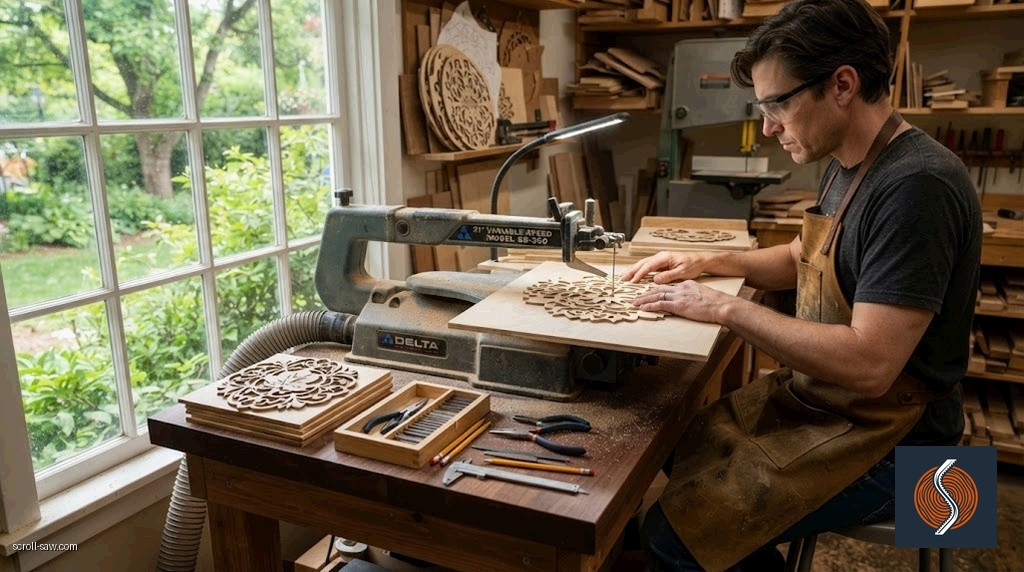
How 21 Scroll Saw Fits Into a Scroll-Saw Workflow
A 21-inch throat sits comfortably between standard 18 to 20-inch hobby saws and larger premium machines, offering slightly more reach without stepping into production-scale territory. Understanding where it fits alongside your other tools helps you use it effectively rather than expecting it to do more or less than it is built for.
Direct answer
A 21-inch scroll saw fits into a workflow as the primary detail and interior-cutting tool for hobby-scale to moderately large projects, sitting between a band saw for rough stock preparation and a sander for finishing work. It comfortably handles most clock faces, decorative panels, and pattern projects without the bulk of a true production-scale saw.
Typical project workflow with this saw
Design and pattern selection. Happens independently of the saw, though a 21-inch throat opens up slightly larger pattern options than an 18-inch machine.
Rough stock preparation. A band saw or jigsaw still handles breaking down larger material efficiently; a scroll saw at any size is not the right tool for this stage.
Entry hole drilling. A drill press or hand drill creates the holes needed for interior cuts before the scroll saw work begins.
Precision and detail cutting. This is where the 21-inch saw does its work, handling everything from fine detail to moderately large panel cuts within its throat capacity.
Finishing. Sanding and finish application happen after all cutting is complete, independent of the scroll saw itself.
What this size handles comfortably
Standard and moderately large clock faces, decorative panels, intarsia projects of typical hobby scale, and general pattern work all fall within a 21-inch throat’s comfortable working range.
What might call for a different size
If you regularly work on very large panels or portrait-scale commissions, a 24 to 30-inch premium saw offers more headroom. If your work is mostly small ornaments or jewelry-scale pieces, a compact 16-inch saw is more proportionate to the task and takes up less bench space.
Complementary tools for a complete setup
A band saw or jigsaw for rough shaping, a drill press for entry holes, a disc or spindle sander for edge finishing, and a reliable range of blades matched to your typical materials round out a workflow built around a 21-inch scroll saw as the centerpiece for detail work.
Verdict and takeaways
-
A 21-inch scroll saw fits as the primary detail-cutting tool for hobby to moderately large project work.
-
It sits comfortably between compact hobby saws and large premium production machines.
-
Pair it with a band saw for rough shaping and a sander for finishing.
-
Consider a larger or smaller saw only if your typical project scale consistently falls outside this range.
Frequently asked questions
What kind of projects suit a 21-inch scroll saw best? Standard to moderately large clock faces, decorative panels, and general pattern work.
Do I still need a band saw if I have a 21-inch scroll saw? Yes, a band saw handles rough stock preparation more efficiently than any scroll saw.
When should I consider a larger saw instead? If you regularly work on very large panels or portrait-scale commissions beyond this saw’s comfortable range.
What tools complement a 21-inch scroll saw in a full workflow? A band saw or jigsaw, a drill press for entry holes, and a sander for finishing.
Is 21 inches too large for small ornament work? Not too large, but a compact 16-inch saw is more proportionate and space-efficient for that scale of work.
What stage of a project does the scroll saw handle? Precision and detail cutting, after rough stock preparation and entry hole drilling.
References
- General scroll saw workflow and throat depth guidance across common brands.


