
How Amt 4600 Scroll Saw Fits Into a Scroll-Saw Workflow
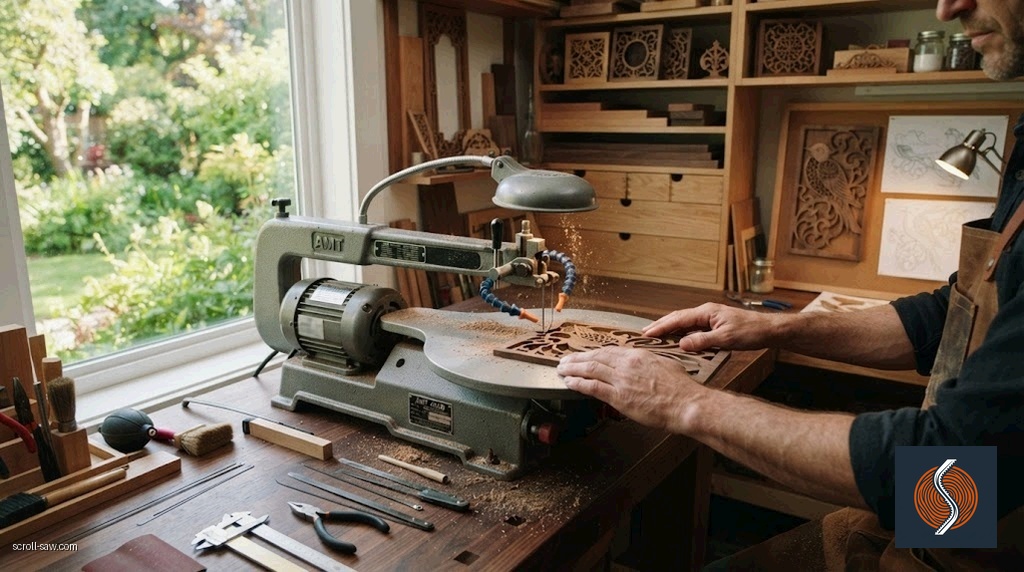
How Amt 4600 Scroll Saw Fits Into a Scroll-Saw Workflow
The AMT 4600 is a legacy scroll saw model, and owners today are typically working with an older unit acquired secondhand or inherited. Understanding its role in a modern workflow helps set realistic expectations for what this saw can do well.
Direct answer
The AMT 4600 fits into a workflow as a basic detail and pattern-cutting tool, suited to general hobby work rather than production-scale or highly technical projects. Given its age, its role today is often as a secondary or learning saw rather than a primary shop tool, especially if newer saws with better dust management and blade systems are available.
Typical workflow role for an older saw like this
Rough stock preparation. Handled by a band saw or jigsaw, independent of scroll saw age or model.
Detail and pattern cutting. The 4600 handles this stage for general project work, though its throat depth and cutting thickness capacity should be confirmed against your specific unit’s specifications since documentation for legacy models can be inconsistent.
Learning and practice. An older saw like this is well suited to developing scroll saw technique without a large investment, especially if acquired at low or no cost.
What to verify on a legacy unit
Throat depth and cutting thickness. Check the nameplate or any available documentation, since these determine what your saw can realistically handle.
Blade compatibility. Confirm what blade format your specific clamp accepts, since older models sometimes use less common clamp designs than modern saws.
Mechanical condition. Inspect the arm mechanism, motor, and switch carefully given the saw’s age, since wear accumulates over decades of potential use and storage.
Electrical safety. Pay particular attention to cord and switch condition on an older unit, replacing anything showing wear before use.
Where a legacy saw like this may fall short
Dust management is often more basic than on modern saws, so plan for supplemental dust control like a shop vacuum positioned near the cut line. Variable speed range, if present at all, may be narrower than on current production saws, so blade selection becomes a more important tool for controlling cut quality.
When to consider replacing it
If the saw struggles with basic maintenance, parts are difficult to source, or its performance limits the projects you want to take on, a modern entry-level saw often provides better dust control, blade options, and reliability at a comparable investment.
Verdict and takeaways
-
The AMT 4600 fits as a basic detail-cutting tool, well suited to learning and general hobby work.
-
Verify throat depth, cutting thickness, and blade compatibility directly on your specific unit.
-
Inspect mechanical and electrical condition carefully given the saw’s age.
-
Consider a modern replacement if dust control or reliability becomes a limiting factor.
Frequently asked questions
What is the AMT 4600 scroll saw good for today? General hobby pattern work and learning scroll saw technique, given its age and typically basic feature set.
How do I find specifications for this legacy model? Check the nameplate directly, since printed documentation for older models can be inconsistent or hard to find.
What should I inspect before using an old AMT 4600? Mechanical condition of the arm mechanism, motor, switch, and power cord given the saw’s age.
Does this saw have good dust collection? Typically more basic than modern saws; plan for supplemental dust control like a shop vacuum.
Should I upgrade from an AMT 4600? Consider it if maintenance becomes difficult or the saw’s limitations affect the projects you want to take on.
What blade format does this saw use? Confirm directly by inspecting your specific clamp, since older models can use less common formats than modern saws.
References
- General legacy scroll saw evaluation and maintenance guidance.


