
Hitachi CW 40 Scroll Saw: Purpose, Fit, and Setup
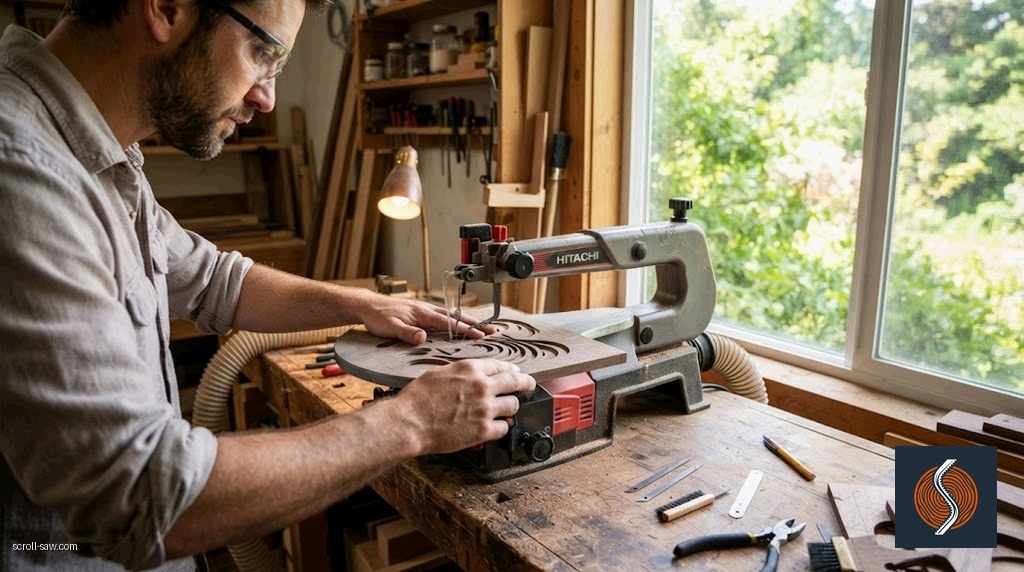
Hitachi CW 40 Scroll Saw: Purpose, Fit, and Setup
Every few weeks, someone posts a photo of a Hitachi CW 40 on a woodworking forum with the same question: “Found this at an estate sale, is it worth keeping?” The answers are always split, which is a fair signal that the machine has a real purpose but also real limits, and knowing which is which decides whether it earns a spot on your bench.
This is what the CW 40 was built for, where it still fits in a modern shop, and the setup and technique that separate a keeper from a doorstop.
What the CW 40 actually is
The Hitachi CW 40 is a 16-inch throat scroll saw, built by Hitachi Koki in Japan during the late 1990s and 2000s, later folded into what is now the HiKOKI brand. It has a C-arm design, a cast iron table, variable-speed motor on most versions, and takes standard 5-inch plain-end scroll saw blades.
The number designation is the trap. The “40” refers to Hitachi’s internal model coding, not any dimension of the machine. It is not a 40-inch saw. It is not a 40-blade capacity magazine. It is a mid-size scroll saw with a 16-inch (roughly 400 mm) throat, which is where the model name likely came from in the first place.
Purpose: what this saw was designed to do well
Hitachi built the CW 40 for the middle ground between hobby and semi-professional woodwork. Its purpose is precise, sustained curve and interior cutting in stock roughly 1/8 inch to 2 inches thick, with a table stable enough for detailed marquetry, intarsia, and fretwork.
It is not, and never was, a production saw. The motor size, the stroke length, and the blade change process all point at the enthusiast who takes an evening to cut one careful piece, not the shop turning out fifty ornaments a day.
What it does well:
-
Clean, controlled cuts in solid wood up to about 3/4 inch, with less blade wander than most contemporary hobby saws thanks to the heavier casting.
-
Bevel cuts up to 45 degrees with a table lock that actually holds position over a long session.
-
Interior pattern work, once you accept that threading a plain-end blade through a starter hole takes a few seconds each time.
-
Fine detail cutting with #1, #3, and #5 blades at reduced speed, where the machine’s mass keeps vibration low enough to see the line.
Fit: does it belong in your setup
A CW 40 fits three types of shops well and one type poorly.
Good fit: the mid-level hobby shop. If you already own a band saw and a jigsaw and want a dedicated scroll saw for curves under an inch thick, the CW 40 sits comfortably as your main scroll station.
Good fit: the second-saw specialist. If you own a modern variable-speed saw for detail work, the CW 40 makes a fine second machine set up permanently with a coarse blade for pattern removal, puzzle blanks, and rough shapes.
Good fit: the fretwork enthusiast on a budget. A well-tuned CW 40 with quality plain-end blades cuts fretwork nearly as cleanly as saws costing several times more, provided you’re patient with blade changes.
Poor fit: the one-and-done buyer. If you want to pull a saw out of a box, plug it in, and cut with no learning curve, look at a modern tool-free blade change machine instead. The CW 40’s blade clamp system is not friendly to first-time users.
Practical setup: what to check before your first cut
Start with the machine unplugged and go through this order.
Mount it. The CW 40 is heavy but not immune to vibration transfer. Bolt it to a solid stand or bench. Rubber pads under the feet reduce noise significantly.
Level the table. Set the table to zero degrees on the scale, then verify with a small square against the blade. Adjust the stop screw underneath the table if the scale reading disagrees with the actual square. Do this once, mark the correct position, and you can trust the scale afterward.
Install a good blade. Start with a reverse-tooth #5 or #7. Olson’s reverse-tooth assortment covers the three sizes you’ll reach for most often. Insert the blade with the teeth pointing down toward the table (a scroll saw cuts on the downstroke), and seat it fully in both upper and lower clamps before tightening.
Tension it correctly. Tighten until the blade rings a clear musical note when you pluck it. A dull thud is loose; a sharp, ringing note that doesn’t want to rise higher is about right. Blade snaps almost always come from either too much tension or from side-loading during cutting.
Set the hold-down foot. The small foot above the table should rest lightly on the workpiece, close to but not touching the blade. Its job is to keep the wood from lifting on the upstroke, not to clamp the piece down.
Check the dust blower. The small flexible tube from the arm should point at the cut line, keeping sawdust cleared so you can see where you’re going. If it’s cracked or missing, replacement tubing from any hardware store fits.
Blade choices that match the CW 40’s strengths
Blade selection is where a well-set CW 40 either impresses or disappoints. The saw is smooth enough to reward quality blades and forgiving enough that cheap blades still cut, they just cut worse than they should.
For general woodwork, reverse-tooth blades in #5 and #7 sizes handle 90 percent of scroll saw jobs. For fretwork and fine puzzle bridges, drop to #1 or #3 skip-tooth. The Pegas skip-tooth blades are Swiss-made and cut faster with less sharpening drift than most alternatives. For work that requires cutting in any direction (letters with internal curves, irregular silhouettes), keep a small pack of spiral blades in the drawer.
A balanced kit for a CW 40 is three sizes of reverse-tooth for general work, one size each of #1 and #3 skip-tooth for detail, and a small pack of spirals for the awkward jobs.
Where the CW 40 falls short
Honest limitations, worth naming so you can decide.
Blade change is slow. Every plain-end blade change requires loosening the tension, releasing the top clamp, threading the blade, and re-tightening. Interior cuts multiply this because you thread the blade through a drilled starter hole. Modern tool-free saws have spoiled users, and the CW 40 will feel dated in this respect.
No quick swap between coarse and fine work. If you cut a lot of variety in one session, you’ll spend real time on setup. Many CW 40 owners keep the saw dedicated to one blade type and rely on a second machine for the rest.
Support and parts. Hitachi Koki became HiKOKI, and while general consumables (belts, blade clamps, hold-down feet) are available in generic form, the exact factory replacement parts for the CW 40 are hard to source.
Noise. These older saws are not quiet. Not band-saw loud, but the mechanical thunk of the stroke at higher speeds is noticeable. Hearing protection for long sessions is a good habit.
The verdict
A Hitachi CW 40 in good condition is a fine mid-tier scroll saw that punches above its era. The casting is rigid, the motor is honest, and the plain-end blade system means you can use any modern quality blade. It is not the right saw for someone who wants tool-free convenience or heavy production capacity, but it is exactly the right saw for a patient user who values a stable, well-mounted cutting platform and doesn’t mind spending a few seconds on blade changes.
Buy one at a fair used price, mount it properly, invest in good blades, and it will produce clean work for years.
FAQ
What blade fits a Hitachi CW 40? Standard 5-inch plain-end scroll saw blades. Any current-production plain-end blade in the common sizes fits.
Is the CW 40 the same as the C40? They are closely related. The CW 40 is generally a later revision with small changes to the blade holder and dust management. Blades, tension technique, and general operation cross over.
Does the CW 40 have variable speed? Most versions do. There were earlier single-speed variants in some markets, so confirm by looking at the front control panel.
What’s the maximum cutting thickness? Approximately 2 inches in soft wood. Comfortable everyday range is 1/8 to 3/4 inch.
Can I still get parts for it? Generic consumables (belts, blades, hold-down feet, dust blower tubing) are easy to find. Model-specific factory parts are difficult, so check for arm play and clamp condition before buying used.
Where’s the manual? HiKOKI’s global support site archives some older Hitachi documentation. Machinery archive communities and eBay listings sometimes have scanned copies.
Why does my blade break so quickly? Over-tensioning is the most common cause. Second most common is side-loading the blade by steering with lateral pressure instead of rotating the workpiece.
Is it worth restoring one that needs bearings? Usually yes. Motor bearings are standard sizes and any competent bearing shop can source replacements. If the arm pivot is worn or the casting is cracked, it is generally not worth the effort.
References
-
HiKOKI (formerly Hitachi Koki) global support archives, legacy documentation for CW-series scroll saws.
-
Olson Saw Company technical resources on blade selection and tension.
-
Scroll Saw Association of the World, general operating and safety guidance.
-
Fine Woodworking magazine archive, blade choice and scroll saw setup articles.
Title tag: Hitachi CW 40 Scroll Saw: Purpose, Fit, and Setup Meta description: What the Hitachi CW 40 scroll saw was built for, where it fits in a modern shop, and the setup and blade choices that make it cut cleanly. URL slug: hitachi-cw-40-scroll-saw Excerpt: The Hitachi CW 40 is a well-built older 16-inch scroll saw that still earns its bench space when set up properly. Here’s what it does well, where it holds you back, and how to get useful, precise cuts from it.


