
Hitachi CW40 Scroll Saw Replacement Parts Guide
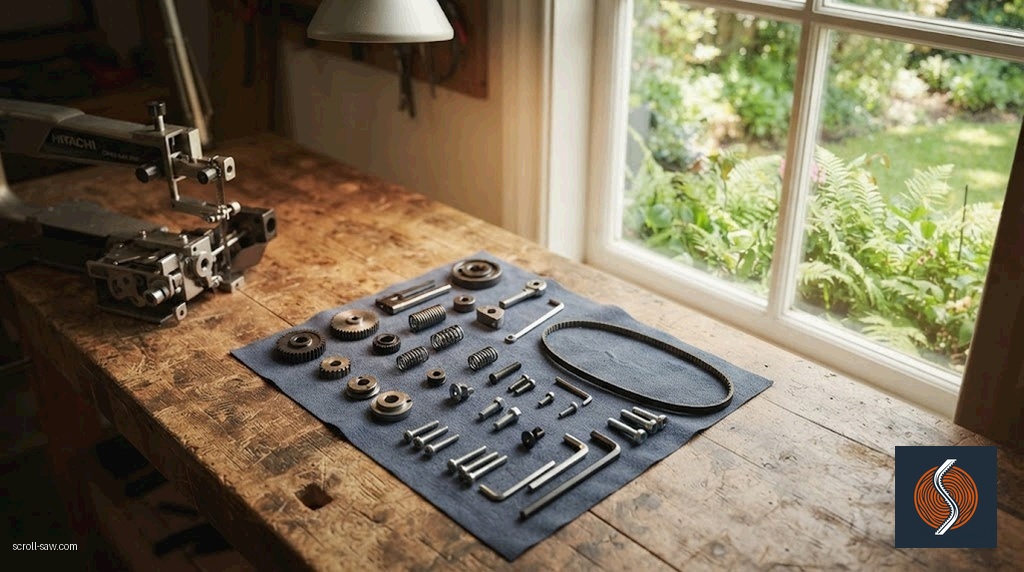
Hitachi CW40 Scroll Saw Replacement Parts Guide
The first surprise for anyone hunting Hitachi CW40 replacement parts is how much of the saw is not model-specific at all. The second surprise is how much of it is. Getting the wrong blade holder because it looks identical in a photo is the kind of small mistake that turns a $40 repair into a $200 headache, and the seller of a used part has no way to know whether their piece will fit your machine unless you both know what to check.
This is a working guide to which CW40 parts need an exact match, which parts are effectively universal, and how to source both without a factory catalogue.
First, read the ID plate
Before any part conversation, four pieces of information from the saw’s ID plate matter.
-
Model number as printed, including any suffix like Type I, Type II, or a revision letter.
-
Serial number, especially the year-code prefix.
-
Voltage and frequency, because electrical parts differ between 120 V 60 Hz and 230 V 50 Hz versions.
-
Manufacturer, whether the plate reads Hitachi Koki, Hitachi Power Tools, or HiKOKI.
A seller who can’t confirm the same information about the part they’re selling is a seller you have to work harder to trust.
Parts that must be an exact CW40 match
These are the parts where a close-enough substitute causes trouble.
Upper and lower blade holder assemblies. The clamp geometry, mounting hole spacing, and clamping bolt size are specific to Hitachi’s design. Blade holders from other 16-inch scroll saws physically look similar and will not grip a blade correctly if forced onto a CW40. Source from a CW40, C40, or a confirmed HiKOKI/Hitachi Koki parts warehouse listing.
Upper arm assembly. Rare that you’ll ever need this, but if the arm cracks or the pivot wears through, the replacement must come from a matching saw. Universal replacements do not exist.
Motor. The CW40 motor is a specific frame size and mounting pattern. A generic replacement motor of similar power will require mounting adaptations and often a new pulley to match the belt path. Not impossible, but not a drop-in job.
Speed controller (variable-speed versions). These vary by production year and by voltage version. An incorrect controller can burn out a working motor. Match the exact part number or find a competent electronics repair for the original.
Table casting. If the table cracks or the tilt trunnion is stripped, the replacement must be a CW40 table. The tilt lock mechanism and the table insert dimensions are model-specific.
Parts that are effectively universal
These are the parts where any reputable equivalent works.
Blades. The CW40 takes standard 5-inch plain-end scroll saw blades. Any current-production blade in that format fits. A working kit covers three sizes:
-
Reverse-tooth #5 or #7 for general 1/4 to 3/4-inch wood work: Olson reverse-tooth assortment.
-
Skip-tooth #1 or #3 for detail and fretwork: Pegas skip-tooth.
-
Spiral blades for cuts that change direction without turning the workpiece: Olson SP46500.
Drive belt. The CW40 uses a standard V-belt or ribbed belt (depending on production run) of a specific length. Any belt supplier can match it by measuring the original: profile, top width, and total inside length. Gates, Optibelt, and Continental all make direct-substitute belts.
Bearings. Motor and arm bearings are standard sealed bearings identified by ISO number stamped on the bearing itself. Any bearing supplier can cross-reference to an equivalent. Bring the old bearing with you if buying in person.
Hold-down foot and pressure plate. The specific factory foot is proprietary in shape, but generic pressure plates from other scroll saw brands can be adapted with minor drilling. Not strictly universal, but not blocked either.
Dust blower tubing. The small flexible tube that directs air across the cut line is generic clear vinyl tubing available at any hardware store. Match the inside diameter of the original.
On/off switch. A standard rocker or paddle switch of the correct voltage and amperage rating fits, though the mounting hole in the base may need slight rework to accept a different switch face.
Table insert. The small removable insert where the blade passes through the table wears out slowly. Some owners make their own from thin hardwood or plastic sheet if the exact factory insert isn’t available.
Power cord. Any correctly rated three-conductor cord replaces the original, wired to match the internal terminal block.
Consumables and wear items
Some parts are meant to be replaced periodically, and the CW40 is no exception.
Blades are the everyday consumable. A good blade lasts anywhere from thirty minutes to several hours of cutting depending on material, blade quality, and technique. Have a stock of at least a dozen on hand for any serious session.
The drive belt typically lasts several years of hobby use before stretching enough to slip. Check it whenever the saw develops noticeable vibration at high speed.
Motor brushes, if your CW40 version uses a brushed motor, wear down slowly and can be replaced individually. Standard brush cartridges are available from motor repair suppliers.
The bulb in the work light (if fitted) burns out on its own schedule. Any small LED replacement in the correct base fits.
Where to source real replacement parts
Sourcing for the CW40 is a hunt more than a shop.
HiKOKI service network. HiKOKI service centres occasionally still hold Hitachi Koki era stock for common wear parts. Their online part search is inconsistent but worth trying with the exact model number.
Independent power tool repair shops. Long-established shops often have drawers of legacy parts and can source through supplier networks that aren’t public-facing.
eBay and Marketplace. Non-running CW40 and C40 saws are often listed cheap as parts machines. Buying one for a specific blade holder or table can be cheaper than buying the part alone if you can find the right seller.
Scroll saw forums. Members with parts drawers, or with the same saw sitting unused, sometimes sell or trade individual pieces. Post the exact part you need with your machine’s ID plate details.
Bearing and belt specialists. For anything that’s not model-specific, an industrial supply house is faster and cheaper than any tool-specific channel.
Cost versus replacement decision
Some CW40 repairs cross the line where a whole different saw makes more sense.
Repair generally makes sense when:
-
The frame, arm, and table casting are sound.
-
The failed part is a consumable or a moderately priced assembly (blade holder, belt, switch, bearings).
-
You already own quality blades, a stand, and dust collection accessories that would transfer to any new saw.
Replacement generally makes sense when:
-
The arm pivot has significant play or the casting has cracked.
-
The motor has failed and no matching replacement is findable at reasonable cost.
-
The total repair estimate approaches the price of a comparable modern 16-inch variable-speed scroll saw with tool-free blade change.
A modern equivalent-class saw with tool-free blade clamps and current parts support often makes better long-term sense than a marginal CW40 repair. But a straightforward blade holder or belt replacement on an otherwise-sound machine is almost always worth doing.
Practical inspection before buying a used CW40
Since the parts hunt is real, it’s worth avoiding trouble by inspecting carefully before purchase.
-
Grip the upper arm at the front and try to move it side to side. Any lateral play means expensive pivot wear.
-
Rotate the pulley or motor shaft by hand with the belt tensioned. Rough or gritty rotation means bearings.
-
Look at the underside of the table around the blade slot for cracks or repair welds.
-
Check both blade holder assemblies for gouges or rounded seats.
-
Confirm the tilt lock actually holds the table at 45 degrees under moderate hand pressure.
A CW40 that passes all five is worth keeping. One that fails on the arm or blade holders is either a project or a parts machine, and it’s fair to price it accordingly.
FAQ
Where can I buy Hitachi CW40 replacement parts? HiKOKI service centres, independent power tool repair shops, forums, and used-machine listings. There is no single online catalogue.
Are C40 parts the same as CW40 parts? Many are, especially blades, belts, and general consumables. Blade holder assemblies and speed controllers are often model-specific, so verify before ordering.
What blade fits the CW40? Standard 5-inch plain-end scroll saw blades. Any current-production blade in that format fits.
Can I use a generic drive belt? Yes. Match the original by profile (V, ribbed) and length. Any industrial belt supplier can supply a direct substitute.
How do I identify my exact CW40 model version? Check the ID plate on the base or arm. The full model number, serial number prefix, voltage, and manufacturer name together identify the specific version.
Is it worth repairing an old CW40? Usually yes, if the frame, arm, and table are sound and the failed part is a bearing, belt, switch, or consumable. Not if the arm pivot is worn or the casting is cracked.
What is the most common CW40 failure? Bearings and the drive belt are the most common wear items. Blade holder wear is close behind on heavily used machines.
Can I upgrade the CW40 with modern accessories? Some aftermarket accessories fit with minor modification (dust extraction adapters, work lights). Full tool-free blade change conversions are not commercially available for this model.
References
-
HiKOKI (formerly Hitachi Koki) global support and part search.
-
Olson Saw Company blade technical data.
-
Scroll Saw Association of the World, operating and maintenance guidance.
-
General industrial bearing and belt sizing references from major suppliers.
Title tag: Hitachi CW40 Scroll Saw Replacement Parts Guide Meta description: Which Hitachi CW40 scroll saw parts must match exactly, which are effectively universal, and where to source real replacements without a factory catalogue. URL slug: hitachi-cw40-scroll-saw-replacement-parts Excerpt: Not every Hitachi CW40 replacement part needs to come from a Hitachi source, but some absolutely do. Here’s the working list of what must match, what can be generic, and how to source parts for a saw that hasn’t been in production for years.


