
King 16 Scroll Saw: What to Check Before First Use
King 16 Scroll Saw: What to Check Before First Use
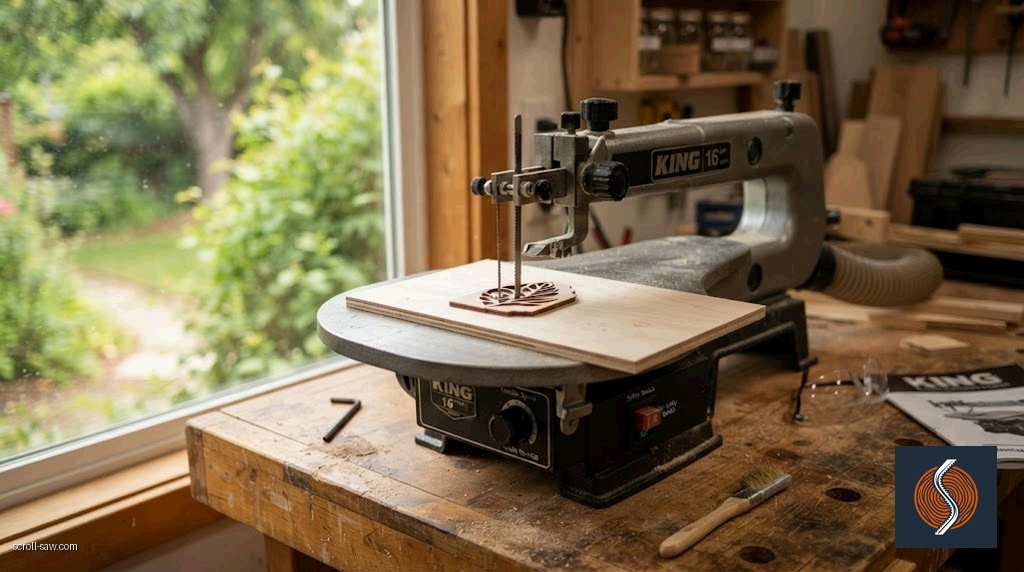
A King 16 scroll saw is usually someone’s second machine, not their first. It shows up as a hand-me-down, a Kijiji find north of the border, or a bench-clearing purchase from a shop that upgraded. If you’ve just brought one home and you’re staring at it before the first cut, resist the urge to plug it in and see what happens. Ten minutes of checks first will save you a snapped blade, a wandering cut, and possibly a trip back to the store for hardware you didn’t know you needed.
Here is what to check, adjust, and stock before you make chips with a King 16.
What the King 16 actually is
King Canada, a brand best known in Canadian and North American shops, sold a number of scroll saws in the 16-inch throat class over the years. Most were built to the same general pattern as other budget and mid-range saws of the era: a C-arm design, cast metal table, variable-speed motor on most models, and blade holders that accept plain-end or pin-end blades depending on the specific model. Some King 16s were rebadged versions of tools built by other overseas manufacturers, which is why you’ll occasionally find one that shares parts with a similarly styled saw from a different brand.
The practical result: the King 16 is a hobby-class scroll saw well suited to occasional and moderate use, not to production.
Fit: what work suits the King 16
The King 16 sits comfortably at the intersection of casual and enthusiast use.
Good fit:
-
Puzzle blanks and hobby signs in 1/4 to 3/4-inch plywood or solid wood.
-
Small clock faces and craft cutouts.
-
Simple fretwork, once the blade change process becomes second nature.
-
Bevel cuts up to 45 degrees for boxes and inlays.
-
Cutting non-ferrous metals up to about 1/16 inch with the right blade.
Not a great fit:
-
Long production runs where blade changes multiply into wasted time.
-
Thick hardwood beyond about an inch, where the motor and stroke length become the bottleneck.
-
Extremely fine fretwork requiring the smoothest possible stroke, where a heavier saw with better damping outperforms.
If your work sits in the good-fit list, the King 16 earns its bench space with minimal fuss. If it’s mostly the second list, a more capable saw will serve you better.
The checks to run before your first cut
With the saw unplugged, work through this in order.
Bolt it down. A King 16 sitting loose on a bench transmits vibration into a chattering blade and a rattling frame. Bolt it to a solid workbench or a dedicated stand, with rubber pads under the feet.
Check the table for square to the blade. Set the table to zero degrees on its tilt scale, then use a small engineer’s square against the blade at three points, near the table, in the middle of the stroke, and near the top of the upper arm. All three readings should be identical. If they aren’t, the blade is bent or the arm has play at the pivot.
Check the blade holders. Look at the small clamping surfaces where a blade seats. They should be flat and unscored. Gouged or rounded holders let the blade rock slightly at each end of the stroke, and every cut wanders.
Confirm the tilt lock actually holds. Set the table to 45 degrees, tighten the lock, then push the table firmly at each corner. If it moves, the lock is worn or dirty and needs attention before bevel cuts will be repeatable.
Test the on/off switch and the speed control. Plug the saw in, cycle through the full speed range with the blade tension released. Listen for smooth rotation without electrical whine or belt slap. Any unusual sound is worth chasing before it becomes a failure.
Check the dust blower. The small flexible tube from the upper arm should point at the cut line. If it’s cracked, missing, or aimed the wrong way, dust will bury your line and you’ll be cutting blind.
Blades: the single biggest decision
The King 16’s cutting quality is set more by the blade you install than by the machine itself.
For plain-end blade models, a working kit covers three sizes.
-
Reverse-tooth #5 or #7 handles the majority of 1/4 to 3/4-inch wood work with a clean underside finish. Olson’s reverse-tooth assortment is a fair starting kit.
-
Skip-tooth #1 or #3 for finer detail and puzzle bridges. Pegas skip-tooth blades hold an edge longer than most alternatives.
-
Spiral blades for lettering and cuts that need to change direction without turning the workpiece. Keep a small pack of Olson SP46500 spirals in the drawer.
For pin-end blade models, standard 5-inch pin-end blades fit. A general pin-end assortment covers the everyday range of TPI you’ll want.
If you’re not sure which type your saw takes, look at the blade holder. Pin-end holders have a slotted seat that catches a small crosspin at each end of the blade. Plain-end holders have a screw or lever clamp that grips the smooth end of the blade directly.
Tensioning without guessing
Blade tension on a scroll saw is set by feel and sound, not by the position of the tension lever.
With the blade installed, pluck it with a fingernail near the middle of its length. The right tension gives a clear, ringing musical note. A dull thud is too loose. A pitch that keeps climbing without settling means you’re overtightening and heading for a blade snap on the first cut.
Over-tensioning is the single most common cause of premature blade failure on scroll saws in this class, second only to side-loading the blade during cutting.
Technique habits that pair well with a King 16
A few habits get the most out of any modest scroll saw.
Let the blade cut, don’t push the wood. Firm, steady feed pressure with your fingers close to the blade (but never under it) is enough. If the blade is bending backward under feed pressure, you’re pushing too hard or the blade is too fine for the material.
Turn the workpiece around the blade, not the blade through the wood. Steering by twisting the wood sideways puts a lateral load on the blade that cuts angled through the thickness and shortens blade life dramatically.
Match speed to the cut. Long rough cuts and straight runs go faster at higher speed. Tight curves, delicate bridges, and the last inch before a stop cut go slower, sometimes much slower. Use the variable-speed control the way a driver uses gears.
Support long workpieces. A piece hanging off the back of the table wants to lift. A simple auxiliary support at the same height keeps it flat and lets you focus on the line, not on wrestling the wood.
Common problems and their real causes
Blade snaps repeatedly. Over-tensioning first, side-loading second, wrong blade for the material third.
Cut angles through the thickness of the wood. Either the table is out of square with the blade, or you’re side-loading the blade with lateral steering pressure.
Loud vibration at speed. Something is loose. Motor mount, table bolts, base fasteners, or a stretched belt. Work outward from the noisiest area.
Wood lifts on the upstroke. The hold-down foot is set too high, the blade is over-tensioned, or you’re running a coarse pin-end blade that pulls hard on the upstroke. Try slower speeds and a lower hold-down setting.
Cut wanders off the line. Blade is bent, blade is dull, or the blade holder isn’t gripping evenly. Change the blade first, then investigate.
Where the King 16 shines and where to hand off
Within its comfort zone (1/4 to 3/4-inch wood, moderate detail, hobby-scale production), a well-set King 16 punches at its weight class. It cuts cleanly, holds its adjustments, and takes standard consumables.
Hand off to another tool when you’re regularly cutting stock thicker than about an inch (band saw is faster and less stressful), when you need long straight rips (table saw), or when the throat depth restricts what you can bring to the blade.
The verdict
A King 16 is a solid, unpretentious hobby scroll saw. Ten minutes of setup checks and a decent blade kit put you 95 percent of the way to good results. Don’t fight it, don’t push it beyond its class, and it will earn its bench space for years. If you find yourself hitting its limits regularly, that’s not a fault of the King 16, that’s a signal that you’ve outgrown the class and it’s time to look at heavier machines with different blade systems.
FAQ
What blade does a King 16 scroll saw use? Depends on the specific model. Plain-end versions take standard 5-inch plain-end blades. Pin-end versions take standard 5-inch pin-end blades. Check the blade holder to identify which.
Is the King 16 the same as the GMC 16? Some King 16 models were rebadged versions of GMC-made saws. Blades and general consumables cross over. Specific parts should be verified by matching the ID plate.
How thick a piece can it cut? Roughly 2 inches at 90 degrees in soft wood. A comfortable everyday range is 1/8 to 3/4 inch.
Where can I find a King 16 manual? King Canada’s support site archives some older manuals. If yours isn’t listed, aggregator sites and forums are the next stops. A general scroll saw manual covers the operational fundamentals.
Can I convert a pin-end King 16 to accept plain-end blades? Aftermarket pinless adapters exist for some models. They clip into the pin-end holder and grip a plain-end blade. Check compatibility with your specific saw before ordering.
Why does my blade keep snapping? Almost always over-tensioning, side-loading during cutting, or running too fine a blade for the material.
Is a King 16 worth buying used? At a fair price, if the arm has no lateral play and the blade holders are unmarked, yes. Modern equivalents are readily available if the used market prices are too high for the condition.
What’s the best upgrade for a King 16? Quality blades are the biggest single improvement. If it’s a pin-end model, an aftermarket pinless blade adapter is a close second, opening the door to modern plain-end blades.
References
-
King Canada support and product documentation.
-
Olson Saw Company blade selection and tensioning technical resources.
-
Scroll Saw Association of the World, operating and safety guidance.
-
Fine Woodworking magazine archive, scroll saw setup articles.
Title tag: King 16 Scroll Saw: What to Check Before First Use Meta description: The setup checks, blade choices, and technique habits to get clean, controlled cuts from a King 16 scroll saw before you plug it in. URL slug: king-16-scroll-saw Excerpt: A King 16 scroll saw is a capable hobby machine when set up right. Here’s what to check before your first cut, which blades match the work you actually do, and the technique habits that keep the blade in the line.


