
King 30 Scroll Saw: Fit, Setup, and Workflow Guide
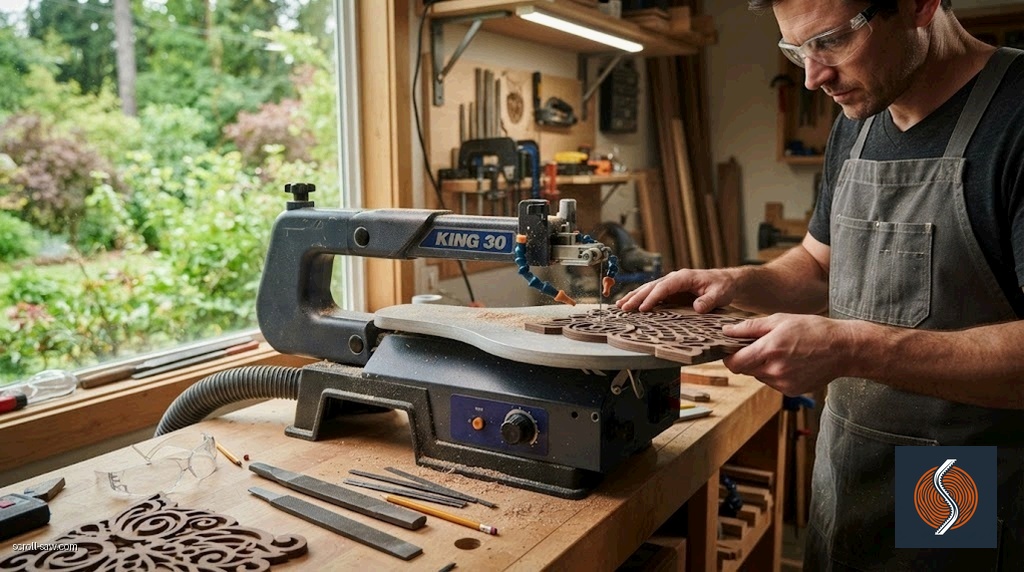
King 30 Scroll Saw: Fit, Setup, and Workflow Guide
The first thing that surprises people who move from a 16-inch scroll saw to a King 30 is how much wood they can suddenly bring to the blade. Thirty inches of throat depth isn’t a small upgrade over the 16-inch class, it’s a different category of work. What was previously impossible (a full-size sign in one setup, a large intarsia layout without piecing) becomes routine. What was previously routine (small hobby cuts) doesn’t change much at all.
That’s the honest fit question for the King 30. Not “is it a good scroll saw,” but “is the work you actually cut big enough to need the throat.”
What the King 30 actually is
King Canada’s larger-throat scroll saws, sold in the 30-inch class over the years, are built for enthusiasts and semi-professional users who regularly work with larger stock. The design pattern is familiar: a C-arm or parallel-arm frame, cast iron or aluminum table, variable-speed motor, and plain-end blade clamps on most versions.
What sets the 30-inch class apart from the 16-inch class isn’t the cutting mechanism, it’s the throat depth. You can rotate a 60-inch-diameter workpiece under the blade without the arm getting in the way, which opens up work that a smaller saw simply cannot do in one setup.
Where the King 30 fits in a workflow
Think of the throat depth as defining the maximum piece the saw can accept, not as improving the quality of small cuts. A King 30 doesn’t cut a 6-inch ornament any better than a 16-inch saw does. It just also cuts things the 16-inch saw can’t touch.
Primary role: large-piece specialist. Signs over 30 inches wide, full-panel intarsia, large clock faces, mantel-scale silhouettes, and one-piece nativity scenes all live comfortably on a 30-inch scroll saw.
Secondary role: main scroll station. For a shop with the space to give the saw a permanent home, a 30-inch scroll saw can serve as the everyday machine. There’s no penalty for cutting small pieces on a large saw. The only cost is bench footprint.
Where it doesn’t earn its keep:
-
A shop that never cuts anything wider than 15 inches doesn’t need the throat depth, and the money is better spent on a heavier 16-inch saw with more refinement.
-
Portable use is off the table. The King 30 is a shop fixture, not a saw you carry to a job site.
-
Extreme precision fretwork on tiny pieces is not what the throat depth buys you. A dedicated high-end small scroll saw does that job better.
Setup and mounting
A 30-inch scroll saw is heavy enough to sit still, but it isn’t heavy enough to be immune to vibration transfer.
Location matters more than mass. Put it on a solid, level bench or a purpose-built stand. Leave enough clearance behind the saw to bring long stock through the throat if a workpiece extends past the front.
Bolt it down and use isolation pads. Rubber or dense foam pads under the feet cut noise noticeably and reduce vibration transfer into the bench.
Check the table for square to the blade. With the table at zero degrees, an engineer’s square against the blade at three points along the stroke should read identically. If not, the blade is bent or the arm has developed play.
Verify the tilt lock. Set to 45 degrees, tighten, push firmly. If the table moves, the lock needs attention before you rely on bevel cuts.
Blade selection for larger work
Blade choice matters more on larger pieces because a wrong blade costs more per cut. A blade that dulls halfway through a 24-inch curve leaves you with a decision no one wants to make: change blades mid-cut and risk a visible transition, or push through and lose finish quality.
For large-piece work, a working kit covers three sizes.
-
Everyday large-piece cutting: Reverse-tooth #7 or #9 for 3/4 to 1-1/2 inch stock. Olson’s reverse-tooth assortment is a fair place to start.
-
Detail work on larger pieces: Skip-tooth #5 or #7 for cleaner detail while still cutting fast enough to finish long lines without a blade change. Pegas skip-tooth blades hold up well over long cuts.
-
Cuts that change direction: Spirals for lettering and irregular silhouettes where turning a large workpiece isn’t practical. Olson SP46500 spirals work in any plain-end scroll saw.
For sustained large-piece work, buy blades in bulk. A large sign that eats three blades during production is normal, and running out mid-project is a scheduling problem more than a technique one.
Working with large stock
Handling large panels on a scroll saw is a different skill from cutting small pieces.
Support the outboard end. A piece hanging off the back of the table wants to lift and pull the blade off the line. Set up an auxiliary support at exact table height, or clamp a temporary support stand behind the saw.
Plan cuts before starting. On a large workpiece, the sequence of cuts affects whether the remaining material stays supported or falls away and drags the blade. Sketch or mentally rehearse the sequence before turning the saw on.
Use starter holes for interior cuts. On a 30-inch panel, threading the blade through a drilled starter hole for interior work is standard practice. A 1/8-inch pilot hole in the waste area of each interior cut is enough.
Rotate rather than push sideways. Steering a large workpiece by lateral pressure on the blade is doubly bad because the leverage from a large panel bends the blade more easily than a small piece would. Turn the piece around the blade, keeping the blade cutting straight ahead into the material at all times.
Manage sightlines. Bright, direct light on the cut line matters more on large pieces because you’ll be tracking a line over long distances. The saw’s own work light is usually enough, but a supplementary lamp helps on dark stock.
Common issues and their real causes
Vibration builds up at higher speeds. A large scroll saw’s mass usually damps vibration, but a stretched belt, loose motor mount, or unbolted base can all bring it back. Check belt tension first.
Cut wanders on long curves. Blade is dull, blade tension has drifted, or you’re side-loading with lateral pressure over the length of the cut. Change the blade and check tension first.
Motor bogs down on thick hardwood. Feed slower or switch to a coarser blade. Even a large scroll saw has motor limits, and a #9 skip-tooth blade cuts hardwood faster with less strain than a finer blade run harder.
Table drifts out of square. Older large scroll saws sometimes develop play in the tilt trunnion. Verify square before each serious session.
Where the King 30 shines and where to hand off
The King 30 shines when the work is wide, when interior cuts on large panels are routine, and when a permanent shop position gives it the bench space to be always available. Full-size signs, panel intarsia, mantel-scale ornament work, and any project where the piece won’t fit under a smaller throat all sit comfortably in its zone.
Hand off to another tool when the work is small and you value refinement over throat depth (a heavier 16-inch saw with premium blade holders may cut more smoothly), when you need production speed on repetitive small parts (a CNC router is faster once programmed), or when the cut is long and straight (a table saw or band saw beats any scroll saw for that job).
The verdict
A King 30 is a specialist tool that earns its bench space when the work justifies it. If you regularly cut pieces too big for a 16-inch throat, it’s the right saw. If your work fits inside 16 inches most of the time, put your budget into a better 16-inch saw and premium blades instead. Throat depth doesn’t improve small cuts, so the value proposition is entirely about the size of what you bring to the blade.
FAQ
What size blades does a King 30 scroll saw use? Standard 5-inch plain-end scroll saw blades on most models. Check the blade holder to confirm.
What is the maximum cutting thickness? Depends on the specific model, but generally around 2 inches in soft wood. Comfortable everyday range is 1/4 to 1-1/2 inch.
Is a 30-inch scroll saw overkill for hobby work? Only if your work fits within a smaller throat. For anyone regularly cutting pieces over 16 inches wide, it’s the right size.
Can I use a King 30 for detailed fretwork? Yes, with fine blades and slow speeds. The larger throat doesn’t hurt detail work; it just costs bench space.
How much space does it need? More than a 16-inch saw. Plan for the machine footprint plus clearance behind the saw for stock that extends past the throat.
Where do I find replacement parts? King Canada’s support network, independent power tool repair shops, and forums where owners occasionally sell spares. Consumables (blades, belts) are universal.
Is the King 30 as smooth as premium scroll saws? Not quite. Premium saws with parallel-arm or parallel-link designs run smoother, but the King 30 is a capable mid-tier machine when tuned.
What’s the biggest workflow change from a 16-inch to a 30-inch saw? Being able to complete large pieces in one setup instead of piecing them together. The cutting technique itself doesn’t change much.
References
-
King Canada product documentation and support resources.
-
Olson Saw Company technical data on blade selection for varied stock thickness.
-
Scroll Saw Association of the World, guidance on working with large stock.
-
Fine Woodworking magazine archive, articles on scroll saw workflow and workshop layout.
Title tag: King 30 Scroll Saw: Fit, Setup, and Workflow Guide Meta description: Where a King 30 scroll saw fits in a workflow, how to set it up for large-piece work, and the blades and technique for cutting big panels cleanly. URL slug: king-30-scroll-saw Excerpt: A King 30 scroll saw earns its bench space when the work is bigger than a 16-inch throat can handle. Here’s how it fits into a real workflow, and the setup and blade choices that make it worth the space.


