
McCulloch 16 Scroll Saw: Applications and Honest Limits
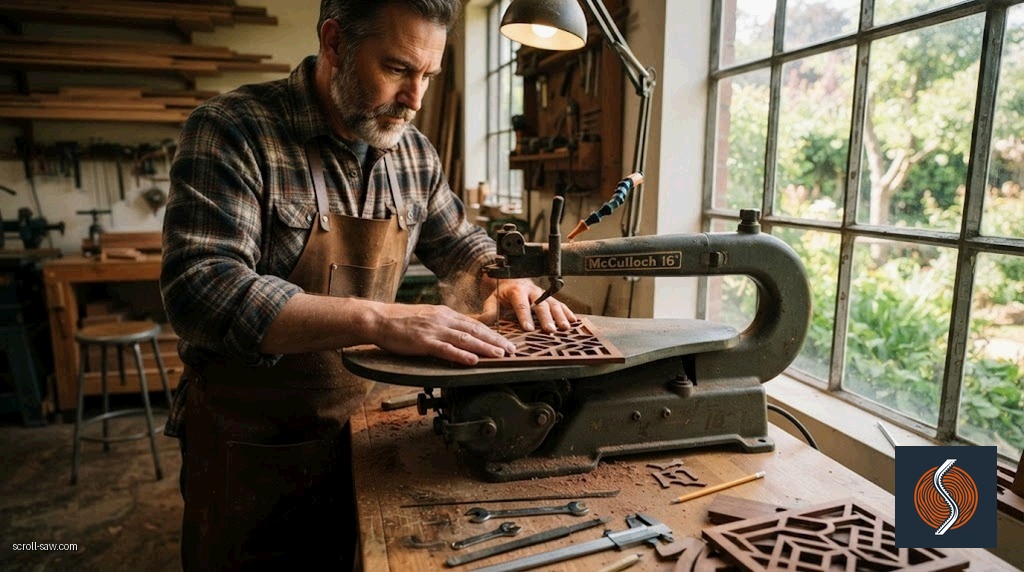
McCulloch 16 Scroll Saw: Applications and Honest Limits
McCulloch is a name most woodworkers associate with chainsaws, not scroll saws. That’s not a mistake. The company built its reputation on outdoor power equipment, and the woodworking machinery it sold under the McCulloch name was always a smaller side of the business. The McCulloch 16 scroll saw is a product of that side, and today it lives on almost entirely in second-hand listings and older shop corners.
If you’ve come across one and are wondering whether it’s worth putting to work, this is a straight look at what it can actually do, where it fits, and where it doesn’t.
What the McCulloch 16 actually is
The McCulloch 16 is a 16-inch throat, C-arm scroll saw built to hobby-class specifications during the years McCulloch was in the woodworking machinery market. Design pattern is familiar for its era:
-
Cast aluminum or cast iron table with tilt from 0 to 45 degrees.
-
Modest single-speed or variable-speed motor depending on the version.
-
Pin-end blade clamps on most versions, plain-end on some later models.
-
A stamped steel base, hold-down foot, and dust blower tube.
Build quality was reasonable for the price point when new. Not premium, not painful, right in the middle of what the hobby scroll saw market looked like.
Useful applications
Where the McCulloch 16 earns its keep today:
Puzzle blanks and hobby cutouts. Any 1/4 to 3/4-inch plywood or solid wood pattern sits comfortably in the machine’s zone. Ornaments, small signs, seasonal decorations, craft parts.
Simple silhouettes and clock faces. With a decent blade and steady technique, the McCulloch 16 produces clean silhouettes in soft wood at reasonable speed.
Non-fine fretwork. Larger interior cuts with generous bridges (1/8 inch or wider) work well. Anything requiring the smoothest possible stroke for hair-thin bridges is at the edge of what this saw does comfortably.
Occasional bevel cuts. The tilt table handles bevel cuts up to 45 degrees for small boxes and simple inlays.
Cutting soft plastics and foam. With the appropriate blade, the McCulloch 16 cuts foam board, cork, and soft plastic sheet cleanly for craft applications.
Where it isn’t useful
Being honest about the limits saves everyone time.
Fine fretwork with hair-thin bridges. The stroke smoothness and blade clamp precision of the McCulloch 16 aren’t in the class where 1/32-inch bridges survive cutting.
Production runs. The blade change process (especially on pin-end versions) and modest motor make sustained daily production a chore.
Thick hardwood. Anything over an inch of oak or maple starts to slow the motor noticeably. Not impossible, but you’ll be feeding slowly and hard on blades.
Precision work where blade drift matters. Older McCulloch 16s often have some play in the arm pivot or blade clamps, which shows up as small wander on long cuts.
Blade options
Blade choice matters more than the machine itself for the outcome quality.
Pin-end blade versions take standard 5-inch pin-end blades. A general pin-end assortment in mixed TPI covers everyday needs. The Skil 18-piece blade set includes both pin and plain versions and is useful if you own more than one machine.
Plain-end blade versions take standard 5-inch plain-end blades. A working kit:
-
Reverse-tooth #5 or #7 for general woodwork: Olson’s reverse-tooth assortment.
-
Skip-tooth #1 or #3 for finer detail: Pegas skip-tooth blades.
-
Spirals for cuts that change direction: Olson SP46500 spirals.
If you have a pin-end McCulloch 16 and want to run modern plain-end blades, aftermarket pinless blade adapters (small clips that fit in the existing pin holders) are the most useful single upgrade you can make.
Setup checks before first use
An unfamiliar older scroll saw always deserves a walk-through before the first cut.
Bolt it to a solid bench or stand. Rubber pads under the feet drop noise noticeably.
Square the table to the blade. Set to zero degrees, use an engineer’s square against the blade at three points along the stroke. If any reading differs, the blade is bent or the arm has developed play.
Inspect blade holder condition. The clamping surfaces should be flat and unscored. Gouged or worn holders let the blade rock and every cut wanders.
Verify the tilt lock. Set to 45 degrees, tighten, push firmly at each corner. If it moves, the lock is worn.
Check the tension mechanism through its full range for smooth operation. Grit or wear in the linkage produces inconsistent tension and premature blade breakage.
Aim the dust blower at the cut line, upstream of the direction of travel.
Realistic verdict
The McCulloch 16 is a serviceable older hobby scroll saw. Not a favourite, not a doorstop. In good mechanical condition and paired with quality blades, it produces work suited to casual and moderate use. Beyond that, it’s a saw whose class limits are honest and worth respecting.
Who should keep one:
-
Occasional users who already own the saw and want to make it work.
-
Hobbyists on a tight budget who found one cheap and can accept the class.
-
Anyone using it as a dedicated second saw for coarse work while a better machine handles detail.
Who should move on:
-
Anyone whose primary work is fine fretwork or precision detail.
-
Anyone hitting the machine’s limits on a regular basis.
-
Anyone finding parts problems or arm pivot play. Repair costs generally exceed the machine’s value at that point.
Common problems and their causes
Blade snaps often. Over-tensioning, side-loading during cutting, or wrong blade for the material.
Cuts wander off the line. Bent blade, dull blade, uneven blade holder grip, or lateral steering pressure.
Loud vibration at speed. Loose motor mount, loose base bolts, stretched belt.
Motor bogs down in hardwood. Feed slower or switch to a coarser blade. A #7 skip-tooth cuts hardwood faster with less strain than a fine blade run hard.
Wood lifts on the upstroke. Hold-down foot too high, over-tensioned blade, or a coarse pin-end blade at high speed.
Parts and support
McCulloch’s scroll saw line is long discontinued. Practical part sources:
-
eBay listings for non-running McCulloch 16 saws sold as parts machines.
-
Woodworking forums where owners occasionally sell spares.
-
Consumables (blades, belts, bearings, dust blower tubing) are universal and available from any competent supplier.
Model-specific parts (blade holders, speed controller, motor) are difficult to source. Factor that into any purchase decision.
FAQ
Is the McCulloch 16 scroll saw still made? No. It’s been discontinued for years and is only available on the used market.
What blade does it use? Depends on the specific version. Pin-end versions take 5-inch pin-end blades. Plain-end versions take 5-inch plain-end blades. Check the blade holder to identify.
How thick can it cut? Roughly 2 inches in soft wood at 90 degrees. Comfortable everyday range is 1/8 to 3/4 inch.
Where do I find a manual? Aggregator sites, machinery archive communities, and occasionally through McCulloch’s parent company support resources. A general scroll saw manual covers the operational fundamentals.
Is it worth buying used? Only at a low price, and only if the arm has no lateral play and the blade clamps are unmarked. Modern equivalents outperform it, so the price needs to reflect the age.
Can I convert a pin-end McCulloch to plain-end blades? Aftermarket pinless blade adapters exist for many pin-end scroll saws. Check compatibility with your specific model before ordering.
What’s the biggest limitation? Blade change convenience and stroke smoothness both lag behind modern equivalents. If those matter to you, look elsewhere.
Is it useful for beginner learning? Works for that role if the price is right and the machine is mechanically sound. A modern entry-level saw with tool-free blade change is easier to learn on.
References
-
Olson Saw Company blade selection and technical resources.
-
Scroll Saw Association of the World, operating and safety guidance.
-
Fine Woodworking magazine archive, scroll saw setup and blade selection articles.
-
General industrial supplier resources for belts, bearings, and consumables.
Title tag: McCulloch 16 Scroll Saw: Applications and Honest Limits Meta description: Where the McCulloch 16 scroll saw is genuinely useful, where it falls short, and what to check before buying, restoring, or keeping one. URL slug: mcculloch-16-scroll-saw Excerpt: The McCulloch 16 scroll saw is a discontinued hobby-class machine that still shows up on the used market. Here’s what it can genuinely do, where its limits are real, and how to decide whether it earns bench space today.


