
MS 18 Scroll Saw: What to Check Before First Use
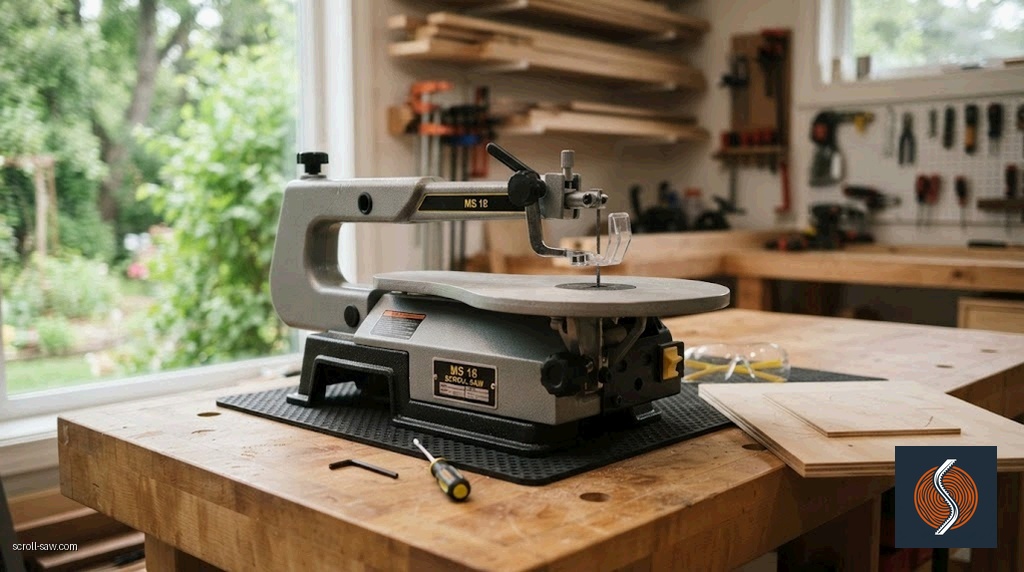
MS 18 Scroll Saw: What to Check Before First Use
The “MS 18” designation shows up on scroll saws from a few different manufacturers, most commonly on hobby machines with an 18-inch throat depth. Dremel’s MS20 is a related but different model. Ryobi and other brands have used similar naming conventions over the years. The first job when you sit down in front of one is to identify exactly which MS 18 you actually have, because the setup differs in small but important ways between them.
Here is a working guide for anyone about to make first cuts on an MS 18 class scroll saw.
Identify the exact machine
Before anything else, read the ID plate. Look for:
-
The full model designation, including any suffix or type number.
-
The manufacturer name.
-
Voltage and frequency rating.
-
Serial number.
Write these down. Different MS 18 models take different blade types (some plain-end, some pin-end) and use different blade change procedures.
What an 18-inch scroll saw actually is
The 18-inch throat class sits above entry-level 16-inch saws and below professional 21 to 30-inch machines. Practically, that means:
-
Slightly deeper throat capacity, useful for pieces up to about 36 inches in diameter.
-
Usually similar motor and stroke specifications to 16-inch class machines.
-
Similar blade requirements. Standard 5-inch blades still fit the vast majority.
-
Comparable cutting thickness capacity, typically 2 inches in soft wood at 90 degrees.
The upgrade from a 16-inch to an 18-inch saw is modest for most work. If your work fits in a 16-inch throat, the 18-inch class doesn’t buy you much. If your work occasionally spills over, the extra 2 inches matters.
Setup checks before your first cut
With the saw unplugged, work through this order.
Mount the saw solidly. Bolt it to a heavy bench or dedicated stand. Rubber pads under the feet reduce noise and vibration transfer.
Level the table to the blade. Set the table to zero degrees, use a small engineer’s square against the blade at three points along the stroke. All three readings should be identical. Adjust the underside stop screw if the tilt scale doesn’t match true square.
Inspect blade holder condition. The clamping surfaces should be flat and unscored. Worn holders let the blade rock at each end of the stroke, and every cut wanders.
Verify the tilt lock. Set the table to 45 degrees, tighten the lock, push firmly at each corner. If it moves, the lock or the trunnion needs attention.
Test the tension mechanism through its full range for smooth operation. Grit or wear inside the linkage produces inconsistent blade tension.
Check speed control (for variable-speed versions). Run the motor through the full speed range with no blade under tension. Smooth ramp up and down without electrical whine confirms the controller is healthy.
Adjust the hold-down foot. Rest it lightly on the workpiece surface, close to but not touching the blade.
Aim the dust blower. Point the small flexible tube at the cut line, upstream of the direction of travel.
Blade choice
For plain-end MS 18 versions, a working kit covers three sizes.
-
Reverse-tooth #5 or #7 for general 1/4 to 3/4-inch wood work: Olson’s reverse-tooth assortment.
-
Skip-tooth #1 or #3 for finer detail: Pegas skip-tooth blades.
-
Spirals for cuts that need to change direction without turning the workpiece: Olson SP46500 spirals.
For pin-end MS 18 versions, a pin-end blade assortment covers the everyday TPI range. If you want to use plain-end blades in a pin-end machine, aftermarket adapters exist for many models.
Buy blades in packs of at least a dozen. A single blade during moderate use lasts thirty minutes to a few hours depending on material, and running out mid-session is worse than the small extra cost of buying ahead.
Tensioning correctly
Blade tension is set by feel and sound, not by the position of the tension mechanism.
With the blade installed, pluck it with a fingernail near the middle of its length. The right tension produces a clear, ringing musical note. A dull thud means it’s too loose. A pitch that keeps climbing without settling means you’re overtightening and heading for a snap.
Over-tensioning is the single most common cause of premature blade failure on any scroll saw, and it doesn’t get better with practice unless you check by feel each time.
Fit: does an 18-inch saw match your work
Good fit:
-
Signs and silhouettes in pieces up to about 30 inches wide.
-
Puzzle blanks, clock faces, hobby cutouts.
-
Simple to moderate fretwork.
-
Bevel cuts up to 45 degrees for boxes and inlays.
-
Cutting foam, cork, thin plastic, and non-ferrous metals up to about 1/16 inch with the right blade.
Not a great fit:
-
Production runs where blade changes multiply into wasted time.
-
Very thick hardwood beyond about an inch, where motor and stroke become the bottleneck.
-
Extremely fine detail requiring premium-class stroke smoothness.
-
Pieces larger than about 30 inches in any direction (upgrade to a 21 or 30-inch class saw).
Technique that pairs well with an 18-inch saw
Feed steadily. Firm, consistent pressure, fingers close to (never under) the blade. If the blade bends backward under feed pressure, you’re pushing too hard or the blade is too fine for the material.
Turn the workpiece around the blade. Never steer with lateral pressure. Twisting the wood sideways bends the blade and produces angled cuts.
Match speed to the cut. Long rough cuts at higher speed. Tight corners and delicate bridges at slower speeds.
Use starter holes for interior cuts. A small pilot hole in the waste area lets you thread a plain-end blade through and cut interior shapes cleanly.
Support long stock. A piece hanging off the back of the table wants to lift. An auxiliary support at exact table height solves it.
Common problems and their causes
Blade snaps often. Over-tensioning first, side-loading second, wrong blade for the material third.
Cut wanders on the line. Bent blade, dull blade, uneven blade holder grip, or lateral steering pressure.
Vibration builds up at higher speeds. Loose motor mount, loose base bolts, stretched belt.
Motor bogs down in hardwood. Feed slower or switch to a coarser blade.
Workpiece lifts on the upstroke. Hold-down foot set too high, over-tensioned blade, or a coarse pin-end blade at higher speed.
The verdict
An 18-inch class scroll saw is a modest upgrade over the 16-inch category, useful mostly if your work occasionally exceeds 16 inches in width. The setup checks and blade choices matter more than the specific brand printed on the machine, because the class defines what you can expect. Tune it well, feed it quality blades, and it earns its bench space for hobby to moderate use.
If your work regularly exceeds the 18-inch throat, look at 21 or 30-inch class machines. If your work fits inside 16 inches most of the time, an 18-inch saw doesn’t buy you much beyond a slightly larger footprint.
FAQ
What does MS 18 mean? A model designation used by a few different manufacturers for 18-inch throat scroll saws. Verify the specific brand and model on your machine’s ID plate.
What blade does an MS 18 use? Depends on the specific model. Plain-end versions take standard 5-inch plain-end blades. Pin-end versions take standard 5-inch pin-end blades.
How thick can it cut? Roughly 2 inches in soft wood at 90 degrees, similar to 16-inch class saws.
Is an 18-inch saw much better than a 16-inch? Only if your work regularly exceeds 16 inches in width. Otherwise, the class advantage is small.
Where do I find a manual? With the specific manufacturer’s support site. Aggregator sites and forums are the usual fallbacks. A general scroll saw manual covers the operational fundamentals.
Can I convert a pin-end MS 18 to plain-end blades? Aftermarket adapters exist for many pin-end saws. Check compatibility with your specific model.
Why does my blade break so quickly? Over-tensioning is the most common cause. Check tension by feel: the blade should ring a clear note when plucked, not thud dully or strain to a high pitch.
Is an MS 18 worth buying used? At a fair price, if the arm has no lateral play and the blade clamps are unmarked. Modern equivalents are readily available if the used price is too high for the condition.
References
-
Olson Saw Company blade selection and tensioning technical resources.
-
Scroll Saw Association of the World, operating and safety guidance.
-
Fine Woodworking magazine archive, scroll saw setup and blade selection articles.
-
General industrial supplier resources for consumables and replacement parts.
Title tag: MS 18 Scroll Saw: What to Check Before First Use Meta description: The setup checks, blade choices, and technique habits for getting clean, controlled cuts from an MS 18 class scroll saw before you plug it in. URL slug: ms-18-scroll-saw Excerpt: An MS 18 class scroll saw is a capable mid-size hobby machine when tuned right. Here’s what to check before your first cut, which blades match the work, and the technique that keeps the blade in the line.


