
Powermatic 95 Scroll Saw: Setup Guide Before First Use
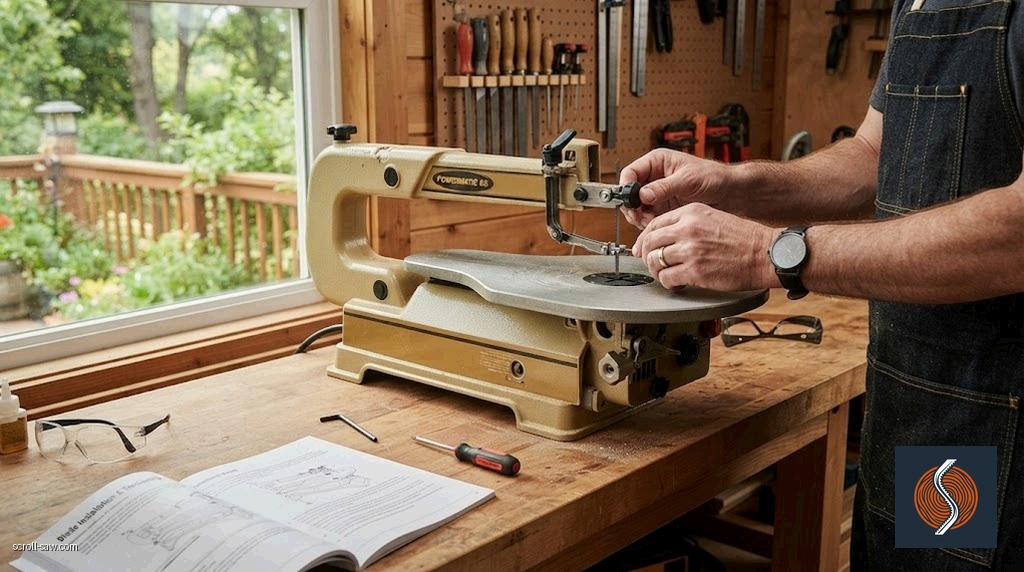
Powermatic 95 Scroll Saw: Setup Guide Before First Use
The Powermatic 95 is a name that carries weight in scroll saw circles. Built during Powermatic’s cast-iron era, the Model 95 was designed as a serious working scroll saw with the mass and rigidity to match its build. Many are still cutting after decades of use, and a good one turns up on the used market often enough to be worth understanding before you plug one in.
Here is what to know before making the first cut on a Powermatic 95.
What the Powermatic 95 actually is
The Powermatic Model 95 is a heavy-duty cast iron scroll saw historically produced during Powermatic’s classic industrial woodworking era. Typical specifications on the surviving machines:
-
Cast iron frame and table, substantial weight.
-
Parallel-arm or heavy C-arm design (depending on generation).
-
Induction motor, usually with a belt drive.
-
24-inch throat depth on the classic Model 95, offering serious clearance for wide workpieces.
-
Plain-end blade holders on most versions.
-
Cast iron table with substantial mass and a machined bevel scale.
The defining feature of a Powermatic 95 is mass. These machines were built to sit permanently on a factory floor and cut for hours. The vibration dampening from that mass, combined with a well-fitted arm mechanism, gives them a smoother stroke than almost anything in the hobby class.
Fit: does the Powermatic 95 belong in your shop
Yes, if:
-
You cut regularly and value stroke smoothness over convenience.
-
You have the bench space for a heavy fixed-position machine.
-
You cut pieces wider than a 16-inch throat can handle.
-
You want a tool that will still be running in 20 years.
-
You already know how to tension a scroll saw blade by feel.
Not really, if:
-
You cut casually a few evenings a month.
-
Bench space is limited.
-
You need portability.
-
Tool-free blade change is a must-have (the Model 95 uses conventional blade clamps).
-
Your work fits easily inside a 16-inch throat.
Setup checks before the first cut
With the saw unplugged, work through this in order.
Verify the machine is level. A Powermatic 95 will sit still on almost any surface, but any rock in the base transmits into the cut. Shim under the feet until it’s rock-solid.
Confirm the mount. These saws are heavy enough not to need bolting, but bolting is still worth doing for vibration isolation and safety. Use rubber pads if noise transfer through the floor is an issue.
Square the table to the blade. Set the table to zero degrees on the bevel scale, then use a small engineer’s square against the blade at three points along the stroke. All three readings should be identical. If not, either the blade is bent or the upper arm has pivot wear.
Check the tilt lock. Set to 45 degrees, tighten, push firmly at each corner. If it moves, the trunnion or the lock needs attention.
Inspect the blade holders. Clamping surfaces should be flat and unmarked. A Powermatic 95 with worn clamps is a common failure and shows up as inconsistent cuts and premature blade breakage.
Check the drive belt. Older Powermatic 95s use standard V-belts that stretch over decades of use. A slack belt slaps at higher speeds. Belt tension should give roughly 1/4 inch of deflection under moderate finger pressure at the midpoint.
Test the motor bearings. Run the saw for a minute with no blade under tension. Listen for smooth rotation without rumble or grinding.
Blade selection
The Model 95 takes standard 5-inch plain-end scroll saw blades. The heavier stroke rewards better blades noticeably.
A working kit for a Powermatic 95:
-
Reverse-tooth #5, #7, or #9 for general 1/4 to 1-1/2-inch stock: Olson’s reverse-tooth assortment.
-
Skip-tooth #1 or #3 for finer detail: Pegas skip-tooth blades.
-
Flying Dutchman ultra-reverse blades for the cleanest bottom-side finish: Flying Dutchman variety pack.
-
Spirals for cuts that need to change direction: Olson SP46500 spirals.
For sustained use, buy blades in bulk. A working Powermatic 95 can easily consume a dozen blades a month depending on materials and work volume.
Tensioning correctly
The Model 95’s blade tension is set the same way as any scroll saw: by feel and sound. Pluck the tensioned blade with a fingernail near the middle of its length. A clear ringing musical note means correct tension. A dull thud means too loose. A rising pitch that won’t settle means overtight, and the blade will snap on the first serious cut.
The smoother stroke of a Powermatic 95 makes correct tension more noticeable than on a rougher machine. Cuts on a properly tensioned blade are visibly cleaner, and blade life extends significantly.
Technique that matches the machine
Feed pressure. Firm and steady, matched to the material. The Powermatic 95 can handle real feed pressure without bogging down, but pushing beyond what the blade wants still bends it and shortens its life.
Turn the workpiece around the blade. Never steer with lateral pressure. Even a premium scroll saw suffers from side-loading.
Match speed to the cut. Use variable speed deliberately. Long straight or gentle-curve runs faster, tight corners and detail slower.
Use starter holes for interior cuts. A small pilot in the waste area lets you thread a plain-end blade through cleanly.
Support long stock. An auxiliary support at exact table height prevents lift on overhanging pieces.
Common issues on older Powermatic 95s
Arm pivot play. Decades of use can develop small amounts of lateral movement at the upper arm pivot. Some play is acceptable; significant play means expensive repair or replacement.
Worn blade holders. The clamp surfaces develop small gouges over time. Replacement holders are increasingly hard to source for older Model 95s.
Motor bearings. Standard sealed bearings identified by ISO number are available from any bearing supplier.
Drive belt stretch. Standard V-belt replacements are readily available.
Table trunnion wear. The tilt mechanism can develop play. Cleaning and shimming often fixes it; sometimes replacement is required.
The verdict
A Powermatic 95 in good mechanical condition is a lifetime scroll saw. The build quality is in a different class from hobby machines, the stroke is smoother than almost anything currently made in the same price range used, and consumables are universal. If the machine you’re evaluating passes the setup checks, it’s worth serious consideration.
A rough Powermatic 95 with arm play, worn blade holders, or a cracked casting is generally not worth restoring. The parts hunt is real and the modern alternatives are competitive on features even if they can’t match the mass.
FAQ
What blade does a Powermatic 95 use? Standard 5-inch plain-end scroll saw blades. Any current-production quality blade fits.
How thick can it cut? Roughly 2 inches in soft wood at 90 degrees. Comfortable working range is 1/8 to 1-1/2 inch.
What is the throat depth of a Powermatic 95? Approximately 24 inches on the classic Model 95, offering serious clearance for wide workpieces.
Is the Powermatic 95 still made? The classic Model 95 has been out of production for many years. Powermatic’s current scroll saw lineup has shifted to different models.
Where do I find replacement parts? Powermatic’s current parts network handles some legacy items. Independent industrial tool repair shops and forums are useful for older-specific parts.
Is a Powermatic 95 worth buying used? In good mechanical condition, yes, especially compared to modern equivalents at similar prices. Rough machines with pivot play or clamp damage are generally not worth restoring.
How much does it weigh? Substantial. Well over 100 pounds depending on the specific generation. Plan for two-person moving.
Why does my blade break so quickly? Over-tensioning first, side-loading during cutting second, wrong blade for the material third. On a Powermatic, the smoother stroke makes correct tension more critical than on a rougher machine.
References
-
Powermatic (JPW Industries) product documentation and support resources.
-
Olson Saw Company blade selection and technical resources.
-
Pegas blade sizing and application guides.
-
Scroll Saw Association of the World, operating and setup guidance.
Title tag: Powermatic 95 Scroll Saw: Setup Guide Before First Use Meta description: The setup checks, blade selection, and technique habits to get the most out of a Powermatic 95 scroll saw before your first cut. URL slug: powermatic-95-scroll-saw Excerpt: The Powermatic 95 is a heavy-duty cast iron scroll saw built to last. Here’s what to check before your first cut, which blades match its class, and the technique that gets the smoothest cuts from a serious machine.


