
Powermatic Model 95 Scroll Saw: Workflow Fit Guide
Powermatic Model 95 Scroll Saw: Workflow Fit Guide
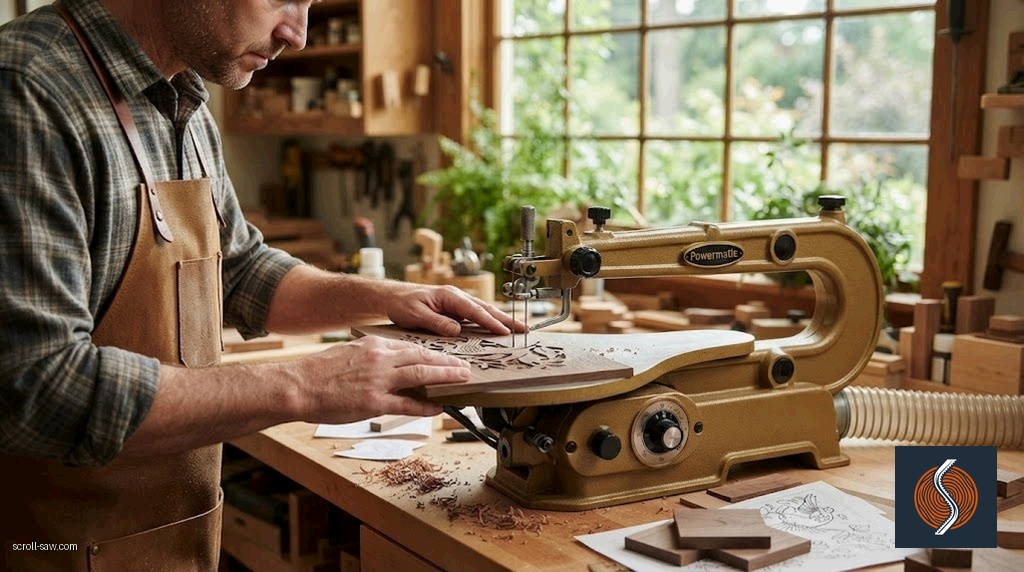
Ask five long-time woodworkers about the Powermatic Model 95 and you’ll get five different opinions, but they all agree on one thing: the mass is what matters. A Powermatic 95 sits on a bench like a piece of shop furniture, and once it’s tuned, the difference between it and a hobby-class saw is immediate. The cuts are cleaner. The blade lasts longer. You don’t have to fight the machine to hold a line.
That doesn’t mean the Model 95 fits every workflow. Where it earns its keep, and where a smaller saw would serve better, is worth knowing before you commit the bench space.
What the Powermatic Model 95 actually is
The Powermatic Model 95 is a classic cast-iron scroll saw with a 24-inch throat, produced during Powermatic’s stationary-machinery era. Key features:
-
Cast iron frame and table.
-
Parallel-arm or heavy C-arm design depending on generation.
-
Induction motor, belt-driven, with variable speed on many versions.
-
Plain-end blade clamps with substantial construction.
-
Generous throat depth (24 inches) for wide workpieces.
-
Substantial weight that damps vibration effectively.
Build quality is in a different class from hobby scroll saws. This isn’t a machine that walks across the bench under vibration or shakes free from its adjustments during a long session.
Where the Model 95 fits in a real workflow
The Model 95’s role in a shop depends on what other tools are present and what work goes through the shop.
As the main scroll station. For a shop where scroll work is a regular activity (detailed cutting, fretwork, intarsia, marquetry), the Model 95 makes an excellent primary machine. The stroke smoothness pays off on every cut, and the throat depth handles most workpieces without concern.
As the large-piece specialist. In a shop that already has a smaller scroll saw for quick jobs, the Model 95 takes on the large-piece and detailed work where the extra throat depth and heavier stroke matter.
As a permanent fixture. The Model 95’s weight makes it a poor candidate for a shop that rearranges layouts often. It belongs in a dedicated spot with electricity, light, and adequate ventilation for dust management.
Not the right fit for:
-
A shop with limited bench space or one that shares space with other activities.
-
Casual users who cut a few evenings a month. The extra capability is wasted.
-
Workflows dominated by rough shape removal (band saw is faster).
-
Portable applications or job-site use.
Advantages the Model 95 brings to the workflow
Stroke smoothness. The mass and the well-fitted arm mechanism produce a stroke that lets fine blades cut without wandering. This shows up most on long curves and delicate bridges.
Blade life. A blade that’s tensioned correctly and fed steadily lasts noticeably longer on a Model 95 than on a lighter machine, because the smoother stroke stops abusing the blade at each end of its travel.
Throat depth. Twenty-four inches accommodates full-size clock faces, larger silhouettes, and mantel-scale ornaments without the workpiece running into the arm.
Repeatability. Once the tilt is set and the blade tension is confirmed, the machine holds those adjustments over long sessions without drift.
Motor endurance. The induction motor is built for sustained duty. Multi-hour cutting sessions don’t stress it the way they would a smaller universal motor.
Trade-offs to know about
No tool-free blade change. Every plain-end blade change requires loosening tension, releasing the clamp, threading the blade, and re-tightening. On interior cuts, this multiplies. Modern hobby saws have set a new expectation for blade change convenience that the Model 95 doesn’t meet.
Weight and space. Not a machine you move without help. Plan for a permanent installation with adequate space around the throat.
Parts sourcing. Some model-specific parts (particular blade holder assemblies, older speed controllers) are difficult to source for the Model 95. Consumables and general wear items are universal and easy.
Noise. These older saws are audibly working when running. Not painful, but hearing protection for long sessions is a good habit.
Blade choice for the Model 95’s strengths
The smoother stroke rewards better blades. Cheap blades will cut, but the machine’s underlying quality is wasted.
A working kit:
-
Reverse-tooth #5, #7, or #9 for general woodwork: Olson’s reverse-tooth assortment.
-
Skip-tooth #1 or #3 for fine detail: Pegas skip-tooth blades.
-
Modified geometry blades for the finest work: Pegas modified geometry line.
-
Flying Dutchman ultra-reverse for clean underside finish: Flying Dutchman variety pack.
-
Spirals for cuts that change direction: Olson SP46500 spirals.
For a Model 95 in regular use, keep bulk blade stock. Running out mid-project is worse than the small extra cost of buying ahead.
Technique matched to the Model 95
Steady feed pressure. The Model 95 can handle real feed pressure. Push what the blade wants, no more.
Rotate the workpiece around the blade. Never steer by lateral pressure. Side-loading a fine blade snaps it.
Match speed to the cut. Use variable speed deliberately.
Use starter holes for interior cuts. A small pilot hole in the waste area lets you thread a plain-end blade cleanly.
Support long stock with an auxiliary support at exact table height for pieces that overhang.
Fitting it into a two-saw workflow
Many owners of a Powermatic 95 also own a lighter modern scroll saw. The workflow splits naturally:
-
The lighter saw for quick jobs, tool-free blade change convenience, and portability if needed.
-
The Model 95 for serious detail work, long sessions, large pieces, and jobs where blade life matters.
This is not overkill. Two scroll saws in one shop is a legitimate setup for anyone who cuts enough to justify it, because each machine is better at different work than a compromise single saw would be.
The verdict
A Powermatic Model 95 earns its bench space in a workflow that includes regular, detailed scroll work at meaningful volume. The stroke smoothness, blade life, and throat depth all pay off measurably in that context. It doesn’t earn its space in a casual or occasional-use workflow, where a lighter modern machine with tool-free blade change is a better daily match.
Select on the basis of your actual work volume and cut quality expectations, not on the appeal of a legacy brand name.
FAQ
What is the throat depth of a Powermatic Model 95? Approximately 24 inches, generous enough for most large workpieces.
What blade does the Model 95 use? Standard 5-inch plain-end scroll saw blades. Any current-production quality blade fits.
How thick can it cut? Roughly 2 inches in soft wood at 90 degrees. Comfortable working range is 1/8 to 1-1/2 inch.
Is the Powermatic Model 95 still made? The classic Model 95 has been out of production for many years. Powermatic’s current scroll saw lineup includes different models.
How much does it weigh? Substantial, well over 100 pounds depending on the specific generation. Plan for two-person moving.
Where do I find a manual? Powermatic’s support resources archive some legacy documentation. Machinery archive communities and vintage machinery forums are useful fallbacks.
Is it worth buying used? In good mechanical condition, yes. Rough machines with arm pivot play or blade clamp damage are generally not worth restoring.
What’s the biggest advantage over a modern hobby saw? Stroke smoothness and blade life. Both come from the mass and the well-fitted arm mechanism.
What’s the biggest disadvantage? No tool-free blade change, and some model-specific parts are difficult to source.
References
-
Powermatic (JPW Industries) product documentation and support resources.
-
Vintage Machinery archive, woodworking equipment documentation.
-
Olson Saw Company blade selection and technical resources.
-
Scroll Saw Association of the World, operating and workflow guidance.
Title tag: Powermatic Model 95 Scroll Saw: Workflow Fit Guide Meta description: Where a Powermatic Model 95 scroll saw fits in a workflow, what it does better than hobby machines, and the trade-offs to know. URL slug: powermatic-model-95-scroll-saw Excerpt: The Powermatic Model 95 is a heavy cast-iron scroll saw that earns its bench space when the work justifies it. Here’s how it fits into a real workflow and where a lighter saw would actually serve better.


