
Scroll Saw DS 115 E: Setup and Technique Guide
Scroll Saw DS 115 E: Setup and Technique Guide
The DS 115 E is a designation used on scroll saws sold under various European house brands, most commonly on compact hobby-class machines with variable-speed motors. The 115 usually refers to the throat depth in millimetres (which puts it in the compact 4.5-inch class, meaningfully smaller than a 16-inch), and the “E” typically indicates the electronic variable-speed version.
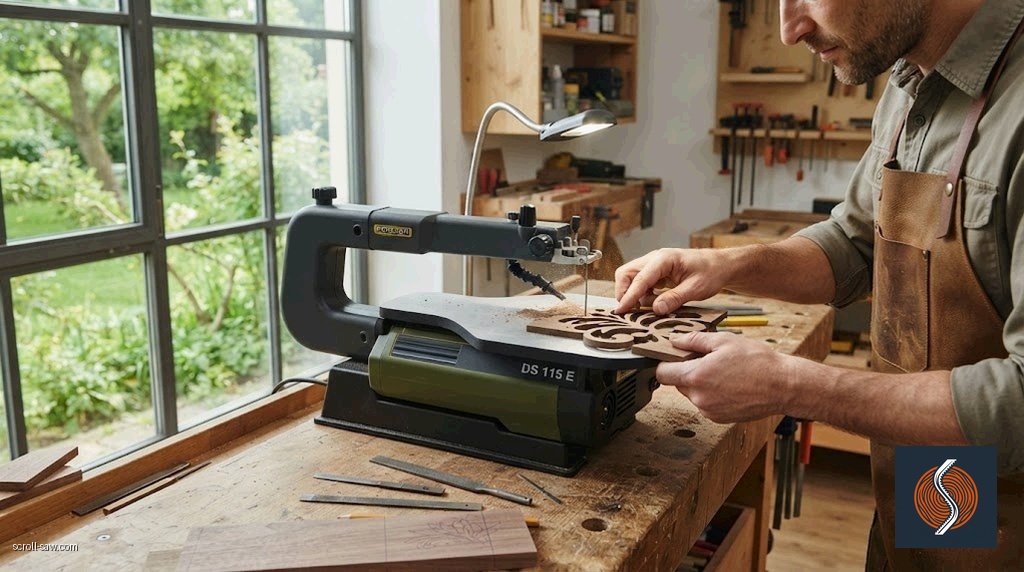
The DS 115 E is a compact tabletop scroll saw aimed at model-makers, jewelers, and hobbyists working with small pieces. Understanding what class it belongs to is the first step to getting useful results from one.
What the DS 115 E actually is
The DS 115 E is a compact benchtop scroll saw with:
-
Roughly 115 mm (about 4.5 inch) throat depth.
-
Small cast or die-cast base with modest weight.
-
Variable-speed universal motor, usually low wattage.
-
Pin-end blade clamps on most versions (some plain-end variants exist).
-
Table with tilt capability, typically up to 45 degrees.
-
Small hold-down foot and work light.
-
Designed for stock roughly up to 30 mm (about 1-1/4 inch) thick.
This is a compact machine, not a scaled-down version of a full-size scroll saw. Its design brief is small, delicate work on small pieces, and it excels within that narrow range.
Set the expectation before setting the machine
The DS 115 E is not a general-purpose scroll saw. It’s a specialist tool for small work. Applications where it shines:
-
Jewelry work in non-ferrous metal sheet.
-
Model railway detail parts.
-
Doll house furniture and fittings.
-
Small marquetry and inlay work.
-
Fine craft cutouts in thin material.
-
Educational settings where a small footprint matters.
Applications where it disappoints:
-
General woodworking in stock over 1 inch.
-
Any workpiece over 4 inches wide (the throat runs out).
-
Extended sessions of continuous cutting (the small motor runs hot).
-
Coarse work where a full-size saw would be faster and easier.
Set up with the right expectations, the DS 115 E is genuinely useful. Asked to be a full-size scroll saw, it’s a frustration.
Setup that matters
With the saw unplugged:
Secure to a solid surface. The DS 115 E is light enough to walk if not secured. Clamps to a heavy bench work well and preserve portability.
Level the table to the blade. Set to zero degrees, use a small engineer’s square against the blade at three points along the stroke. Adjust the underside stop screw if the tilt scale zero doesn’t equal true square.
Check blade holders. The clamping surfaces should be flat and unmarked. On a small machine, worn blade holders show up quickly as inconsistent cuts.
Verify the tilt lock. Set to 45 degrees, tighten, push each corner firmly.
Test the tension mechanism through its full range.
Check speed control by cycling through the full range with no blade under tension. Smooth ramp with no whining.
Set the hold-down foot lightly on the workpiece surface.
Aim the dust blower at the cut line if the machine has one; some DS 115 E versions don’t.
Blade selection for a compact machine
Blade choice matters enormously on a small scroll saw because the machine’s own capability is modest.
Most DS 115 E versions use standard 5-inch blades. Pin-end versions accept the standard pin-end blade assortment.
For plain-end DS 115 E versions:
-
Fine skip-tooth #1 or #3 for delicate detail: Pegas skip-tooth blades.
-
Reverse-tooth #5 for general small-scale wood: Olson’s reverse-tooth assortment.
-
Spirals for cuts that need to change direction without turning the workpiece: Olson SP46500 spirals.
-
Ultra-fine Flying Dutchman blades for jewelry-scale work: Flying Dutchman variety pack.
For jewelry work, jeweler’s saw blades (used in a scroll saw with appropriate adapters) offer even finer teeth for precious metal work. These are typically sold by size number, with #0 through #4/0 being useful ranges.
Tensioning correctly
Set by feel and sound. Pluck the tensioned blade with a fingernail near the middle. A clear ringing note is correct. Dull thud is loose. Rising pitch is overtight.
On a small machine like the DS 115 E, correct tension is especially important because the modest stroke has less tolerance for a loose blade.
Technique for small-scale work
Feed lightly. The DS 115 E’s small motor doesn’t respond well to hard pressure. Light, consistent feed with slower speeds produces the cleanest work.
Rotate the workpiece around the blade. Even more critical on small work where lateral pressure quickly bends a fine blade.
Match speed to the cut. For fine detail in metal or thin wood, lower speeds work best.
Use starter holes for interior cuts. On small parts, drilling a tiny pilot hole in the waste area is essential.
Support small parts carefully. A finger positioning aid or small clamps protect the workpiece from moving under vibration and keep hands well clear of the blade.
Take breaks. The small motor runs hot on extended sessions. Fifteen minutes off per hour of continuous cutting extends its life significantly.
Use appropriate lubrication for metal. A drop of cutting oil on the blade when cutting non-ferrous metal reduces heat and extends blade life.
Materials the DS 115 E handles well
Thin non-ferrous metal (up to 2 mm). Brass, copper, silver, aluminum. With appropriate fine blades and light cutting oil.
Thin plywood and hardwood (up to 15 mm). Model parts, small decorative pieces.
Soft plastic sheet (up to 3 mm). Craft parts, model railway components.
Foam board and cork. Model landscaping, craft work.
Balsa wood. All thicknesses within the machine’s cutting capacity.
Materials that push the DS 115 E beyond its comfort zone: any hardwood over 15 mm, plywood over 15 mm, or steel of any thickness.
Common problems and their causes
Blade snaps often. Over-tensioning, side-loading, or wrong blade for the material.
Cut wanders. Bent blade, dull blade, blade holder wear, or lateral steering pressure.
Motor bogs in thicker material. Feed slower or move to a different tool. The DS 115 E isn’t built for stock beyond its class.
Vibration or walking. Insufficient mounting. Clamp to a heavier surface.
Workpiece flutters on upstroke. Hold-down foot too high, or blade too coarse for the material.
The verdict
The DS 115 E is a specialist tool. Within its narrow zone (small delicate work in thin material), it produces results that a full-size scroll saw wouldn’t. Outside its zone, it disappoints. If your work is small-scale model-making, jewelry, or craft cutouts in thin material, the DS 115 E earns its bench space. If your work is general woodworking, a 16-inch class scroll saw is what you actually want.
FAQ
What does DS 115 E mean? A designation used on several European house-brand compact scroll saws. 115 refers roughly to throat depth in millimetres; E indicates the electronic variable-speed version.
What can I cut on a DS 115 E? Thin non-ferrous metal, thin plywood and hardwood, plastic sheet, balsa, foam, cork. Small workpieces up to 4 inches wide.
How thick can it cut? Roughly 30 mm (1-1/4 inch) in soft wood at 90 degrees. Comfortable range is 3 to 15 mm.
What blade does it use? Most versions take standard 5-inch scroll saw blades. Some accept jeweler’s saw blades with appropriate adapters.
Where can I find a manual? Specific to the branded version. Aggregator sites and forums are the usual fallbacks.
Is a DS 115 E good for jewelry work? Yes, within its capability. A dedicated jeweler’s saw offers even finer control for the finest work.
Can I use it for general woodworking? Not really. The throat and cutting capacity are too small for general work. A 16-inch class saw is what you want for general woodworking.
Is it worth buying used? At a fair price, yes, if your work matches its small-scale specialty. Modern compact scroll saws are competitive alternatives at similar prices.
References
-
Olson Saw Company blade selection and technical resources.
-
Pegas blade sizing and application guides.
-
Scroll Saw Association of the World, operating and material guidance.
-
Jewelry-making resources for jeweler’s saw blade selection.
Title tag: Scroll Saw DS 115 E: Setup and Technique Guide Meta description: How to set up and get useful results from a DS 115 E compact scroll saw, with the technique habits that make small-scale work possible. URL slug: scroll-saw-ds-115-e Excerpt: The DS 115 E is a compact specialist scroll saw for small-scale work in thin materials. Here’s how to set it up, choose blades that match its class, and get results within its narrow but genuinely useful zone.


