
Scroll Saw Fruit Bowl: A Project Plan That Anticipates Fragile Cuts
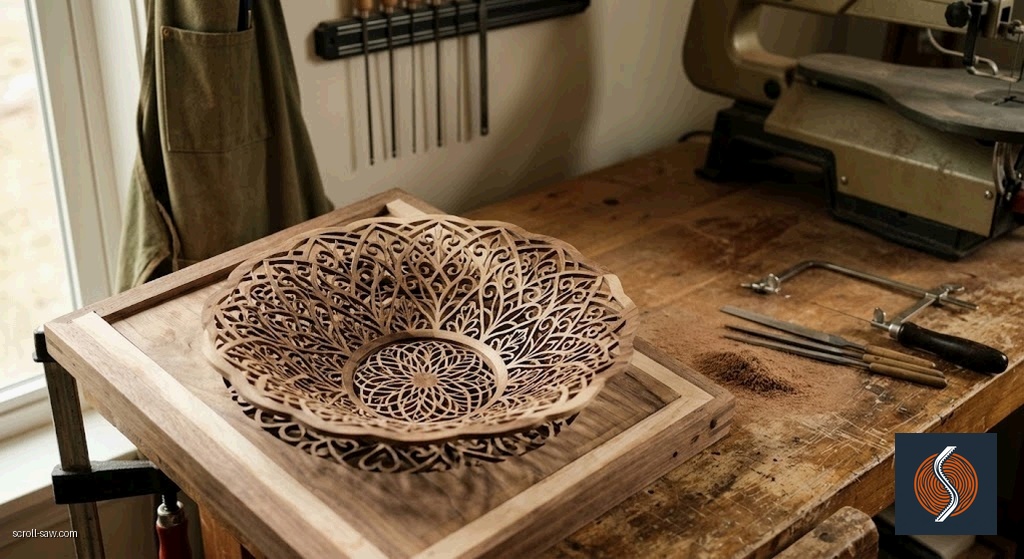
Scroll Saw Fruit Bowl: A Project Plan That Anticipates Fragile Cuts
A scroll saw fruit bowl is a kitchen-going version of the standard scroll saw bowl. Same technique of concentric angled ring cuts, same stacking geometry, but with three differences that shape every decision: food contact, cleaning, and daily handling. The bowl sits on the counter, gets loaded with fruit, gets emptied and wiped, and repeats. That routine changes wood, finish, and joinery.
Getting a fruit bowl right means anticipating the fragile spots (thin rings that can crack under fruit weight) and the food-safety spots (which finish, which glue) before starting.
What fruit bowls typically look like
Most scroll saw fruit bowls are one of three shapes. A shallow wide bowl for a fruit-basket look (10 to 14 inch diameter, 3 to 4 inch tall). A deep round bowl for hidden storage (8 to 10 inch diameter, 5 to 6 inch tall). A rectangular fruit tray with sloped sides (12 to 16 inch long, 6 to 8 inch wide, 2 to 3 inch tall).
Quick answer: cut from 3/4 to 1 inch thick cherry, walnut, or maple. Use a #5 skip-tooth blade tilted 20 degrees off vertical. Cut concentric rings from the outside in. Stack and glue with Titebond III (waterproof) or Titebond II (moisture-resistant). Finish with mineral oil and beeswax for food safety.
Wood choice for kitchen use
Hard maple in 3/4 to 1 inch thick. The traditional cutting-board wood: dense, closed-grain, food-safe, easy to clean.
Cherry in 3/4 to 1 inch. Warm oiled tone, closed grain, food-safe.
Walnut in 3/4 to 1 inch. Darker warm tone, closed grain, food-safe.
Avoid oak (open pores harbor food residue), pine (splits during angled cuts), plywood (glue lines exposed to food), and MDF (dust and off-gassing not food-safe).
Anticipating fragile cuts on a fruit bowl
Fruit bowls carry weight. The rings need to survive daily loading with apples, oranges, and bananas. Fragile spots to anticipate:
-
Ring width: rings drawn narrower than 3/8 inch can crack under fruit weight. Use 3/8 to 1/2 inch ring width.
-
Grain direction across the ring: grain running across a thin ring section is a stress concentration point. Use straight-grained boards.
-
Rim thickness: the top rim experiences the most handling. Sand the rim slightly rounded rather than sharp.
-
Base: the bowl’s base ring or disc supports the whole load. Make the base slightly thicker (1/2 to 5/8 inch ring width) than the walls.
Blade choice
A #5 skip-tooth blade for most fruit bowl cutting on 3/4 to 1 inch stock. Fresh blade for every bowl.
A #7 skip-tooth for very thick stock or particularly dense hardwoods like hard maple.
Tilt angle for fruit bowl profile
Twenty degrees tilt for a typical fruit-bowl profile. Not too steep, not too shallow. Gives a bowl that reads as functional rather than decorative.
Eighteen degrees for a shallower bowl profile that reads as a fruit basket rather than a bowl.
Twenty-two degrees for a taller bowl profile with more interior volume for hidden fruit storage.
Always cut a test ring on scrap first.
Cut sequence for a round fruit bowl
-
Sand both faces of the blank flat to 220 grit.
-
Mark concentric circles on the top face with a compass. Start with the outer bowl perimeter. Space each concentric circle inward by 3/8 to 1/2 inch (the ring width).
-
Drill an entry hole on the outermost concentric line.
-
Tilt the saw table to 20 degrees.
-
Feed the blade through the entry hole. Cut along the outermost concentric line all the way around back to the entry point.
-
The outermost ring pops free. Set it aside in order.
-
Drill an entry hole on the next concentric line inward.
-
Cut the next ring. Set it aside.
-
Continue inward until the innermost cut releases a small circular disc that becomes the bowl’s base.
Stacking and gluing for food-safe use
-
Lay out all rings and the base disc on a flat surface in order from largest to smallest.
-
Test-fit the entire stack without glue. Adjust ring positions to eliminate gaps.
-
Apply Titebond III (waterproof, FDA-approved for indirect food contact) or Titebond II (moisture-resistant) to the mating surfaces of each ring.
-
Stack the rings.
-
Clamp lightly with cauls above and below, or weight with sandbags.
-
Wipe glue squeeze-out from the interior chamber immediately with a damp cloth.
-
Cure 24 hours before shaping.
Shaping the bowl
After glue cures, the bowl’s inside and outside profiles are stepped where the rings meet:
-
Outside: random-orbit sander with 80 grit for rough shaping, 120, 220. Or a lathe for perfectly rounded outer profile.
-
Inside: hand-held rotary tool with sanding drums, or a small drum sander. Same grit progression.
-
Rim: hand-sand flat and slightly rounded on a reference surface with 220.
Sand thoroughly. Fruit bowls get handled daily; any rough spot causes splinters.
Where fruit bowls fail
Rings don’t nest cleanly. Tilt angle off. Test on scrap and verify.
A ring cracks under fruit weight. Ring drawn thinner than 3/8 inch. Increase ring width on the next bowl.
Glue line shows on the finished bowl. Squeeze-out not wiped immediately. Wipe with damp cloth during clamping.
Bowl doesn’t sit flat. Base ring cut off-center or unevenly. Use a large-diameter reference for the base circle when marking the blank.
Fruit stains show on light wood. Cherry or maple picks up berry stains. Wipe fruit residue immediately; refresh the mineral oil finish monthly.
Food-safe finishing
Mineral oil for kitchen fruit bowls. Non-toxic, food-safe, easily reapplied. Apply generously with a soft cloth, let soak in overnight, wipe off excess.
Mineral oil plus beeswax blend (butcher block conditioner) for slightly more protection. Apply after mineral oil dries, buff to a soft luster.
Carnauba wax for high-sheen finish on formal fruit bowls. Same food-safe status as mineral oil and beeswax.
Avoid film-forming finishes (polyurethane, lacquer, shellac). Films crack under daily use, and cracked film harbors food residue.
Avoid stains and dyes; stain particles can leach into fruit.
Refresh the finish every one to three months depending on use. Fruit bowls that see daily heavy use need monthly refresh; occasional-use bowls need seasonal refresh.
Cleaning between uses
-
Wipe with a damp cloth after each fruit refill.
-
Hand-wash with mild dish soap if fruit residue accumulates.
-
Never dishwasher-wash. Heat and water cycles crack the glue joints between rings.
-
Never soak submerged in water. Wood swells and glue joints can fail.
-
Air-dry standing upright.
Comparing three fruit bowl projects
Simple shallow round fruit bowl in 3/4 inch cherry, tilt angle 20 degrees, five rings, mineral oil finish. The reliable first fruit bowl. Cuts and glues in a weekend.
Deep round fruit bowl with rotated-ring decorative offset in 3/4 inch walnut, tilt angle 22 degrees, seven rings, beeswax and mineral oil finish. The mid-range piece.
Large rectangular fruit tray with sloped sides in 3/4 inch hard maple, ten stacked rings arranged in an oval, beeswax and mineral oil, carnauba wax top layer. The signature piece.
Conclusion
A scroll saw fruit bowl anticipates its fragile cuts when the ring width is 3/8 to 1/2 inch minimum, the base ring is slightly thicker than the walls, and the wood species is closed-grain and food-safe. Three-quarter to 1 inch thick hard maple, cherry, or walnut. A #5 skip-tooth blade at 20 degrees tilt. Titebond III or Titebond II glue. Mineral oil plus beeswax finish, refreshed regularly. Careful cleaning between uses. Do those and the finished bowl sits on the counter for years, holding fruit and reading as warm wood every time someone reaches for an apple.
Frequently asked questions
What wood works best for a scroll saw fruit bowl? Hard maple for the traditional cutting-board wood, cherry for warm oiled tone, or walnut for darker formal look. All closed-grain and food-safe.
Which glue is safe for a fruit bowl? Titebond III (FDA-approved for indirect food contact) or Titebond II (moisture-resistant). Both hold up in daily kitchen use.
What finish is food-safe? Mineral oil or mineral oil plus beeswax blend. Both non-toxic, easily reapplied. Refresh every 1 to 3 months.
How thick should the rings be? Three-eighths to 1/2 inch ring width to hold fruit weight without cracking. Base ring slightly thicker (1/2 to 5/8 inch).
Can I wash a scroll saw fruit bowl? Hand-wash with mild dish soap. Never dishwasher, never soak. Air-dry standing upright.
How do I remove fruit stains? Wipe with a damp cloth immediately after use. For set stains, gently sand the area with 400 grit and refresh the mineral oil finish.
How often should I refresh the finish? Monthly for daily-use bowls, seasonally for occasional-use bowls. Reapply mineral oil, let soak in, wipe off excess.
References
-
Titebond III food-contact glue product notes: titebond.com
-
Fine Woodworking food-safe finish resources: finewoodworking.com
-
Scroll Saw Woodworking & Crafts, Fox Chapel Publishing: foxchapelpublishing.com


