
Hobby Scroll Saw: Fit, Safety, Performance Checks
Hobby Scroll Saw: Fit, Safety, Performance Checks
A hobby scroll saw is a broad category covering the machines aimed at weekend woodworkers and committed hobbyists. Skil, WEN, Craftsman, Ryobi, and mid-range Delta all sit in this space. Before you make your first cut on a hobby scroll saw, whether it’s fresh out of the box or newly acquired used, a walk-through of fit, safety, and performance saves hours of later frustration.
What a hobby scroll saw actually is
A hobby scroll saw is a scroll saw class aimed at non-professional woodworkers, typically with:
-
14 to 22-inch throat depth.
-
Approximately 2 inches maximum cutting capacity at 90 degrees.
-
Cast aluminum or basic cast metal table with tilt from 0 to 45 degrees.
-
Variable-speed universal or induction motor.
-
Blade clamps accepting pin-end, plain-end, or both.
-
Standard hold-down foot, dust blower, and work light.
-
Weight in the 30-60 pound range.
Build quality spans a range within the hobby class, from entry-level to premium. Sizes and specifications overlap with craft scroll saws at the entry end and with light-professional machines at the premium end.
Fit: does the hobby scroll saw belong in your shop
Yes, if:
-
Weekend and evening hobby use fits your pattern.
-
Beginner to intermediate skill level.
-
Bench space is available for a permanent installation.
-
Casual to regular scroll work fits the intended output.
No, if:
-
Full production or semi-commercial output is planned.
-
Fine detail fretwork at professional standards is the primary goal.
-
Bench space is very limited.
Safety checks before first cut
Inspect the power cord. Cracks in insulation, damaged plug, or stiff cord all signal replacement.
Confirm the on/off switch operates cleanly. No hesitation, no sparks.
Verify the hold-down foot rests on the workpiece without touching the blade.
Wear safety glasses. Non-negotiable.
Position hands with intent. Never in front of the blade or in the cut path.
Ensure adequate lighting. Overhead task lighting reduces fatigue and error.
Verify the dust blower operates so chips clear the cut line.
Know how to reach the off switch without looking.
Performance checks with the saw unplugged
Bolt to a solid bench or stand. Loose mounting is the single biggest performance killer.
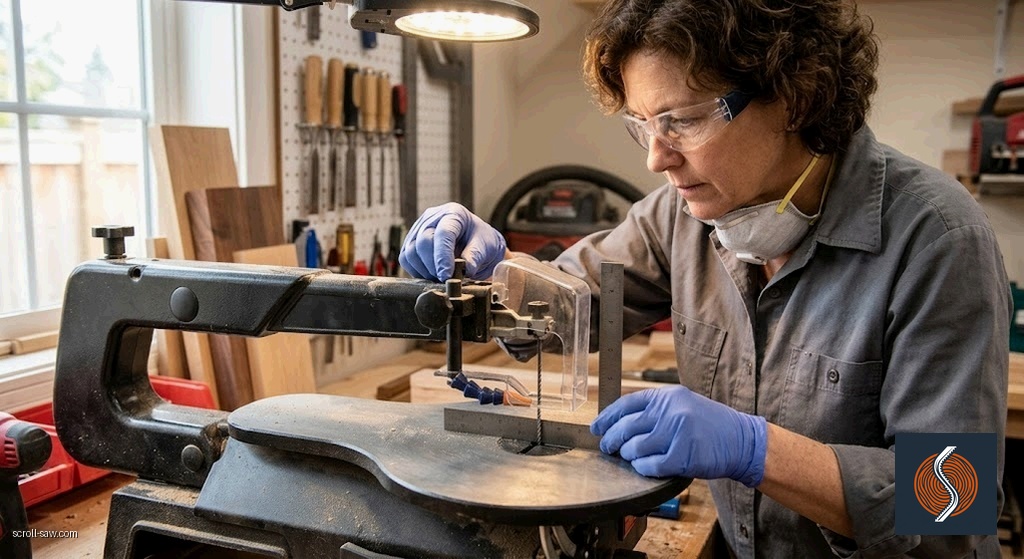
Level table to blade at zero degrees using engineer’s square at three points.
Check blade holders for wear on clamping surfaces.
Verify tilt lock at 45 degrees.
Test tension mechanism through full range.
Check speed control across full range with no blade under tension.
Set hold-down foot lightly on workpiece.
Aim dust blower at cut line.
Verify no arm play with the saw off.
Blade selection
Depends on your saw’s blade clamp type.
Plain-end saws:
-
Reverse-tooth #5 or #7 for general work: Olson reverse-tooth.
-
Skip-tooth #1 or #3 for detail: Pegas skip-tooth.
-
Spirals: Olson SP46500 spirals.
-
Variety pack for experimenting: Flying Dutchman variety pack.
Pin-end saws:
-
General assortment: pin-end blade assortment.
-
Mixed set: Skil 18-piece blade set.
Tensioning correctly
Pluck the tensioned blade near the middle. Clear ringing note is correct. Dull thud is loose. Rising pitch is overtight.
Technique for the first session
Start with softwood scraps in the 1/4 to 1/2-inch range.
Cut simple curves before intricate patterns.
Use a #5 or #7 reverse-tooth blade to start.
Feed steadily.
Rotate the workpiece around the blade.
Take breaks on your first session.
Common problems
Blade snaps immediately. Over-tensioned.
Cut wanders. Bent blade, dull blade, blade holder wear, or lateral pressure.
Vibration or walking. Insufficient mounting.
Motor bogs. Feed slower or coarser blade.
Wood lifts on upstroke. Hold-down foot too high or over-tensioned blade.
Choosing which hobby scroll saw fits
Entry-level: Casual weekend use, learning the craft, tight budget. WEN 3921, Ryobi entry, Tool Shop.
Mid-range: Regular hobby use, dual pin/plain-end capability. Skil 3335, mid Craftsman, mid Ryobi.
Premium hobby: Serious hobby to small-shop use, smooth stroke important. DeWalt DW788.
Specialist hobby: Fine detail and fretwork focus. Hegner Multimax, Excalibur.
The verdict
A hobby scroll saw, well set up and used with quality blades, does real work for weekend and evening woodworkers. Safety and performance checks before first cut save hours of later frustration. Match the saw class to your intended work, and the machine earns its bench space for years.
FAQ
What’s the best hobby scroll saw for beginners? Mid-range models with variable speed and dual blade capability.
How thick can a hobby scroll saw cut? Most handle roughly 2 inches in soft wood at 90 degrees.
Do I need to bolt down a hobby scroll saw? Yes.
What blade should a beginner start with? Reverse-tooth #5 or #7.
Why does my blade break so quickly? Over-tensioning first.
Can I do fretwork on a hobby scroll saw? Mid-range and premium models handle simple to moderate fretwork well.
How much space does a hobby scroll saw need? Roughly 2 feet by 2 feet of bench space.
How is a hobby scroll saw different from a craft scroll saw? Hobby scroll saws are more capable than craft scroll saws, with better motors, sturdier frames, and higher cutting capacity.
References
-
Olson Saw Company blade selection resources.
-
Scroll Saw Association of the World safety and operating guidance.
-
Fine Woodworking magazine archive.
Title tag: Hobby Scroll Saw: Fit, Safety, Performance Checks Meta description: Fit, safety, and performance checks to run on a hobby scroll saw before first use, plus blade selection and technique. URL slug: hobby-scroll-saw Excerpt: A hobby scroll saw rewards a careful walk-through before power goes on. Here are the fit, safety, and performance checks that separate a smooth first session from a frustrating one.


