
Scroll Saw Parts: Identify Type Numbers and Source Replacements
Scroll Saw Parts: Identify Type Numbers and Source Replacements
Scroll saw parts sourcing is one of those tasks that starts simple and gets complicated fast. A worn blade holder, a stretched belt, a failed speed controller — each replacement requires the right part number for the exact model and often the exact type number within that model. Getting it right the first time saves the frustration of a wrong-fit part sitting in a box while your project waits.
Here is how to identify scroll saw parts correctly and source replacements without guessing.
Start with your saw’s identification
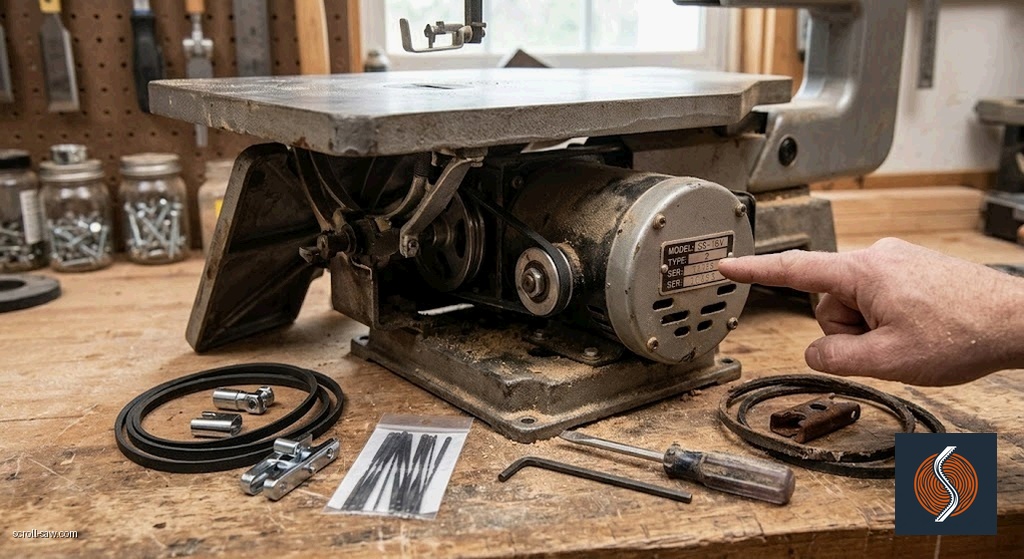
Before any parts search, gather from the ID plate:
-
Full model designation with any suffix or type number.
-
Serial number.
-
Voltage rating.
-
Motor amp rating.
-
Manufacture date if visible.
Write it all down. Parts vendors work faster and more accurately with all five pieces of information.
Common wear parts across scroll saws
Blade holders. Most frequent replacement. Wear on the clamping surfaces reduces tension consistency and blade grip. Model and type-specific.
Drive belt. V-belts stretch over time. Some are model-specific; many use universal sizes measured by circumference and width.
Speed controller. Electronic module on variable-speed machines. Failure is less common but serious. Requires exact type match.
Motor brushes. Universal-motor machines have replaceable brushes. Standard sizes exist.
Dust blower tube. Flexible tubing stiffens and cracks with age. Universal replacement works.
On/off switch. Standard tool switches. Aftermarket replacements fit most versions.
Table insert. Consumable. Shop-made or universal replacements work.
Blade tension mechanism components. Springs and linkage. Often model-specific.
Bearings. Identified by ISO number. Any bearing supplier stocks the standards.
Power cord. Standard tool cord. Any electrician can rewire.
Hold-down foot. Occasionally breaks or wears. Often model-specific.
Work light. Bulbs are standard; sockets may be model-specific.
Where to find scroll saw parts
Manufacturer’s parts network. First stop for any brand. Current and recent model parts are typically available directly.
Sears Parts Direct. Historically a major source of Craftsman and multi-brand parts. Legacy items sometimes available.
Third-party parts distributors. Ereplacement Parts, PartsWarehouse, ToolPartsPro. Wide catalogs across brands.
Amazon. Universal wear parts (belts, brushes, switches) often available.
eBay. For discontinued parts, non-running scroll saws sold for parts are sometimes the only source.
Independent tool repair shops. Long-established shops sometimes have parts stashes.
Manufacturer customer service. For discontinued models, some manufacturers email documentation or source discontinued parts on special request.
Cross-referencing part numbers
When ordering:
-
Manufacturer’s model and type.
-
Serial number.
-
Manufacturer’s part number for the specific item.
-
Photograph of the failed part if the number isn’t legible.
All four pieces speed up the ordering process.
Universal parts
Some items are truly universal:
Scroll saw blades. Any 5-inch plain-end or pin-end blade fits standard clamps of the same type.
V-belts. Match by measured length and width.
Bearings. ISO numbered.
Motor brushes. Match by measured dimensions.
Power cord. 16 or 18-gauge tool cord.
Work light bulbs. Standard sizes.
Consumables versus spare parts
Blades are consumables, not spare parts. Order in bulk from any quality supplier.
Working blade kit:
-
Reverse-tooth #5 or #7: Olson reverse-tooth.
-
Skip-tooth #1 or #3: Pegas skip-tooth.
-
Spirals: Olson SP46500 spirals.
-
Pin-end assortment: pin-end blade assortment.
When parts sourcing fails
Three options:
-
Adapt a similar part from a comparable model. Requires measurement and fitting.
-
Buy a working machine for parts. Sometimes cheaper than a single hard-to-find component.
-
Replace the machine. If total repair cost approaches a modern equivalent, replacement is the honest answer.
Parts-related decisions before buying used
Before buying a used scroll saw, verify:
-
Blade holders in serviceable condition (replacement possible but slow).
-
Speed controller functional (expensive replacement).
-
Motor healthy (replacement often uneconomic).
-
Base and table cast metal without cracks (uneconomic to repair).
A saw that needs blade holders is fixable. A saw that needs a motor is often not worth fixing.
The verdict
Scroll saw parts sourcing is manageable with the right identification and channel choices. Manufacturer networks handle current items; third-party distributors and eBay handle older and discontinued parts. Always provide model, type, serial, and part number when ordering, and switch strategies when a specific part isn’t findable through official channels.
FAQ
Where do I find scroll saw parts? Manufacturer network first, then third-party distributors, then eBay.
How do I know which part number to order? Match by model, type, and serial using the parts diagram.
What’s the most common wear part? Blade holders, followed by drive belts.
Are scroll saw parts universal across brands? Universal items (belts, brushes, bearings) yes. Model-specific parts (blade holders, controllers) no.
Is it worth restoring a scroll saw with worn parts? Depends on total repair cost versus replacement.
How do I contact a manufacturer for older parts? Customer service typically handles legacy requests with the model, type, and serial.
Can I use aftermarket parts? Universal items yes. Model-specific parts require exact fit verification.
Where do I find parts diagrams? Manufacturer’s support resources or the model’s manual.
References
-
Manufacturer support and parts networks.
-
Third-party parts distributors.
-
Olson Saw Company blade selection resources.
Title tag: Scroll Saw Parts: Identify Type Numbers and Source Replacements Meta description: How to identify scroll saw parts by type number, source replacements from manufacturer and aftermarket channels, and know when repair beats replacement. URL slug: scroll-saw-parts Excerpt: Scroll saw parts sourcing gets complicated fast without the right identification. Here’s how to find the right parts and know when to switch strategies.


