
Scroll Saw Sanding Strips: Useful Applications and Alternatives
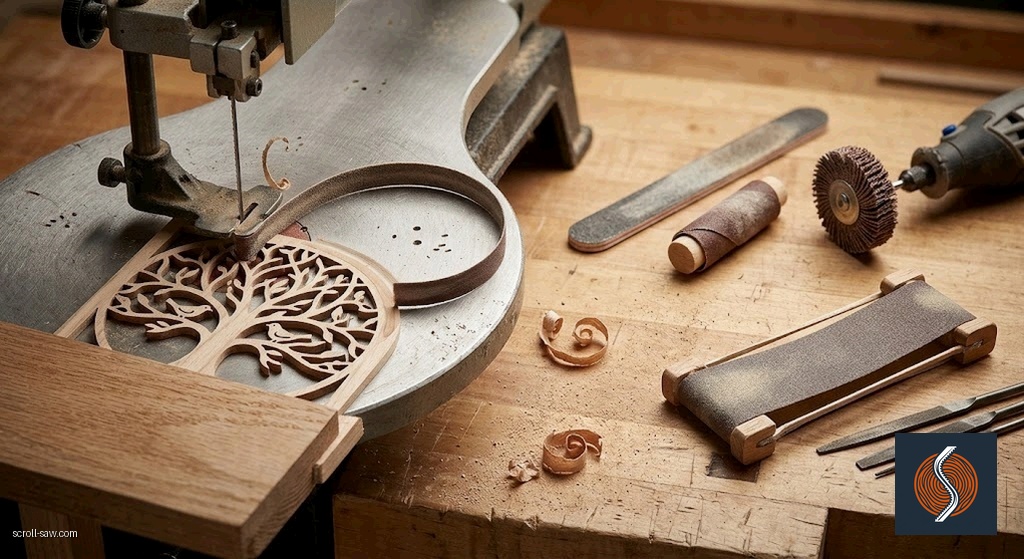
Scroll Saw Sanding Strips: Useful Applications and Alternatives
Scroll saw sanding strips are thin abrasive strips designed to fit standard scroll saw blade clamps. Instead of cutting, the strip sands within the same setup, letting you smooth interior curves and tight corners that are difficult to reach with any other tool. Are they useful? For specific applications, yes, genuinely so.
Where scroll saw sanding strips are genuinely useful
Smoothing interior curves. After cutting an interior shape, a sanding strip in the scroll saw smooths the cut surface without needing separate tools.
Tight corner cleanup. Corners that a rotary sanding tool can’t reach are accessible to a thin sanding strip.
Fretwork edge smoothing. After delicate fretwork cutting, sanding strips smooth interior edges without risking breakage.
Puzzle piece edge blending. After cutting puzzle pieces, sanding strips remove kerf residue and blend edges for closer fit.
Intarsia joint smoothing. Interior joints between intarsia pieces smooth quickly with sanding strips.
Removing pattern paper residue. After cutting a pattern applied with spray adhesive, sanding strips remove paper residue from cut edges.
Where scroll saw sanding strips aren’t the best tool
Large flat surfaces. Random-orbit sanders or belt sanders cover ground faster.
Aggressive material removal. Sanding strips are for finish work, not shaping.
Extended production sanding. Wear rate is high compared to dedicated sanding tools.
Types of scroll saw sanding strips
Adhesive-backed strips. Cut sandpaper backing with pressure-sensitive adhesive applied to a metal backer that fits the blade clamps.
Woven abrasive strips. Fabric-backed abrasive designed to flex slightly.
DIY strips. Cut from standard sheet sandpaper, glued to metal backers.
Grit ranges typically 80 to 320. Coarser grits for shaping, finer for finish.
Setup for using sanding strips
Reduce speed. Sanding strips work at lower speeds than cutting. Try 500-800 SPM to start.
Adjust hold-down foot. Set slightly higher than for cutting to avoid pinching.
Turn off dust blower or redirect. Dust from sanding is different from cutting chips.
Connect dust extraction. Sanding produces fine dust; extraction matters more than for cutting.
Alternatives
Detail sanders. Small triangular sanders reach some interior curves.
Rotary tools (Dremel). Small sanding drums fit tight spots.
Hand sanding. For very fine work, sandpaper wrapped around dowels or profiles.
Cabinet scrapers. For smooth surfaces on hardwood, cabinet scrapers leave excellent results.
Files and rasps. For aggressive shaping in tight spots.
Sourcing sanding strips
Sanding strips are less commonly stocked than scroll saw blades. Options include:
-
Specialty scroll saw supply houses.
-
DIY fabrication from standard sandpaper.
-
Online craft suppliers.
For blade work when the scroll saw is set up conventionally:
-
Reverse-tooth #5 or #7 for general woodwork: Olson reverse-tooth.
-
Skip-tooth for detail: Pegas skip-tooth.
-
Modified geometry: Pegas modified geometry.
DIY sanding strips
Cut standard sandpaper into strips slightly narrower than your blade clamps’ width. Glue to a thin metal backer (steel strip stock or aluminum) with contact cement. Cure fully before use.
Grit progression: 80 for shaping, 120 for smoothing, 220 for finish, 320 for pre-finishing.
Technique
Light pressure. Sanding strips work with contact and speed, not pressure.
Move the workpiece steadily as you would when cutting.
Change strips when they load. Loaded strips smear rather than sand.
Work through grits. Coarse to fine.
Finish with hand sanding for critical show surfaces.
Safety
Wear a dust mask. Sanding generates finer dust than cutting.
Safety glasses remain non-negotiable.
Keep hands away from the strip as you would from a blade.
Ventilation matters more for sanding than cutting.
The verdict
Scroll saw sanding strips are useful for specific finishing tasks that other tools struggle to reach. Interior curves, tight corners, and fretwork edges are the sweet spot. Alternatives cover most other sanding tasks better. For scroll saw specialists, sanding strips are a legitimate part of the finishing kit.
FAQ
What are scroll saw sanding strips? Thin abrasive strips that fit scroll saw blade clamps for sanding instead of cutting.
Do all scroll saws accept sanding strips? Most plain-end blade clamps accept strips. Verify with your machine.
What grits are available? Typically 80 to 320 grit.
Can I make my own sanding strips? Yes. Cut standard sandpaper to width, glue to metal backer.
What speed for sanding strips? Lower than cutting. Try 500-800 SPM.
Do sanding strips replace hand sanding? For interior curves and tight corners, often yes. Finish work usually benefits from hand sanding.
Are they worth buying? For scroll saw specialists doing fretwork or intarsia, yes.
How long do they last? Depends on grit and material. Coarser strips last longer than fine.
References
-
Scroll Saw Association of the World technique resources.
-
Olson Saw Company blade selection resources.
-
Fine Woodworking magazine archive.
Title tag: Scroll Saw Sanding Strips: Useful Applications and Alternatives Meta description: Where scroll saw sanding strips are genuinely useful, when to reach for other tools instead, and how to make your own strips. URL slug: scroll-saw-sanding-strips Excerpt: Scroll saw sanding strips solve specific finishing problems that other tools struggle to reach. Here’s where they earn their place and how to use them well.


