
Cutting a Scroll Saw Grandfather Clock: Entry Holes, Interior Cuts, and Assembly
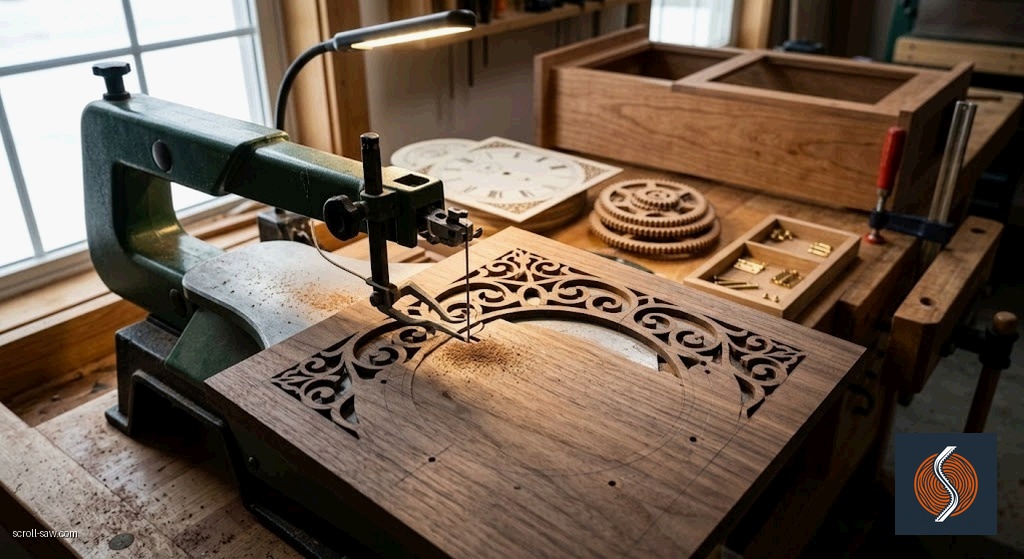
Cutting a Scroll Saw Grandfather Clock: Entry Holes, Interior Cuts, and Assembly
A scroll saw grandfather clock is the biggest single-project undertaking most scroll saw hobbyists attempt. Full-height grandfather clocks stand five to seven feet tall, contain a working mechanical or quartz movement, house a swinging pendulum, and often include hanging weights and chimes. The scroll saw work covers the case fretwork: pierced side panels, decorative crown molding, dial face, pendulum door, and any applied ornament.
A project on this scale takes months. Getting the case fretwork right is what separates a grandfather clock that reads as heirloom from one that reads as plywood project.
What grandfather clock patterns typically include
Most scroll saw grandfather clock patterns include a case body with pierced or fretted side panels, a hooded top section with pierced ornament, a pendulum door with a glass or open cutout window, a dial face with pierced or applied numerals, and a base plinth. The interior houses the movement, pendulum arm, and (for mechanical clocks) hanging weights.
Quick answer: choose a Klockit or similar full-height movement (quartz for practical, mechanical for heirloom) before designing. Cut case body from 3/4 inch cherry, walnut, or oak. Cut fretted side panels and pierced ornament from 3/8 to 1/2 inch of the same stock. Use a #5 skip-tooth for structural cuts and a #3 reverse for pierced detail. Assemble with Titebond II. Finish with wipe-on oil.
Movement selection first
The movement dictates case dimensions:
-
Quartz grandfather clock movements are battery-powered, produce hourly chimes, and drive the pendulum from the movement rather than by real gravity. Case depth requirement: 6 to 10 inches.
-
Mechanical Westminster chime movements are gear-driven, use hanging weights on chains, and require real pendulum swing space. Case depth requirement: 10 to 14 inches.
Measure the movement’s dial diameter (typically 6 to 10 inches), pendulum length (typically 30 to 42 inches for full grandfather clocks), and weight chain length if mechanical.
Design the case around those measurements. Order the movement first so you can measure it before cutting any wood.
Wood choice
Three-quarter inch quartersawn cherry for warm heirloom clocks.
Three-quarter inch walnut for formal or dark-tone clocks.
Three-quarter inch oak for traditional country-style clocks. Oak was the traditional grandfather clock wood and matches historical originals.
Avoid pine (too soft for full-height case), MDF (dust and no traditional look), and plywood (edge grain doesn’t match solid wood).
Blade choice
A #5 skip-tooth blade for structural case body cuts on 3/4 inch stock.
A #3 reverse-tooth blade for pierced fretwork on 3/8 to 1/2 inch side panels and ornament.
A #1 blade for the finest fretwork detail on heirloom-grade pierced panels.
Stock up on blades. A grandfather clock project consumes 40 to 60 blades across the whole project.
Case components to cut
A typical grandfather clock case has these separately-cut components:
-
Two side panels (structural, 3/4 inch stock).
-
Back panel (structural, 3/4 inch or exterior plywood for hidden interior).
-
Base plinth panels (front and sides, 3/4 inch stock).
-
Pendulum door frame with glass or open window (3/4 inch stock).
-
Pendulum door pierced or fretted panel insert (3/8 to 1/2 inch stock).
-
Hooded top section (crown, sides, and front, 3/4 inch stock).
-
Pierced top ornament (3/8 inch stock).
-
Dial face with numeral cutouts (3/8 inch stock).
-
Applied fretwork ornaments (leaves, filigree, corner accents, 3/8 inch stock).
Entry hole planning
Every pierced element on every panel needs a drilled entry hole. For a grandfather clock, entry hole locations include:
-
Pendulum door decorative pierces: 10 to 30 entry holes.
-
Top ornament pierces: 10 to 20 entry holes.
-
Dial face numeral counter interiors: one per closed counter across all numerals.
-
Side panel fret detail (if pierced): 20 to 50 entry holes.
-
Applied ornament interior pierces: varies by ornament count.
Batch drilling for each panel in one session. Drill all entry holes on one panel before starting the next panel.
Cut sequence for each panel
Standard sequence per panel:
-
Sand both faces to 220 grit before cutting.
-
Apply the pattern.
-
Drill every entry hole.
-
Cut smallest interior detail first.
-
Cut medium interior detail.
-
Cut the outer panel perimeter last.
Assembly
-
Cut every case component before starting assembly.
-
Dry-fit the entire case before glue.
-
Assemble base plinth first: front, sides, and top platform.
-
Assemble side panels to the base.
-
Attach back panel.
-
Attach pendulum door frame.
-
Attach hooded top section.
-
Mount all applied ornaments after primary assembly cures.
Use Titebond II wood glue for interior structural joints. Cure 24 hours between assembly steps. Corner clamps for square joints. Bar clamps for large panel joints.
Installing the movement, pendulum, and weights
-
Mount the movement to the interior movement plate (a small plywood shelf mounted inside the top of the case) with the included hardware.
-
Feed the movement shaft through the dial face hole.
-
Attach dial face to the front of the movement plate.
-
Attach hour, minute, and second hands.
-
Attach pendulum arm to the movement’s pendulum drive fitting.
-
Feed pendulum arm down through the pendulum door area.
-
Attach pendulum bob to the pendulum arm.
-
For mechanical clocks: attach weight chains to the movement, feed weights down through the case interior.
-
Insert battery (quartz) or wind (mechanical). Set time. Verify pendulum swing rate.
Where scroll saw grandfather clocks fail
Case not square. Components not cut square or assembly not clamped square. Verify each component with an engineer’s square before glue.
Movement pendulum doesn’t swing freely. Pendulum door frame too narrow or pendulum arm hits the case interior. Measure pendulum swing radius before cutting the door frame.
Fretted side panels crack. Grain runs across a fretted section. Rotate the pattern.
Hooded top section doesn’t align with the case body. Hooded section assembled separately and dry-fit onto the case body. Small adjustments in the hooded section’s base before final glue.
Finishing
Wipe-on boiled linseed oil for cherry, walnut, and oak. Three coats over three days for full-height cases (more coats than smaller pieces because the case sees more handling).
Oil-varnish blend for slightly more protection.
Gold leaf on numerals or corner ornaments for heirloom-grade cases. Apply gold leaf over sizing adhesive.
Avoid heavy polyurethane; the film thickness reads plastic on hardwood cases.
Comparing three grandfather clock projects
Simple full-height quartz grandfather clock with plain side panels and single pierced pendulum door, 3/4 inch oak, oiled. The reliable first grandfather clock. Reserve two to three months of dedicated work.
Traditional Westminster chime quartz grandfather clock with pierced side panels, ornamental hooded top, and applied leaf ornaments, 3/4 inch cherry, oiled. The mid-range piece. Reserve four to five months.
Heirloom mechanical Westminster chime grandfather clock with hanging weights, pierced side panels, ornamental hooded top, gold-leafed numerals, and applied ornaments, 3/4 inch walnut, oiled with gold leaf accents. The signature piece. Reserve six months to a year.
Conclusion
A scroll saw grandfather clock reads as heirloom when the movement is chosen before the case is designed, every panel is cut and squared before assembly, and the pierced fretwork on side panels and ornaments matches the case style. Three-quarter inch cherry, walnut, or oak. A #5 skip-tooth for structural cuts and #3 reverse for pierced detail. Titebond II glue with 24 hour cure between assembly steps. Wipe-on oil finish, three coats. Do those and the finished clock stands in the room for generations, chiming the hours and reading as the family heirloom it’s meant to be.
Frequently asked questions
What movement should I use for a scroll saw grandfather clock? A quartz Westminster chime movement for a practical first project. A mechanical Westminster chime with hanging weights for heirloom-grade work.
What wood works best? Three-quarter inch quartersawn cherry, walnut, or oak. Oak matches historical originals; cherry and walnut give warm heirloom tones.
Which blade cuts pierced side panels cleanest? A fresh #3 reverse-tooth blade for most fretwork, dropping to a #1 for the finest heirloom detail.
How long does the project take? Two to three months for a simple quartz grandfather clock. Four to five months for a traditional pierced-fretwork case. Six months to a year for a heirloom mechanical clock.
How do I keep the case square? Check each panel with an engineer’s square before glue. Corner clamps and bar clamps for even glue pressure. Cure fully between assembly steps.
Will the pendulum swing freely? If the pendulum door frame accommodates the pendulum’s full swing radius. Measure the pendulum swing before cutting the door frame.
Can I use gold leaf on the numerals? Yes, for heirloom cases. Apply gold leaf over sizing adhesive after sealing the wooden numerals.
References
-
Klockit grandfather clock movement guide: klockit.com
-
Steve Good, Scrollsaw Workshop clock pattern archive: scrollsawworkshop.blogspot.com
-
Scroll Saw Woodworking & Crafts, Fox Chapel Publishing: foxchapelpublishing.com


