
Craftsman Professional 20 Scroll Saw: Specs and Setup
Craftsman Professional 20 Scroll Saw: Specs and Setup
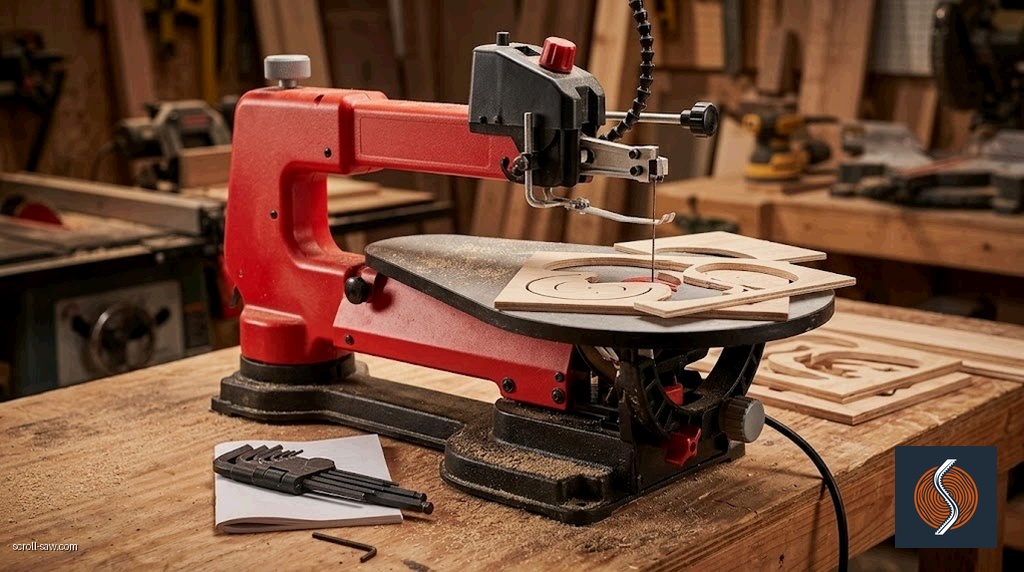
Craftsman Professional was Sears’ upmarket line, aimed at the small-shop professional and serious hobbyist market. The Craftsman Professional 20-inch scroll saw sat at the higher end of Craftsman’s scroll saw offerings, competing against DeWalt DW788, Delta industrial models, and similar mid-to-upper hobby machines.
Understanding the specifications and where the machine fits in a real workflow helps decide whether one is right for your shop.
Specifications
Throat depth: 20 inches.
Cutting capacity: Approximately 2 to 2.25 inches at 90 degrees.
Motor: Variable-speed induction motor on most versions (some earlier universal-motor variants exist).
Speed range: Typically 400 to 1600 strokes per minute.
Table size: Approximately 15 by 24 inches on most versions.
Tilt: 0 to 45 degrees.
Blade type: Standard 5-inch plain-end blades on most versions.
Weight: Roughly 50 to 70 pounds.
Motor amperage: Typically 1.5 to 2.0 amps.
Table material: Cast metal.
Blade change: Tool-assisted on most versions; some later models offered partial tool-free.
Dust management: Integrated dust blower and often dust extraction port.
Work light: Integrated on most versions.
Exact specifications vary by model year and specific submodel. Verify against your ID plate.
Where the Craftsman Professional 20 fits
As a serious hobby saw. The 20-inch throat and refined build suit committed hobby users.
In small-shop use. Small commercial operations doing scroll work benefit from the class.
As a two-saw shop primary. Alongside a specialist scroll saw, the Professional 20 covers general work.
Not the right fit for:
-
Casual weekend hobby use. More saw than the pattern justifies.
-
Full production runs at industrial scale.
-
Very fine specialist fretwork (dedicated specialist saws offer smoother stroke).
Setup for productive use
With the saw unplugged:
Bolt to a heavy bench or stand. The Professional 20 benefits from solid mounting; induction motors reward stability.
Level table to blade. Zero degrees on tilt scale, engineer’s square at three points, adjust stop screw.
Check blade holders. Clamping surfaces flat and unmarked.
Verify tilt lock at 45 degrees.
Test tension mechanism through full range.
Check speed control across full range.
Set hold-down foot lightly on workpiece.
Aim dust blower at cut line.
Connect dust extraction if the version supports it.
Blade selection
Standard 5-inch plain-end blades.
-
Reverse-tooth #5 or #7: Olson reverse-tooth.
-
Skip-tooth #1 or #3: Pegas skip-tooth.
-
Modified geometry: Pegas modified geometry.
-
Spirals: Olson SP46500 spirals.
-
Variety pack: Flying Dutchman variety pack.
Tensioning correctly
Pluck the tensioned blade near the middle. Clear ringing note is correct.
The Professional 20’s induction motor and refined mechanism reward correct tension with visibly better cut quality.
Technique
Steady feed pressure.
Rotate the workpiece around the blade.
Match speed to the cut.
Starter holes for interior cuts.
Support long stock.
Take advantage of the 20-inch throat for larger workpieces that would exceed hobby-class 16-inch saws.
Materials
Softwood up to 3/4 inch: Reverse-tooth #5 or #7 at medium-to-high speed.
Hardwood up to 3/4 inch: Skip-tooth at medium speed.
Hardwood up to 1 inch: Skip-tooth #7 at slow-to-medium speed.
Plywood up to 1/2 inch: Reverse-tooth #5.
Non-ferrous metal up to 1/16 inch: Fine metal blade at low speed.
Thin plastic up to 1/8 inch: Fine-tooth at low speed.
Common problems
Blade snaps often. Over-tensioning or side-loading.
Cut wanders. Bent blade, blade holder wear, or lateral pressure.
Vibration. Loose mount or belt.
Speed control acts erratically. Service through Craftsman/Sears channels or specialty repair.
Parts and support
Sears Parts Direct handles most Craftsman items. Craftsman’s transition to Stanley Black & Decker has changed some support channels. Third-party distributors (Ereplacement Parts, PartsWarehouse) cover many items.
The verdict
A Craftsman Professional 20 scroll saw in good condition earns its bench space for serious hobby and small-shop use. Induction motor smoothness, 20-inch throat, and refined mechanism make it a legitimate mid-range choice. Support and parts availability have changed over the years, so verify current status before buying used at a premium price.
FAQ
What blade does the Craftsman Professional 20 use? Standard 5-inch plain-end blades.
How thick can it cut? Roughly 2 to 2.25 inches in soft wood at 90 degrees.
Is it still made? Craftsman’s scroll saw lineup has evolved. Check current listings.
Where do I find a manual? Sears Parts Direct or aggregator sites.
Is a used Craftsman Professional 20 a good buy? In good condition at a fair price, yes.
Where do I find replacement parts? Sears Parts Direct, third-party distributors, and eBay.
Why does my blade break so quickly? Over-tensioning first.
How does the Craftsman Professional 20 compare to a DeWalt DW788? Similar class. DW788 is known for its very smooth stroke and strong hobbyist reputation; the Craftsman Professional 20 offers more throat depth and comparable build quality.
References
-
Sears Parts Direct and Craftsman product documentation.
-
Olson Saw Company blade selection resources.
-
Scroll Saw Association of the World.
Title tag: Craftsman Professional 20 Scroll Saw: Specs and Setup Meta description: Specifications, workflow fit, and setup guidance for a Craftsman Professional 20 scroll saw, plus blade selection and technique. URL slug: craftsman-professional-20-scroll-saw Excerpt: The Craftsman Professional 20 scroll saw sits at the upper end of the hobby class. Here are the specifications, where it fits, and how to set one up for productive work.


