
Pin Type Scroll Saw Blades: TPI, Kerf and Selection
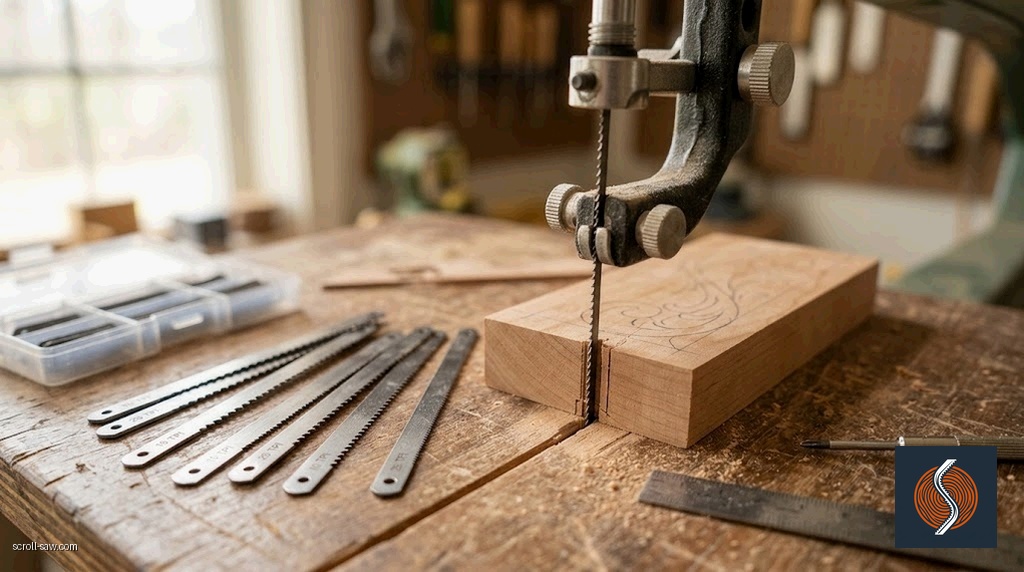
Pin Type Scroll Saw Blades: TPI, Kerf and Selection
Pin type scroll saw blades have a small crosswise pin at each end. The pin drops into a slot in the saw’s blade clamps, and the blade seats without any tightening needed. That simple mechanical fit is the whole story: pin blades are the easy-load option built for entry-level saws.
They are also the option most enthusiast scrollers eventually leave behind. Understanding why starts with what the pin actually forces on the blade design.
Why the pin changes the blade
A pin-end blade has to be thick enough at the ends to hold a crossways pin without tearing. That end thickness translates to overall blade width. A pinned #5 blade is wider than a plain-end #5, so the smallest pinned blade you can buy is roughly equivalent to a plain-end #5 or #7 in cutting size. Anything finer (a plain-end #2/0, #1, or #3 for intricate portrait work) simply cannot be made in pinned form because the pin end would be wider than the useful cutting section.
That single constraint tells you everything you need to know about who pinned blades are for: they suit outline cutting in wood 1/4 inch and thicker, and they suit saws that were built around the pinned system. They do not suit fine fretwork, portrait scrolling, or any project that needs to fit through a small pilot hole.
TPI on a pinned blade
TPI runs from about 10 to 25 on common pinned blades:
-
10 to 12 TPI: general wood cutting, 3/8 to 3/4 inch stock, aggressive material removal.
-
15 TPI: mid-range wood and thin plywood, good all-around choice.
-
18 to 20 TPI: fine cuts in wood 1/4 inch and thinner, cleaner walls.
-
25 TPI: metal, plastic, and very fine wood detail.
Most pinned blade multipacks include a mix of 10, 15, and 20 TPI to cover common jobs. That range is fine for the first year of scrolling. Once you outgrow it, the fix is a new saw that accepts plain-end blades, not more pinned blade sizes.
Kerf
Pinned blades cut a wider kerf than plain-end blades in the same rough size class. Expect 0.025 to 0.035 inches of material removed per cut. That matters for two things:
-
Interior bridges. Any fretwork bridge under 1/16 inch (0.062 inches) barely survives one cut and will not survive a second pass. Design accordingly.
-
Inlay and intarsia fit. Two pieces cut to the same line will show a gap. Compensate at the pattern stage or fill with tinted glue at assembly.
If kerf width matters for your work, the pinned blade is the wrong tool. Move to a plain-end saw and a fine plain-end blade.
Turning radius
Because pinned blades are wider than plain-end equivalents, they need a larger turning radius to pivot cleanly without binding. A 10 TPI pinned blade needs roughly 5/16 inch of turning room to spin freely. A 20 TPI pinned blade tightens that to about 1/8 inch.
For outline cuts and gentle curves this is plenty. For anything with tight interior corners or letters like B, R, and lowercase e, the pinned blade will bind or leave a visible arc at every corner.
Finish quality off the blade
A sharp 15 TPI pinned blade in poplar or Baltic birch ply leaves a cut wall that needs sanding at 150 grit before finish. A 20 TPI blade in the same material leaves a wall closer to 220-grit ready. In hardwoods, expect visible tear-out on the underside unless you back the workpiece with a sacrificial sheet.
Compared to a modern plain-end premium blade in the same stock, the finish is noticeably rougher. Compared to a bargain plain-end blade, the finish is comparable. Pinned blades from Olson, Delta, and Bosch are all in the same rough tier of cut quality.
Blade brands still selling pinned
Olson PL series (Olson’s pinned line) is the most consistently available brand in US hardware stores. Sold in multipacks with a mix of TPIs.
Delta 40-series pinned blades were the standard accessory for older Delta scroll saws and are still available online.
Bosch and Skil pinned blades ship in multipacks intended for the entry-level scroll saws those brands sell.
Any of the three will cut acceptably. Brand differences are smaller than the design constraints of the pinned format.
Saws that use pinned blades
Most budget hobby saws under 200 dollars accept pinned blades. Some accept both pinned and plain-end blades with a clamp adapter; some accept only pinned. Check the saw’s manual before buying blades.
Enthusiast and professional scroll saws (DeWalt DW788, Excalibur, Hegner, Pegas 21, EX-16) do not use pinned blades. Those saws accept plain-end blades only.
If you own a saw that accepts both, run plain-end blades whenever the cut demands finer geometry. Reserve pinned blades for quick loads on utility cuts.
When to move past pinned blades
Watch for three signals that your pinned setup is limiting your work:
-
You want to cut fretwork through a pilot hole smaller than 1/16 inch, and the pinned blade will not fit.
-
Your intricate designs are getting rounded corners because the pinned blade cannot pivot tight enough.
-
Your finish work needs less sanding, and the pinned blade’s cut wall is what you keep improving.
When any of the three is true, the next upgrade is a saw that accepts plain-end blades, not more pinned blades.
Bottom line
Pin type blades load fast and cut acceptably for outline work in wood 1/4 inch and thicker. They are the right blade for entry-level saws and utility cuts. They are the wrong blade for portraits, fine fretwork, and anything demanding a small pilot hole or a tight interior corner. If you already own a pinned saw, buy a multipack of Olson PL series in mixed TPIs and get to work. If you are shopping for a saw, spending 100 dollars more on a plain-end model opens up the full range of scroll saw work.
FAQ
What is a pin type scroll saw blade? A blade with a small crosswise pin at each end. The pin drops into a slot in the saw’s blade clamps, allowing quick loading without tightening screws.
Are pinned blades better than plain-end blades? No. Pinned blades load faster but cannot be made as thin, cannot pivot as tight, and leave a rougher finish than plain-end blades.
Can I use plain-end blades in a pinned scroll saw? Some saws include an adapter that accepts both. Most budget saws accept only one style. Check the saw’s manual.
What TPI is best for pinned blades in wood? For general 1/4 to 1/2 inch wood, 15 TPI is a solid all-around choice. Drop to 10 TPI for thicker stock and rise to 20 TPI for thinner or finer work.
Why can’t I cut fretwork with pinned blades? The pin ends are too wide to feed through the small pilot holes fretwork requires. Fretwork needs plain-end blades that can be threaded through a 1/16-inch hole.
What brands still make pinned scroll saw blades? Olson (PL series), Delta, Bosch, and Skil are the most common in US hardware stores.
Do pinned blades cost more than plain-end blades? Slightly less, per blade. The lower unit price does not always translate to lower cost per project because pinned blades dull faster in hardwood.
References
-
Olson Saw Company PL series product data, olsonsaw.com
-
Delta scroll saw manuals and accessory guides, deltamachinery.com
-
Steve Good, Scroll Saw Workshop notes on blade types, scrollsawworkshop.blogspot.com
-
Bear Woods scroll saw blade guide, bearwood.com


