
Quick Release Scroll Saw Blade Holders: Guide
Quick Release Scroll Saw Blade Holders: Guide
Swapping a scroll saw blade is one of those small tasks that adds up fast. For fretwork with dozens of interior cuts, you unthread the blade, feed it through the next pilot hole, and re-clamp it every time you move to a new opening. Do that fifty times on a single portrait and the standard thumbscrew clamps that came with your saw become the reason you are avoiding the next project.
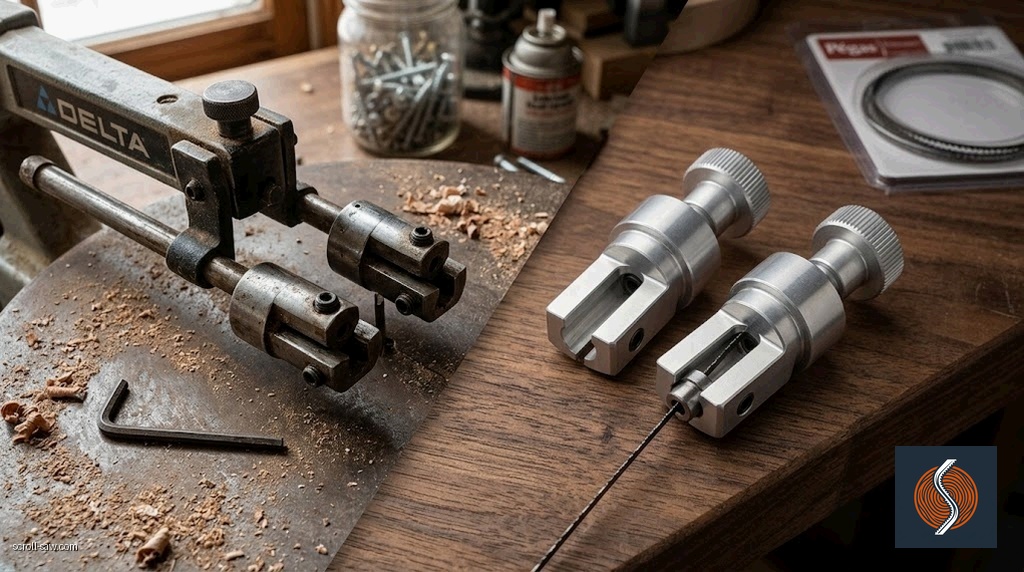
Quick release blade holders replace the thumbscrew with a cam lever. Flip the lever, the blade drops free; feed the blade through the pilot hole, flip the lever back, and you are cutting again. The switch cuts blade-change time from thirty seconds to about five. Over a portrait project, that is an hour saved, and the hour matters because it is the hour you were about to lose to fatigue.
Here is how to pick a set that fits your saw and install it without ruining anything.
Not every quick release fits every saw
The first question, and the one that decides which product you buy, is what saw you own. Quick release blade holders are made specifically for particular scroll saw models. The mounting geometry, the blade thickness the clamp accepts, and the tension mechanism differ from saw to saw.
The most common fitments on the market:
Pegas Chuck conversion kits fit the DeWalt DW788, the older Delta scroll saws (P20, 40-series), and the Excalibur EX-16 and EX-21. Pegas makes model-specific versions of the same basic clamp; the DW788 kit is not interchangeable with the Delta kit.
Hegner factory quick release fits Hegner Multimax saws only. Hegner does not sell adapters for other machines.
Seyco quick clamp fits their own SD26 saw and, with the correct adapter, some Excalibur models.
Aftermarket universal clamps exist but the fit is often approximate. Read reviews from users of your specific saw model before buying anything sold as universal.
If your saw is not on any list, contact the manufacturer or the aftermarket brand directly and ask before ordering. A wrong-fit clamp is worse than the stock thumbscrew because you cannot easily reverse the modification.
What quick release does and does not do
Does: Cuts blade change time from about 30 seconds to about 5. Removes the small screwdriver from your workflow. Keeps blade tension consistent because the cam lever throws the same distance every time. Reduces the chance of over-tightening and stripping a clamp.
Does not: Change how long the blade lasts. Change the cut quality. Fix a saw with worn upper arms or a wobbly lower blade holder. If your saw is already worn, a quick release clamp will not make it cut better; it will just make it faster to swap out broken blades.
Installation, step by step for a typical Pegas conversion
Every kit ships with instructions specific to the saw model. The generic sequence for the DeWalt DW788, which is the most common conversion:
-
Unplug the saw. Every time. No exceptions. A saw that starts unexpectedly during clamp swaps is the single most common workshop injury on a scroll saw.
-
Release blade tension with the saw’s built-in tension lever and remove the current blade.
-
Unscrew the stock upper blade clamp from the upper arm. It typically threads out with the thumbscrew and a small captive washer.
-
Thread the Pegas upper clamp into the same threads, hand-tight, then snug it with the small wrench included in the kit. Do not over-tighten; the aluminum body threads strip easily.
-
Repeat on the lower blade holder. The lower clamp on the DW788 requires removing the throat plate and reaching under the table to access.
-
Test the clamp motion with no blade installed. The lever should throw smoothly through its full range with light finger pressure.
-
Install a blade. Feed the blade end into the lower clamp with the lever open, close the lever, then feed the top end into the upper clamp with the arm at its lowest point. Close the upper lever.
-
Tension the blade using the saw’s tension lever. The clamp holds; the tension mechanism is separate.
-
Pluck the blade. You want a clear ringing note. Re-check after the first minute of cutting.
If any step feels wrong (a clamp that will not thread cleanly, a lever that binds, a blade that slips under tension) stop and check the kit against the saw model. Trying to force a mismatched clamp cracks aluminum bodies and loses screws inside the saw arm.
Adjustment for optimal grip
Most quick release clamps have a small setscrew that adjusts the cam pressure. Too loose and the blade slips under tension; too tight and the lever is hard to close. Find the middle by cycling the lever with the blade installed and adjusting until the lever closes with moderate thumb pressure and the blade does not shift under a firm pull.
After about 100 blade changes, expect to check the setscrew again. Cam pressure drifts slightly as the mechanism beds in.
Fit issues to watch for
Blade thickness. Most quick release clamps accept the full range of scroll saw blade sizes, from #2/0 up through #12. A very small number of aftermarket clamps have a minimum blade thickness. Confirm before ordering if you use #2/0 or smaller for portrait work.
Blade length. Standard scroll saw blades are 5 inches long. Quick release clamps designed for 5-inch blades will not accept the shorter blades some European scroll saws use. Match blade length to clamp before buying.
Clearance for the arm. On saws with tight throat clearance, some aftermarket clamps stick up higher than the stock clamp and hit the upper arm at full stroke. This is rare on the common conversion targets (DW788, Excalibur, Delta) but check the first stroke slowly by hand before running the motor.
When quick release is the wrong upgrade
If you only cut outline shapes with no interior cuts, blade changes are already infrequent and quick release delivers little value. Same if your saw is beat up enough that other repairs matter more. Spending 100 dollars on a Pegas conversion for a saw with a wobbly lower arm is putting the wrong money in the wrong place.
Bottom line
For anyone doing fretwork, portrait scrolling, or any project with multiple interior cuts, a quick release blade holder is the single highest-impact upgrade you can make to a scroll saw. Match the kit to your saw model, install carefully, and expect the return on the first project. For pure outline cutters, keep the stock clamps.
FAQ
Do I need a quick release blade holder? Only if you do work with multiple interior cuts per piece. For outline-only cutting, the stock thumbscrews are fine.
Will Pegas quick release fit my scroll saw? Pegas makes kits for the DeWalt DW788, older Delta scroll saws, and Excalibur EX-16 and EX-21. Confirm the exact model before ordering.
Can I install a quick release myself? Yes, for most common conversion kits. The installation is straightforward and requires only a small wrench, which usually ships with the kit.
How long does a quick release clamp last? Several thousand blade changes at least. The cam mechanism eventually wears; replacement parts are available from the same manufacturer.
Does a quick release affect cut quality? No. It changes how fast you swap blades. Cut quality depends on blade choice, tension, feed, and speed.
Why does my new quick release let the blade slip? The setscrew adjusts cam pressure. Snug it up until the blade holds firm under a hand pull, but the lever still closes with moderate thumb pressure.
Can I use my old blades with a quick release? Yes, as long as the blade end style (plain-end) matches the clamp. Most quick release conversions are plain-end only.
References
-
Pegas quick release chuck conversion documentation, pegas-swiss.com
-
Hegner USA quick release accessory guide, hegner.us
-
Seyco scroll saw accessory catalog, seyco.com
-
DeWalt DW788 owner’s manual, dewalt.com


