
Reverse Scroll Saw Blades: Selection and Setup Guide
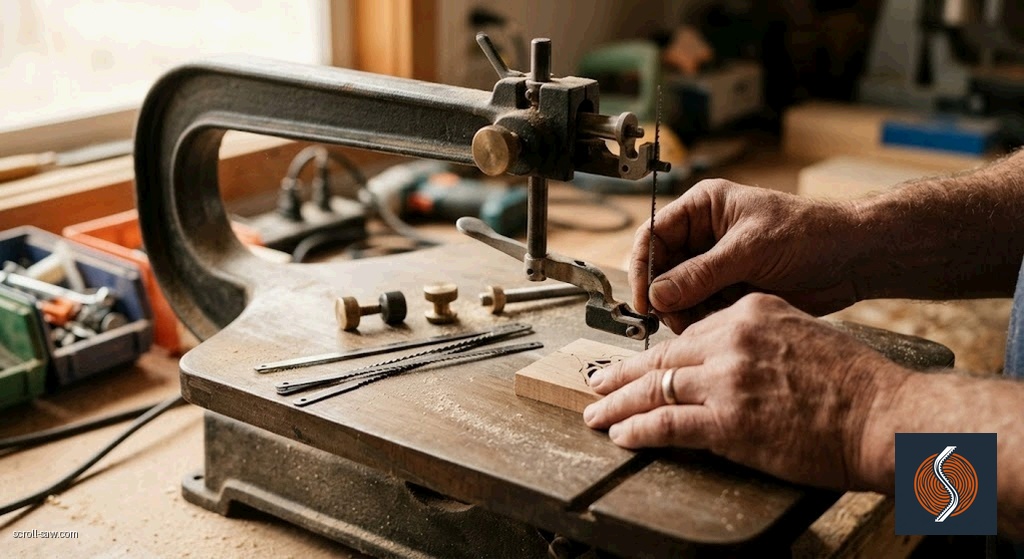
Reverse Scroll Saw Blades: Selection and Setup Guide
The first time you flip a piece of Baltic birch plywood after a clean cut and see splinters lifted all along the underside, you understand why reverse scroll saw blades exist. The standard blade cuts on the downstroke. The teeth push through the top face cleanly, but they lift the bottom fibers on their way out, and any veneered or thin plywood picks up tear-out you have to hide with paint or sanding.
A reverse-tooth blade solves that by adding a section of upward-facing teeth at the bottom of the blade. Those teeth cut on the return stroke and clean the underside of the workpiece as the blade rises. The top face still cuts smoothly from the downward teeth. Both faces come out finish-ready.
Here is how to pick and use one.
What reverse actually means
A reverse-tooth scroll saw blade has three to six teeth at the bottom of the blade turned to face upward. The exact count varies by manufacturer and blade size; larger blades typically have more reverse teeth than smaller blades. The rest of the blade has standard downward-facing teeth.
That mixed geometry means the blade cuts on both the down stroke (from the majority of teeth) and the up stroke (from the reverse teeth). The up-stroke cut is what cleans the underside. Feed rate is slightly slower than a straight skip-tooth blade of the same size because the reverse teeth push back on the feed a bit, but the finish is better on any material where the underside shows.
The scenarios where reverse pays off
Reverse-tooth blades earn their price in five specific situations:
-
Plywood signage. Baltic birch and cabinet plywood have thin outer veneers that tear out easily. Reverse blades leave both faces clean.
-
Stack cutting. Cutting two or more thin sheets at once, the bottom sheet always splintered with standard blades. Reverse cleans it up.
-
Painted work. Any paint or finish that will show tear-out benefits from a clean bottom face.
-
Fretwork where both sides matter. If the piece will be viewed from both faces (ornaments, hanging decorations), reverse blades save the flip-and-sand step.
-
Veneered stock. Thin decorative veneers over MDF or plywood core tear out spectacularly with standard blades. Reverse blades preserve the veneer.
Where reverse does not pay off:
-
Solid hardwood outline cutting where the bottom face will not show. Standard skip-tooth is faster.
-
Very thick stock (over 3/4 inch) where the reverse section is too short relative to blade length to help.
-
Fine detail work in thin stock; the return-stroke cut can slow the feed enough to make tight corners harder.
Brands worth naming
Olson Ultra Reverse (SKR series) is the American workhorse. Available in sizes #1 through #9, sold in bundles of 12. Widely stocked.
Pegas Reverse grinds the teeth after forming, giving cleaner cut walls plus the reverse-tooth benefit. Higher cost per blade, longer life.
Flying Dutchman Ultra Reverse (FD-UR) ships from Mike’s Workshop in bundles of 12. Popular with hobbyists for a good balance of price and cut quality.
Niqua Puma is the German reverse-tooth line. Precision-ground, longer life, higher cost.
PS Wood Ultra Reverse ships from psWood.com, a small Ohio operation with strong reputation among serious scrollers.
All five cut acceptably. Personal preference and shipping speed usually decide.
Sizing for common materials
| Material | Thickness | Reverse blade size |
|---|---|---|
| Baltic birch ply | 1/8 in | #3 reverse |
| Baltic birch ply | 1/4 in | #5 reverse |
| Cabinet plywood | 1/2 in | #7 reverse |
| Veneered MDF | 1/4 to 1/2 in | #5 or #7 reverse |
| Basswood | 1/8 in | #3 reverse for painted signs |
| Cherry ply | 1/4 in | #5 reverse |
| Stack of 2 sheets 1/8 in ply | 1/4 in equivalent | #5 reverse |
Setup notes for reverse-tooth blades
Tension firm. Reverse blades need slightly higher tension than same-size skip-tooth blades because the up-stroke cut adds a small side load.
Speed moderate. Middle of the SPM range for hardwood plywood. Maximum speed can blue the reverse teeth quickly.
Feed slightly lighter. The return-stroke cut adds resistance to the feed. Push the same amount you would for a skip-tooth blade and you will feel the blade fighting you.
Correct blade orientation. The reverse teeth face upward. When you install the blade, the downward-facing teeth (the majority) should be at the top of the blade at the highest arm position. The reverse teeth should be at the bottom.
Positioning the reverse section for your material
Most reverse blades come with the reverse-tooth section positioned so it engages the workpiece in the middle of the blade’s stroke on standard 3/4-inch stock. For thinner stock, you can raise the blade slightly in the upper clamp so the reverse section aligns with the bottom face of the workpiece.
Specifically, if your material is 1/4 inch thick and the reverse section is 3/8 inch long starting from the bottom of the blade, raise the blade in the upper clamp by roughly 1/8 to 1/4 inch so the reverse teeth clean the underside during the middle of the stroke, not at the top of the stroke.
This is a fine adjustment and most scrollers get acceptable results with the default positioning. Try the default first, adjust only if you see tear-out on the bottom of thin stock.
Where reverse blades disappoint
Solid hardwood outline. A skip-tooth blade cuts faster and cleaner in solid stock where the bottom face will not show. Save the reverse blades for plywood work.
Very thick stock. The reverse section covers only part of the blade length. In 1-inch or thicker stock, the reverse section may not engage the underside consistently.
Aggressive feed cutters. If you push the wood hard through a cut, the reverse teeth catch and the blade wants to jump. Guide the wood; do not push it.
Bottom line
For any scroll saw work involving plywood, veneered stock, or signage where both faces show, one bundle of reverse-tooth blades in the size you use most (usually #5) belongs in the drawer. For solid hardwood outline cutting, standard skip-tooth is faster and cleaner. Owning both, and choosing based on the material in front of you, is the setup that produces the best finish across the widest range of work.
FAQ
What is a reverse scroll saw blade? A blade with a section of teeth at the bottom facing upward. Those teeth cut on the up stroke and clean the underside of the workpiece.
When should I use a reverse blade instead of a skip-tooth? Anytime the underside of the workpiece will show, especially with plywood and veneered stock. For solid wood outline cutting where the bottom will not show, skip-tooth is faster.
How do I install a reverse blade correctly? Downward-facing teeth (the majority) at the top; upward-facing teeth (the reverse section) at the bottom. If the blade is upside down, both faces will splinter.
Does a reverse blade cut slower than a skip-tooth? Slightly. The return-stroke cut adds a small resistance to the feed. Difference is small enough that most scrollers do not notice after adjusting.
How many reverse teeth are on the blade? Usually three to six, depending on blade size. Larger blades have more.
Can I use reverse blades on any scroll saw? Yes, provided the end style matches your saw. Reverse blades come in plain-end and pinned versions.
Which brand of reverse blade is best? Olson SKR series is the American standard. Pegas Reverse and PS Wood Ultra Reverse cut cleaner at higher cost. Try a bundle of each in #5 and pick the one that suits your feel.
References
-
Olson Saw Company SKR series product data, olsonsaw.com
-
Pegas Scroll Saw reverse blade documentation, pegas-swiss.com
-
Flying Dutchman Ultra Reverse blade guide, mikesworkshop.com
-
Niqua GmbH Puma line, niqua.de
-
PS Wood Machines Ultra Reverse catalog, pswood.com


