
Scroll Saw Air Blower: Upgrade and Install Guide
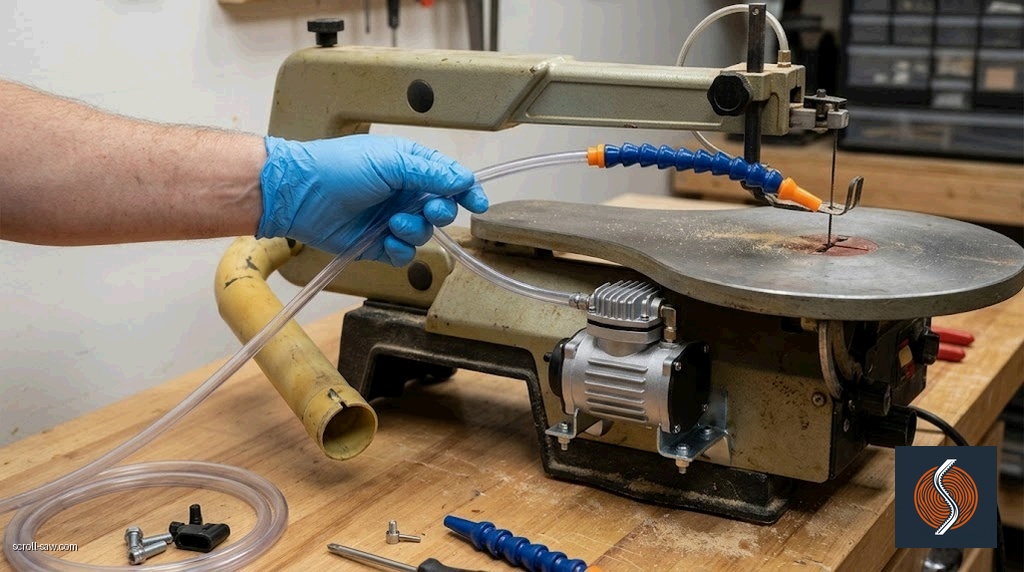
Scroll Saw Air Blower: Upgrade and Install Guide
An air blower on a scroll saw does one small job and does it constantly: it pushes sawdust away from the cut line so you can see the pattern you are following. That sounds trivial until you spend twenty minutes squinting through a haze of poplar dust trying to hit a 1/16-inch pilot line. A working blower is the difference between watching your cut and guessing at it.
Most scroll saws ship with a factory blower tube. Some are excellent. Many are undersized, poorly aimed, or dead within a year. Replacing or upgrading the blower is a small project that pays back the first cut you make after.
What a scroll saw blower actually is
The blower is a small air pump built into the saw, usually driven by an eccentric on the same motor shaft that drives the blade arm. A flexible tube carries the airflow from the pump to a nozzle mounted near the blade. Every stroke of the blade pumps a small burst of air through the tube; over the course of continuous cutting, the flow feels constant.
Airflow rates on stock scroll saw blowers range from about 5 to 15 cubic feet per minute at the nozzle. That is not a lot in absolute terms, but aimed directly at the cut line, it moves sawdust effectively.
When the stock blower needs help
Three signs your saw’s blower is not doing its job:
-
Dust piles up on the line. If you have to stop and brush sawdust off every few minutes to see the pattern, the blower is too weak or aimed wrong.
-
The tube is stiff and cracked. Cheap blower hoses become brittle within two years, especially in hot workshops. A cracked hose leaks most of the airflow before it reaches the nozzle.
-
The nozzle is dead in a specific position. Some factory blowers have a fixed nozzle angle that only aims well at one blade position. Move the piece and the airflow misses.
For any of these, an upgrade or replacement is worth the small cost.
Types of blower upgrades
Flexible articulating hose replaces the stiff factory tube with a segmented hose (Loc-Line is the common brand) that holds any position you set it to. The hose accepts standard nozzles and lets you aim the airflow precisely at the cut line for any position of the workpiece. Fits most saws with minor adaptation.
Add-on shop-air blower taps into your workshop’s compressed air line and mounts a low-volume, high-pressure nozzle at the saw. Gives much stronger airflow than any built-in pump, at the cost of tapping compressed air. Overkill for most hobby work.
Small electric blower (aquarium pump or similar) runs off wall power and pushes a continuous stream of air through an aimed hose. Quieter than compressed air, higher volume than the stock pump.
For most hobby scrollers, the flexible articulating hose upgrade is the sweet spot. It fits nearly any saw, holds an aimed position without drooping, and costs less than twenty dollars.
Compatibility check before buying
Before ordering any blower upgrade, check three things on your saw:
Existing nozzle mount. Most factory blowers exit the saw at a threaded fitting, a barb, or a friction-fit tube stub. Loc-Line and similar articulating hoses connect to any of these with the right adapter, but you need to know which one you have.
Available mounting location. Some saws have a threaded hole on the upper arm for the blower tube. Others have the tube coming up through the base. Confirm where you will mount the flexible hose so it does not interfere with the arm or the workpiece.
Airflow source. The upgrade only helps if the saw’s blower pump is producing meaningful airflow. If the pump itself is dead (no air coming out of the factory tube), replacing the hose does nothing. Test with the factory tube in place before ordering upgrades.
Installing a flexible articulating hose
The simple version, for a Loc-Line hose upgrade on a saw with a threaded exit fitting:
-
Unplug the saw.
-
Remove the factory blower tube. Unscrew the fitting or pull the tube off the barb.
-
Install the Loc-Line adapter into the saw’s threaded fitting. Hand-tight is enough; do not force it.
-
Snap on the hose segments one by one until the hose reaches the blade area with a few inches of adjustable slack.
-
Add the nozzle. Loc-Line ships in several nozzle styles; a small round nozzle 3/16 inch inside diameter works well for scroll saw work.
-
Aim the nozzle at the cut line, about 1 to 1.5 inches away from where the blade meets the wood. The airflow should push chips forward, away from the leading edge of the cut.
-
Plug in and test. Run the saw and confirm airflow reaches the intended spot without the hose vibrating loose or interfering with the blade stroke.
If the hose sags under its own weight, add a support bracket or use shorter segments.
Adjusting the nozzle for different work
The right aim depends on the piece:
-
Straight outline cuts. Aim the nozzle about 1 inch ahead of the blade, in the direction the wood is feeding. Chips clear forward, keeping the line visible.
-
Interior fretwork. Aim directly at the blade, from the side. Chips scatter away from the cut and out of the throat.
-
Portrait detail. Aim across the top of the workpiece, slightly angled downward. Chips lift and blow off the surface, keeping the whole face visible.
Re-aim any time you switch to significantly different work. A blower aimed at yesterday’s outline job is not aimed for today’s fretwork.
Where a blower upgrade is not the fix
If the visibility problem is that your shop lighting is poor, an LED work light does more good than a blower upgrade. If the problem is fine dust hanging in the air rather than piling on the cut line, a dust collection system with a hood over the throat is the right investment.
The blower moves the immediate chips out of the way. Dust collection removes the airborne fines. Lighting lets you see the line. All three are different problems.
Bottom line
A flexible articulating hose upgrade (Loc-Line style) is the highest-value blower improvement for most scroll saws. It fits nearly any machine, holds an aimed position, and costs under twenty dollars. Install it once and you never fight the factory tube again. For workshops with compressed air, a shop-air nozzle gives stronger airflow at the cost of tapping the air line.
FAQ
Do all scroll saws have air blowers? Most enthusiast and professional saws do. Entry-level saws sometimes ship without one; an aftermarket blower can usually be added.
What is Loc-Line and why do scrollers use it? Loc-Line is a segmented flexible hose that snaps together to any length and holds any position you set. It is the standard aftermarket upgrade for scroll saw blowers.
Can I connect my scroll saw blower to shop compressed air? Yes, with the right regulator and a low-flow nozzle. Compressed air gives stronger airflow than any built-in pump.
Why does my scroll saw blower not seem to work? Usually a cracked hose, a clogged nozzle, or a dead pump inside the saw. Test each in turn to find the failure point.
Where should I aim the blower nozzle? 1 to 1.5 inches from where the blade meets the wood, angled to push chips forward away from the leading edge of the cut.
How much airflow does a scroll saw blower need? Enough to move sawdust off the cut line continuously. 5 to 15 cubic feet per minute at the nozzle is typical and adequate.
Can a blower replace dust collection? No. A blower moves immediate chips off the cut line. Dust collection removes the airborne fines. Both are useful for different reasons.
References
-
Loc-Line modular hose product information, locline.com
-
Rockler scroll saw accessory catalog, rockler.com
-
Steve Good, Scroll Saw Workshop on blower upgrades, scrollsawworkshop.blogspot.com
-
DeWalt DW788 owner’s manual, dewalt.com


