
Scroll Saw Bellows: Selection and Installation Guide
Scroll Saw Bellows: Selection and Installation Guide
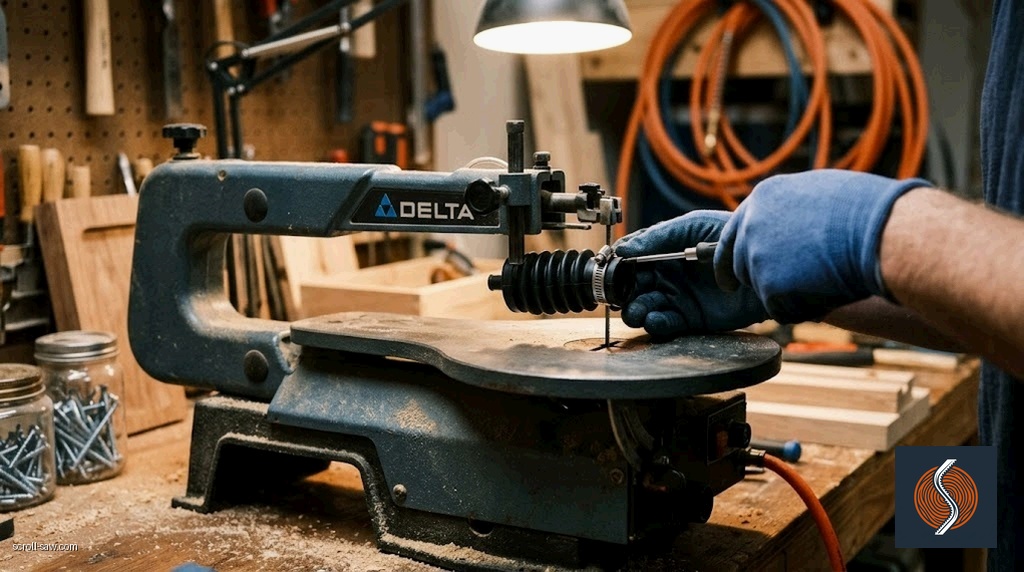
The scroll saw bellows is the small rubber pump that pushes air through the blower tube. Every stroke of the blade compresses the bellows and forces a burst of air out toward the cut line. It is one of the least glamorous parts on the saw and one of the first to fail, because rubber compresses hundreds of thousands of times over the life of a scroll saw and eventually splits, hardens, or tears loose from its mount.
When the bellows dies, the blower stops. The cut line disappears under sawdust and you find yourself brushing chips off every few minutes to see the pattern. Fixing it starts with picking the right replacement.
What a bellows actually does
A scroll saw bellows sits inside the saw’s upper arm or motor housing, connected mechanically to the arm’s motion so that each cutting stroke squeezes the bellows and releases a puff of air. That air travels through a tube to the nozzle at the blade area. The mechanism is simple: no fan, no electric motor, just rubber compression driven by the saw’s own movement.
Bellows sizes range from about 30 to 80 cubic centimeters of internal volume. Larger bellows push more air per stroke but require more room inside the saw. Most factory bellows fall in the 40 to 60 cc range.
Signs the bellows needs replacement
Three symptoms almost always mean bellows failure:
-
No air at the nozzle. The most obvious sign. If the pump is not moving, the bellows is likely split.
-
A hiss from the saw body during cutting. A partial split lets air escape at the bellows itself rather than through the tube.
-
Weak flow that used to be stronger. Rubber hardens with age; a bellows that was compressing fully three years ago may now be too stiff to compress much.
Before blaming the bellows, check that the blower tube itself is not cracked and that the nozzle is not clogged with dust. A leaking or blocked tube produces the same symptoms as a failing bellows.
Fit issues to check before buying a replacement
Bellows are not universal. What must match:
Saw make and model. Every manufacturer sizes and mounts the bellows differently. A DeWalt DW788 bellows is not the same part as a Delta 40-series bellows. Buy the specific replacement listed for your saw, or a documented equivalent.
Mounting geometry. Some bellows have a screw-in mount, some have a friction fit, some have a bracket that clips into the arm. Compare the failed part to the replacement before ordering when possible.
Air outlet fitting. The bellows connects to the blower tube through a barb, threaded fitting, or friction stub. The replacement has to match your existing tube or you need to replace both together.
Cubic centimeter volume. Approximate replacements are acceptable if the volume is close. A 40 cc replacement in a saw designed for a 50 cc unit will produce slightly less airflow but generally still works.
Sources for replacement bellows
Factory parts. DeWalt, Delta, Hegner, Excalibur, and Pegas all sell replacement bellows for their saws through customer service channels or parts distributors. Factory parts fit exactly, cost more, and sometimes ship slowly.
Aftermarket brand equivalents. Companies like Sloan’s Woodshop and Bear Woods stock aftermarket bellows for common saw models at lower cost than factory parts. Verify the fit by cross-referencing the saw model.
Universal bellows kits. A few suppliers sell generic bellows with an assortment of fittings intended to fit multiple saws with minor adaptation. Useful if you cannot find your specific saw’s part; requires more setup work at install.
Salvage. For discontinued saws, a used bellows from a similar model on a secondary marketplace may be your only option. Inspect carefully for splits or hardening before installing.
Installation basics
Every saw is different but the general sequence:
-
Unplug the saw.
-
Remove the upper arm cover or motor housing panel to access the bellows.
-
Disconnect the blower tube from the bellows outlet.
-
Unclip or unscrew the old bellows from its mounting bracket and from the drive linkage.
-
Install the new bellows in the same orientation. If the mounting geometry differs slightly, adapt the bracket rather than forcing the bellows into a wrong position.
-
Reconnect the blower tube to the outlet fitting. Confirm it seats tightly with no gaps.
-
Reassemble the housing and plug the saw back in.
-
Test. Run the saw briefly with no blade. Confirm air is flowing at the nozzle. If not, check the tube connection and the mounting orientation.
If the new bellows is stiff and produces less air than expected in the first minute of use, run the saw for a few minutes at moderate speed to break in the rubber. Airflow often improves after the first hour of operation.
When to upgrade instead of just replace
If you have already replaced the bellows once and the blower still underperforms, the pump itself may be limited by design. Consider:
Larger aftermarket bellows if your saw’s mounting allows a slightly larger unit. More volume per stroke means more airflow.
Shop-air conversion for workshops with compressed air. Bypasses the mechanical bellows entirely, delivering strong constant airflow through a regulated line. Costs more, requires a compressor.
Small electric blower (aquarium pump size) plumbed into the existing blower tube. Runs continuously, does not depend on the saw’s mechanical pump.
Any of the three eliminates future bellows failures at the cost of some initial setup.
Bottom line
When your scroll saw blower stops working, the bellows is the most likely cause after a cracked hose. Match the replacement to your specific saw make and model, install carefully, and expect to replace the bellows every three to five years of regular use. For workshops that use the saw heavily, converting to shop-air or a small electric blower eliminates the recurring failure.
FAQ
What is a scroll saw bellows? A small rubber pump that compresses with each cutting stroke to push air through the blower tube toward the cut line.
How long does a scroll saw bellows last? Typically three to five years of regular use before rubber failure. Heavy use or hot workshop conditions shorten that.
Can I use a bellows from a different saw model? Rarely. Bellows are sized and mounted for specific saws. Universal kits exist for some situations but factory or documented aftermarket parts fit best.
Why does my bellows keep failing? Usually workshop temperature, ozone exposure (some workshops with certain equipment produce ozone that degrades rubber), or a manufacturing defect. Consider a shop-air conversion if failures recur.
Do all scroll saws have bellows? Most do. Some entry-level saws omit the blower entirely; some professional saws use electric fans instead.
Can I repair a split bellows? Rubber cement patches sometimes work as a short-term fix but fail again quickly. Replacement is the correct repair.
Where do I buy a bellows for a discontinued saw? Secondary marketplaces for used original parts, or an aftermarket universal kit adapted to fit.
References
-
DeWalt DW788 parts and service documentation, dewalt.com
-
Sloan’s Woodshop scroll saw parts, sloanswoodshop.com
-
Bear Woods scroll saw accessories, bearwood.com
-
Pegas Scroll Saw parts catalog, pegas-swiss.com


