
Cutting a Scroll Saw Keychain: Entry Holes, Interior Cuts, and Assembly
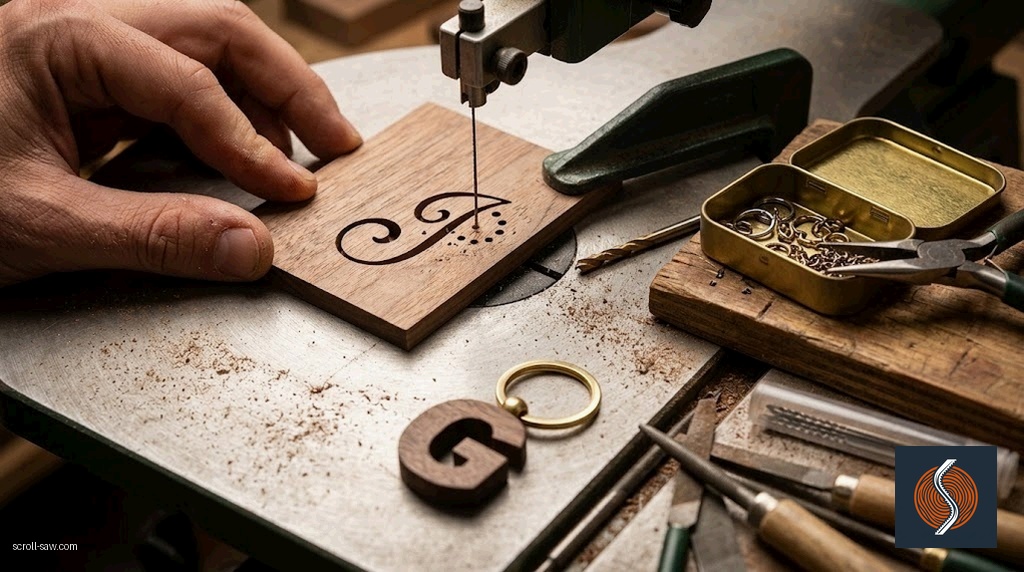
Cutting a Scroll Saw Keychain: Entry Holes, Interior Cuts, and Assembly
A scroll saw keychain is one of those small projects that hits above its weight. It fits in a pocket, gets used every day, and often becomes a favorite gift because it’s personal without being fussy. The category runs from simple silhouettes (a fish, a heart, an initial) to pierced monograms with fine detail, and every version cuts on the same basic technique.
What separates a keychain that lasts years from one that cracks in a month: wood species, thickness, and the location of the keyring hole relative to the piece’s grain and edges.
What keychain patterns typically include
Most scroll saw keychains are one of three types. A silhouette keychain (a fish, animal, sports icon, or heart cut as a solid shape). A pierced initial or monogram keychain (a letter or two letters pierced through a wooden background). A shaped keychain (a specific icon like a car, guitar, or state outline).
Quick answer: cut from 1/4 to 3/8 inch exotic hardwoods (cherry, walnut, bloodwood, ebony, or maple). Use a #3 skip-tooth blade for outer perimeter and a #1 or #2/0 for pierced initial detail. Drill the keyring hole with a 1/8 inch bit. Cut interior detail before outer perimeter. Attach a metal split ring after finishing. Finish with wipe-on oil.
Wood choice
Quarter-inch to 3/8 inch cherry for warm oiled keychains.
One-eighth to 3/8 inch walnut for darker warm keychains.
One-eighth to 3/8 inch bloodwood for bright red statement keychains.
One-eighth to 3/8 inch ebony for near-black formal keychains. Cuts slowly.
One-eighth to 3/8 inch maple for pale keychains that take stain or paint.
Avoid pine (grain fights fine detail and splits along thin sections) and MDF (not durable enough for daily pocket wear).
Material thickness
Quarter-inch stock for standard-size keychains (1.5 to 2.5 inches at longest dimension).
Three-eighths inch stock for larger keychains where more substantial feel is wanted.
One-eighth inch stock for very small keychains (under 1.5 inches). More fragile but reads more like fine jewelry.
Stay under 1/2 inch. Anything thicker feels bulky in a pocket.
Blade choice
A #3 skip-tooth blade for outer perimeter cuts on 1/4 to 3/8 inch stock.
A #1 or #2/0 blade for pierced initial detail on 1/4 inch stock.
A #5 skip-tooth for outer perimeter on 3/8 inch stock or particularly dense hardwoods.
Fresh blades matter more on small pieces than on large ones. A dulled blade on a keychain’s initial detail destroys the piece.
Keyring hole placement
The keyring hole is the critical detail:
-
Drill diameter: 1/8 inch for standard split rings.
-
Position: at least 1/4 inch from the piece’s edge and at least 1/4 inch from any pierced detail.
-
Direction: perpendicular to the piece face, drilled with a drill press for accuracy.
Drill the hole before cutting the outer perimeter. Drilling into a finished small piece risks slipping and damaging the piece.
Entry hole planning
Every pierced initial or interior detail needs a drilled entry hole. Common keychain entry hole locations:
-
Initial or monogram: one entry hole per closed counter (A, B, D, O, P, Q, R).
-
Pierced silhouette detail (a fish’s eye pierce, an animal’s eye or ear pierce).
-
Decorative border pierce (rosettes, small floral pierces).
Drill entry holes with a 1/32 inch bit for fine detail work.
Cut sequence
-
Sand both faces of the panel to 220 grit before cutting.
-
Apply the pattern with painter’s tape and light spray adhesive.
-
Drill the keyring hole with a 1/8 inch bit at the pre-marked location.
-
Drill every interior detail entry hole with a 1/32 inch bit.
-
Cut interior detail smallest to largest.
-
Cut the outer perimeter last in one continuous cutting path.
-
Peel the pattern paper from the finished piece.
Where scroll saw keychains fail
Keyring hole cracks. Hole drilled too close to the piece edge. Leave at least 1/4 inch of wood between the hole and the outer edge.
Initial detail shears off. Detail drawn thinner than 1/16 inch. Thicken.
Outer perimeter point breaks. Point drawn thinner than 1/16 inch. Blunt slightly on pattern.
The keychain cracks in a pocket. Grain runs across a thin cross-section, or wood species too brittle. Use straight-grained hardwood with grain along the piece’s longest axis.
The keychain’s initial reads wrong. Font stroke thickness too thin for the small keychain size. Choose bold sans-serif fonts and verify minimum stroke thickness of 1/16 inch at final size.
Grain orientation
Grain runs along the keychain’s longest axis. For a fish keychain, grain runs from head to tail. For a monogram keychain, grain runs vertically along the initial’s dominant stroke.
Grain crossing thin initial strokes weakens the piece for pocket wear.
Finishing
Wipe-on boiled linseed oil for cherry, walnut, and maple. Two coats over two days.
Oil-varnish blend for slightly more protection against pocket wear.
Mineral oil plus beeswax blend for keychains that will contact skin (some people wear a keychain against the wrist on a lanyard).
Carnauba wax paste finish for a soft-luster keychain that develops patina with pocket wear.
Spray lacquer for painted keychains: shellac sanding sealer, acrylic craft paint, matte water-based polyurethane top coat.
Avoid heavy polyurethane; film thickness reads plastic on small pieces.
Attaching the split ring
After finishing:
-
Thread a metal split ring (typically 3/4 to 1 inch diameter) through the pre-drilled keyring hole.
-
If desired, add a jump ring between the wooden piece and the split ring for freedom of movement.
Split rings come in stainless steel, brass, or antiqued bronze. Match the metal to the wood species (brass with cherry, stainless with maple, antiqued bronze with walnut).
Comparing three keychain projects
Simple heart or fish silhouette in 1/4 inch cherry, oiled, stainless split ring. The reliable first keychain. Cuts in an afternoon.
Pierced initial or monogram keychain in 3/8 inch walnut, oiled, brass split ring. The mid-range piece.
Detailed sports icon or state outline keychain with painted color scheme in 1/4 inch maple, sealed and painted, brass split ring. The signature piece.
Conclusion
A scroll saw keychain lasts years of daily pocket wear when the wood species is closed-grain hardwood, the keyring hole is at least 1/4 inch from any edge, and the initial or interior detail is drawn at least 1/16 inch thick on the pattern. Quarter to 3/8 inch cherry, walnut, or bloodwood. A #3 skip-tooth outline with #1 or #2/0 for interior detail. Wipe-on oil finish. Metal split ring attached after finishing. Do those and the finished keychain becomes a favorite everyday carry piece, which is why keychains keep getting requested as gifts.
Frequently asked questions
What wood works best for a scroll saw keychain? Quarter to 3/8 inch cherry, walnut, bloodwood, or maple. Closed-grain hardwoods that survive pocket wear.
Which blade cuts keychain detail cleanest? A fresh #3 skip-tooth for outer perimeter, dropping to a #1 or #2/0 for fine initial detail.
How far should the keyring hole be from the edge? At least 1/4 inch of wood between the hole and the outer edge, at least 1/4 inch from any pierced detail.
How thin can I safely draw an initial stroke? Minimum 1/16 inch on the pattern at final size. Thinner strokes shear off during cutting or wear.
How should the grain run? Along the keychain’s longest axis. Grain crossing thin initial strokes weakens the piece.
What finish holds up in a pocket? Wipe-on oil or oil-varnish blend for wood color, carnauba wax for a soft-luster piece that develops patina with wear.
How do I attach a split ring? After finishing, thread a stainless steel, brass, or antiqued bronze split ring through the pre-drilled keyring hole. Add a jump ring between for freedom of movement.
References
-
Steve Good, Scrollsaw Workshop pattern archive: scrollsawworkshop.blogspot.com
-
Sue Mey, Scroll Saw Artist: scrollsawartist.com
-
Scroll Saw Woodworking & Crafts, Fox Chapel Publishing: foxchapelpublishing.com


