
Scroll Saw Blade Adapter: Selection and Setup
Scroll Saw Blade Adapter: Selection and Setup
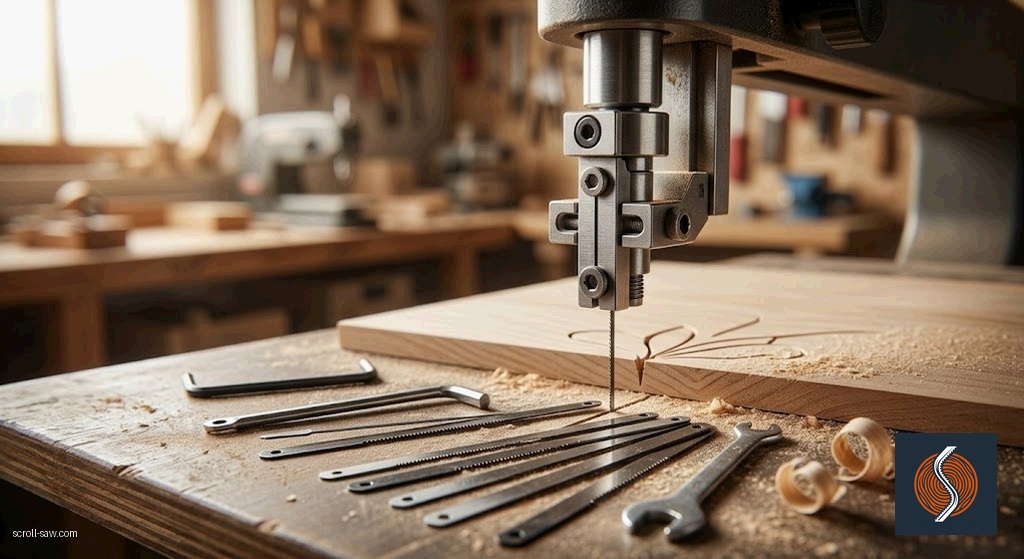
A scroll saw blade adapter lets you use a blade format your saw was not designed for. The most common case: a saw built for pinned blades that you want to run with plain-end blades because plain-end blades come in finer sizes and cut cleaner. The adapter is a small metal fitting that clamps the plain-end blade and presents itself to the saw as if it were a pinned blade.
Adapters expand what your saw can do without buying a new machine. They also introduce a small mechanical link that has to hold under tension without slipping, and picking the right adapter starts with knowing which blade sizes you actually need to run.
Why anyone bothers with an adapter
Pinned blades are limited. The pin at each end makes the blade too wide for very fine sizes (nothing smaller than roughly a #5 equivalent), too wide to feed through small pilot holes for interior fretwork, and too wide to turn as tight as a plain-end blade of the same nominal cutting size.
If you own a pin-end saw and you want to do fretwork with tiny bridges, portrait scrolling with dozens of tight turns, or any work that requires threading the blade through a hole smaller than 1/16 inch, an adapter is the affordable alternative to buying a new saw.
The size question
Once the adapter is installed, you can run any plain-end blade size the adapter accepts. Most adapters accept the full range of standard 5-inch scroll saw blades from #2/0 through #12.
Match blade size to material the same way you would with a native plain-end saw:
| Material | Thickness | Blade size |
|---|---|---|
| Basswood | 1/8 in | #3 skip-tooth |
| Baltic birch ply | 1/8 in | #3 reverse-tooth |
| Baltic birch ply | 1/4 in | #5 reverse-tooth |
| Cherry, walnut | 1/4 in | #5 skip-tooth |
| Cherry, walnut | 1/2 in | #7 skip-tooth |
| Oak, maple | 1/2 in | #7 skip-tooth |
| Oak, maple | 3/4 in | #9 skip-tooth |
| Pine, spruce | 3/4 in | #9 skip-tooth |
| Portrait fretwork | 1/4 in wood | #2/0 or #1 spiral |
What to check before buying an adapter
Saw pin size. Different pin-end saws use slightly different pin diameters. The adapter has to have a pin (or pin equivalent) that matches your saw’s clamp. Confirm the pin diameter from your saw’s manual or by measuring the pin on a stock blade.
Clamp method. Adapters use either a setscrew, a wedge lock, or a friction fit to grip the plain-end blade. Setscrew adapters hold the tightest but require a small hex key for every blade change. Wedge lock adapters change blades faster. Friction fit is the least reliable.
Blade size range. Some adapters accept the full range of plain-end blades. Others have a minimum blade thickness. Confirm compatibility with the sizes you want to run.
Pair count. You need two adapters per saw: one for the upper clamp, one for the lower clamp. Some suppliers sell them as pairs; some sell them individually. Read the listing carefully.
Installation and setup
Installation is simple in principle: the adapter slides into the saw’s blade clamp exactly like a stock pinned blade would, and the blade clamps into the adapter.
-
Unplug the saw.
-
Release blade tension and remove any existing blade.
-
Insert the lower adapter into the lower blade clamp. Confirm it seats fully and holds against light finger pressure.
-
Insert the upper adapter into the upper blade clamp.
-
Clamp a plain-end blade into the adapters. Teeth pointing down and forward.
-
Apply tension using the saw’s tension mechanism.
-
Pluck the blade. Ring, not thud. Re-tension if the note is dull.
-
Test-cut on scrap before touching the workpiece.
Pay attention to whether the blade slips at any point during tensioning. A blade that pulls out of the adapter under tension is a setup problem, not a blade problem. Tighten the setscrews or reseat the wedge lock.
Common problems
Blade slipping under tension. Usually the setscrew was not tight enough, or the adapter’s grip surface has become polished from many blade changes. Retighten; if slipping persists, roughen the grip surface with fine sandpaper or replace the adapter.
Blade breaking early. Adapters can create a stress point where the blade exits the adapter. If the blade always breaks in the same spot, the adapter may be pinching the blade at an angle. Check alignment.
Adapter loose in saw’s clamp. The saw’s original clamp may be worn. Check with a stock pinned blade to see if that seats correctly.
Reduced blade life. Adapters introduce a small extra mass at the blade ends, which can affect blade life slightly. Reduction of 10 to 20 percent from what you would expect on a native plain-end saw is normal.
Where adapters do not solve the problem
If your pin-end saw has a limited stroke length, weak tension mechanism, or worn arm bushings, an adapter will not fix any of that. Adapters expand blade selection; they do not upgrade the saw itself. If the saw is fundamentally worn out or too limited for the work you want to do, a new plain-end saw is the correct upgrade.
Bottom line
A scroll saw blade adapter is a cheap way to run fine plain-end blades on a pinned scroll saw. For a hobbyist who wants to try fretwork or portrait scrolling without buying a new machine, a pair of adapters plus a bundle of plain-end blades in the sizes you need is the practical starting kit. Match blade size to material as with any scroll saw, and expect slightly shorter blade life than on a native plain-end saw.
FAQ
What is a scroll saw blade adapter? A small fitting that clamps a plain-end blade and presents itself to the saw as a pinned blade, letting pinned saws run plain-end blades.
Do I need two adapters or one? Two. One for the upper blade clamp, one for the lower.
Will any adapter fit my scroll saw? Only adapters designed for your saw’s pin size and clamp geometry. Check the manual or measure your stock blade’s pin.
Can I use the smallest plain-end blades with an adapter? Most adapters accept the full range from #2/0 through #12. Confirm the specification on the adapter.
Does an adapter reduce blade life? Slightly, by roughly 10 to 20 percent compared to a native plain-end saw. Usually not enough to matter for hobby use.
Why does my blade slip out of the adapter? Usually the setscrew is not tight enough or the grip surface is polished from wear. Retighten and inspect.
Should I buy an adapter or a new plain-end saw? Adapters cost a fraction of a new saw and work for casual use. Serious scrollers eventually move to a native plain-end saw for better cut quality and simpler blade changes.
References
-
Sloan’s Woodshop scroll saw adapters, sloanswoodshop.com
-
Bear Woods scroll saw accessories, bearwood.com
-
Steve Good, Scroll Saw Workshop on blade adapters, scrollsawworkshop.blogspot.com
-
Olson Saw Company blade documentation, olsonsaw.com


