
Scroll Saw Blade Clamp Parts: Selection Guide
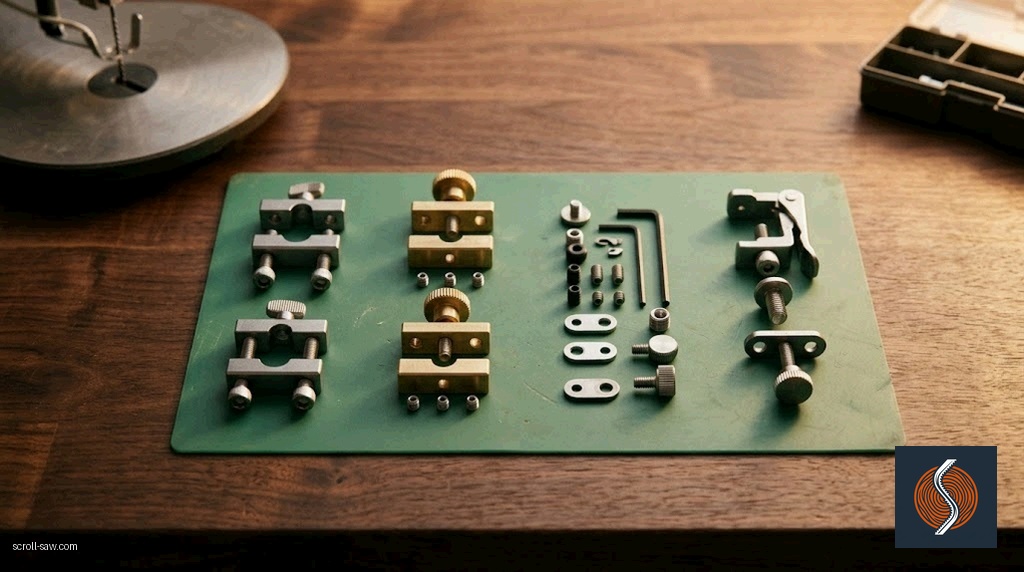
Scroll Saw Blade Clamp Parts: Selection Guide
A scroll saw blade clamp fails in small, annoying ways long before it fails entirely. A thumbscrew that will not stay tight. A clamp block with polished faces that let the blade slip. A stripped thread on the arm mount. Each of these is a five-dollar part and a twenty-minute repair, but only if you order the right part for your saw. Order the wrong one and you have added days of downtime for nothing.
Here is how to identify what you actually need before you spend on replacements.
The parts inventory
A scroll saw blade clamp typically has these components:
-
Clamp body. The main housing that mounts to the saw’s arm.
-
Clamp block or jaw. The moving piece that grips the blade end.
-
Thumbscrew or setscrew. Applies pressure to hold the clamp block.
-
Captive washer or spring. Keeps the thumbscrew in place and provides consistent pressure.
-
Mounting stud or thread. Attaches the clamp body to the arm.
-
Grip insert. A small hardened or knurled surface in the clamp jaw that grips the blade end.
Different saws combine these components differently. Some saws use a one-piece clamp body with a thumbscrew; some use multi-piece assemblies with springs and washers.
Diagnosing which part failed
Before ordering anything, identify the actual failure:
Thumbscrew loose or stripped. If you can turn the thumbscrew freely with no resistance, the thread is stripped or the screw itself is worn. Look at the threads for wear. If the screw threads are worn, replace the screw. If the clamp body threads are worn, replace the whole clamp body.
Clamp block polished or dented. The clamp block should have a small textured or grooved surface where it contacts the blade. If that surface is polished smooth from years of blade changes, the block slips even when the thumbscrew is tight. Replace the block or roughen the surface with a fine file.
Blade end shows compression marks in the same spot. If your used blades all have a dent in the same location from the clamp, the clamp is gripping in one point rather than distributing pressure. Either the clamp block is worn or the thumbscrew is bent.
Clamp body wobbly on the arm. The mounting stud or threads on the arm are worn. Sometimes fixable with thread-locking compound; often requires a new clamp body.
Blade slips out entirely under tension. Multiple parts may be worn. Inspect thumbscrew, block, and grip surface.
Matching parts to your saw
What has to match on any replacement clamp part:
Saw make and exact model. Parts are not interchangeable between saws even from the same manufacturer. A DeWalt DW788 upper clamp is not the same part as a DeWalt DW788Type 2 clamp; each production run has slightly different part numbers.
Position. Upper and lower clamps are often different parts. Order both if replacing a pair.
Thread pitch. Thumbscrews have specific thread pitches (metric or imperial). A random replacement screw from a hardware store may not thread correctly.
Clamp jaw dimensions. The blade slot has to accept the blade thickness range you use. Some clamps have very narrow slots that will not accept larger blade sizes.
Grip surface. Original clamps often have a factory-hardened grip surface. Aftermarket replacements may use different materials.
Before ordering, cross-reference the part number in your saw’s service manual against the manufacturer’s parts catalog. Photograph the failed part next to a ruler and keep the image for reference.
Sources for replacement clamp parts
Factory parts through the saw manufacturer’s customer service or authorized parts distributors. Fits exactly, costs more, ships in a few days to a few weeks depending on stock.
Aftermarket from Sloan’s Woodshop, Bear Woods, PS Wood, and similar scroll saw specialty retailers. Lower cost, wider selection, sometimes better designs than the factory original. Verify fit by cross-referencing the saw model.
Salvage from a used saw of the same model. Only viable if you know the part is in good condition; a used clamp with the same wear as yours is not a repair.
Installation for common clamp repairs
Thumbscrew replacement.
-
Unplug the saw.
-
Release blade tension and remove the blade.
-
Unscrew the failed thumbscrew from the clamp body.
-
Thread in the replacement. Hand-tight; do not over-tighten.
-
Test with a blade to confirm proper grip.
Clamp block replacement.
-
Unplug the saw.
-
Release tension and remove the blade.
-
Remove the thumbscrew.
-
Slide out the old clamp block.
-
Insert the new block, confirming orientation matches.
-
Reinstall the thumbscrew.
-
Test with a blade.
Full clamp body replacement.
-
Unplug the saw.
-
Release tension and remove the blade.
-
Unscrew the clamp body from the arm’s mounting thread.
-
Thread the new clamp body into the arm. Hand-tight, then snug with a wrench if the kit includes one.
-
Install the thumbscrew and clamp block if separate.
-
Test with a blade.
Common mistakes
Over-tightening. Aluminum threads on scroll saw arms strip easily. Hand-tight plus a quarter turn is usually enough.
Wrong thread size. A close-but-not-matching thread cross-threads the aluminum and destroys the mount. Confirm the thread size before installing.
Ignoring the grip surface. A new thumbscrew in a worn clamp body still fails. Replace all worn components at once.
Missing the captive washer. Some thumbscrews have a small washer that must be installed in a specific orientation. Losing or misinstalling it lets the thumbscrew back out under vibration.
When clamp parts are not the fix
If the clamp itself is in good condition and the blade still slips or breaks:
-
Check blade tension. Under-tensioned blades wander regardless of clamp condition.
-
Check for a cambered blade. Roll each blade on a flat surface before installing.
-
Check the arm bushing or bearing. A worn arm bushing lets the whole upper arm shift under load, mimicking clamp failure.
Systematic diagnosis saves the cost of replacement parts you did not need.
Bottom line
Start with the saw model and the exact failed part. Order factory or documented aftermarket replacements from a scroll saw specialty retailer. Install carefully with hand-tight torque plus a small final snug. Do not order clamp parts to fix a problem that turned out to be tension, blade choice, or arm wear.
FAQ
Where do I find the part number for my clamp? In the saw’s service manual, or through the manufacturer’s parts diagram online.
Can I use a hardware store thumbscrew as a replacement? Only if the thread pitch, length, and head style match exactly. Woodworking supply catalogs stock scroll saw thumbscrews in the correct specifications.
Why does my new thumbscrew keep loosening? Usually a missing captive washer, a stripped thread in the clamp body, or excessive vibration. Inspect the thread and check for a captive washer in the kit.
Can I repair a stripped thread instead of replacing the clamp? Sometimes, with a helicoil insert or a thread-locking compound. For a scroll saw clamp under tension, replacement is usually more reliable.
How often should I replace clamp parts? When wear appears: loose grip, blade slippage, stripped threads. In light hobby use, that might be never. In heavy use, every few years.
Are aftermarket clamp parts better than factory? Sometimes. Aftermarket suppliers occasionally produce improved designs (better grip surfaces, sturdier construction). Read reviews from users of your specific saw.
Can I upgrade to a quick release chuck instead of replacing clamp parts? Yes, if a compatible quick release kit exists for your saw. Often a better long-term investment than repeated clamp part replacements.
References
-
DeWalt DW788 parts diagram, dewalt.com
-
Sloan’s Woodshop scroll saw parts catalog, sloanswoodshop.com
-
Bear Woods scroll saw accessories, bearwood.com
-
Pegas Scroll Saw replacement parts, pegas-swiss.com


