
Scroll Saw Blade Conversion: Sizing Guide
Scroll Saw Blade Conversion: Sizing Guide
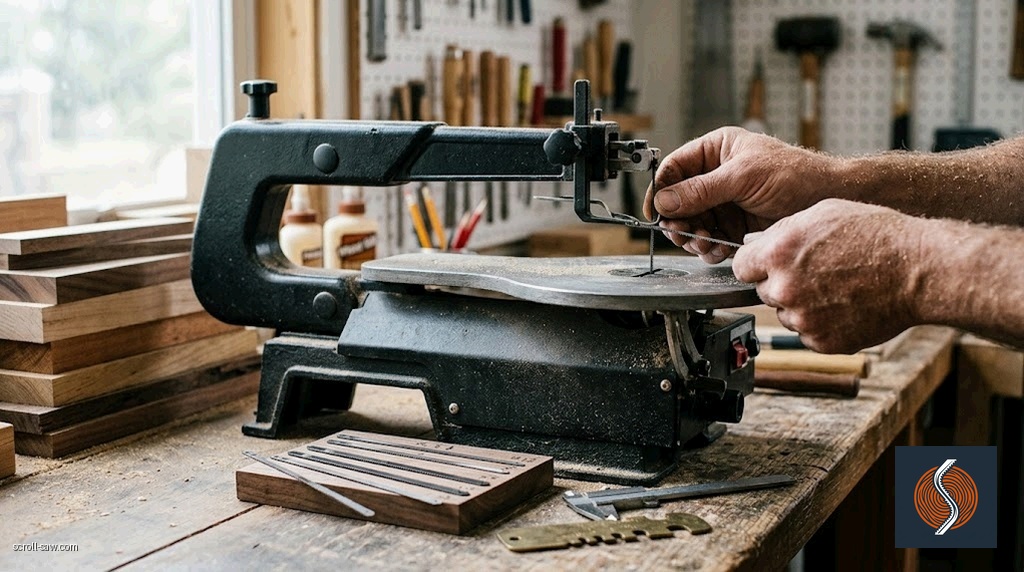
A scroll saw blade conversion changes what blade styles your saw accepts. The most common conversion moves a pin-end saw to accept plain-end blades, opening up the full range of blade sizes from #2/0 through #12. Once the conversion is done, blade selection works the same as on any native plain-end saw: match the number to the material.
Getting the size right is the difference between a satisfying afternoon of cutting and a frustrating one where the blade wanders, burns the wood, or breaks every few minutes.
What conversion actually enables
Before conversion, a pin-end saw is limited to pinned blades. Pinned blades cannot be made smaller than roughly a #5 equivalent, cannot fit through pilot holes smaller than 1/16 inch, and cannot turn as tight as fine plain-end blades.
After conversion (adapters or a full clamp replacement), your saw accepts plain-end blades in every size the market offers. That unlocks:
-
Fine fretwork with bridges as thin as 1/32 inch, using #2/0 or #1 blades
-
Portrait scrolling with tight interior curves, using spiral or reverse-tooth blades
-
Interior cuts through pilot holes as small as 1/16 inch
-
Cleaner cut walls in hardwood with precision-ground blades
None of that changes if you keep loading only #5 and #7 blades. The conversion is worth it only if you use the new capability.
The complete sizing chart
| Material | Thickness | Blade size | Style |
|---|---|---|---|
| Basswood | 1/8 in | #3 | Skip-tooth |
| Basswood | 1/4 in | #5 | Skip-tooth |
| Baltic birch ply | 1/8 in | #3 | Reverse-tooth |
| Baltic birch ply | 1/4 in | #5 | Reverse-tooth |
| Cherry, walnut | 1/4 in | #5 | Precision ground skip-tooth |
| Cherry, walnut | 1/2 in | #7 | Precision ground skip-tooth |
| Cherry, walnut | 3/4 in | #9 | Skip-tooth |
| Oak, maple | 1/2 in | #7 | Skip-tooth |
| Oak, maple | 3/4 in | #9 | Skip-tooth |
| Pine, spruce | 3/4 in | #9 | Skip-tooth |
| Ipe, teak | 1/2 in | #7 | Precision ground with coating if available |
| Portrait detail | 1/4 in wood | #2/0 or #1 | Spiral or reverse-tooth |
| Fine fretwork | 1/8 to 1/4 in | #1 or #3 | Reverse-tooth |
| Corian | 1/4 in | #5 | Skip-tooth at half speed |
| Acrylic | 1/8 to 1/4 in | #5 | Skip-tooth at low speed |
| Brass, aluminum 1/16 in | 1/16 in | #3 | Metal-cutting blade with fluid |
The rule of thumb
Choose the largest blade that still holds the detail your pattern requires. Larger blades:
-
Track straighter through cuts
-
Break less often
-
Cut faster
-
Handle heavier feed
Smaller blades handle finer detail but wander more, break more often, and cut slower. Do not size down unless the pattern demands it.
Setup notes for plain-end blades after conversion
Tension firm. Plain-end blades need consistent tension. Pluck; you want a clear ring. Re-tension after the first minute of cutting.
Speed appropriate to material. Middle SPM for hardwood, upper middle for softwood, lower for plastics.
Feed light. Guide the wood; do not push. If you feel yourself pushing, the blade is too small for the material.
Zero-clearance insert. Fine blades tip through wide throat openings when cutting small pieces. A zero-clearance insert prevents pinches and unexpected breakage.
Blade brand recommendations after conversion
Once your saw can run plain-end blades, brand choice matters more:
Olson SK series for general skip-tooth cutting at moderate price. Widely available.
Olson PGT for precision ground cuts in hardwood. Cleaner walls, longer blade life.
Pegas for premium ground blades. Higher cost, longest blade life in dense stock.
Niqua Onyx and Puma for German precision at prices between Olson and Pegas.
Flying Dutchman for a broad range of specialty blades including spiral and multi-directional.
Buy a bundle of each in your most-used size and see which suits your feel. Personal preference matters more than blade rankings.
Common problems after conversion
Blade slipping in the adapter or new chuck. Setscrew not tight enough, or the grip surface is polished. Retighten or roughen the surface.
Blade breaking early. The adapter or new chuck adds a small extra mass at the blade ends. Expect blade life to drop by 10 to 20 percent compared to a native plain-end saw.
Blade tension inconsistent. The saw’s original tension mechanism may not be optimized for the range of blade sizes now available. Larger blades need more tension; smaller blades need less.
Sawdust builds up in the new chuck mechanism. Blow out with compressed air occasionally to prevent jamming.
When conversion is the wrong approach
If your saw has fundamental limitations (weak motor, worn arm bearings, small throat), a blade conversion will not fix any of that. For an old saw that is struggling in every way, a new plain-end saw is often the better investment than continued modifications to an aging machine.
Also reconsider if you only cut outline shapes with #7 and larger blades. The conversion opens up capabilities you may never use, and the money would be better spent elsewhere (better blades, dust collection, a work light).
Bottom line
After a blade conversion, size selection works the same as any plain-end saw. Match the number to the material and thickness. Buy quality plain-end blades in the sizes you use most. Tension firmly, feed lightly, and use the new fine sizes for the work that motivated the conversion in the first place.
FAQ
What does a scroll saw blade conversion do? Changes the saw’s blade clamps to accept a different blade style, most commonly converting a pinned saw to accept plain-end blades.
Which blade size should I buy first after conversion? #5 skip-tooth as your workhorse, plus a bundle of #3 or #2/0 for the fine work the conversion enables.
Does the conversion change how a specific blade cuts? No. TPI, kerf, radius, and finish come from the blade itself. The conversion just lets you use more blade types.
Why do my blades break sooner after conversion? Adapters and aftermarket chucks add a small extra mass at the blade ends, reducing blade life by roughly 10 to 20 percent compared to a native plain-end saw.
Can I still use my old pinned blades after conversion? Depends on the conversion. Adapters typically require removing the adapter to use pinned blades. Full clamp replacements usually do not accept pinned blades at all.
How do I know what tension is right for the new blades? Pluck the tensioned blade. You want a clear ringing note. Higher tension for larger blades; slightly lower for the smallest sizes.
Should I convert or buy a new plain-end saw? Conversion for a saw with good fundamentals. New saw for a saw with weak motor, worn bearings, or other underlying issues.
References
-
Olson Saw Company plain-end blade catalog, olsonsaw.com
-
Pegas Scroll Saw blade documentation, pegas-swiss.com
-
Sloan’s Woodshop conversion kits and adapters, sloanswoodshop.com
-
Steve Good, Scroll Saw Workshop on saw conversions, scrollsawworkshop.blogspot.com


