
Scroll Saw Blade Converter: Size and Style Guide
Scroll Saw Blade Converter: Size and Style Guide
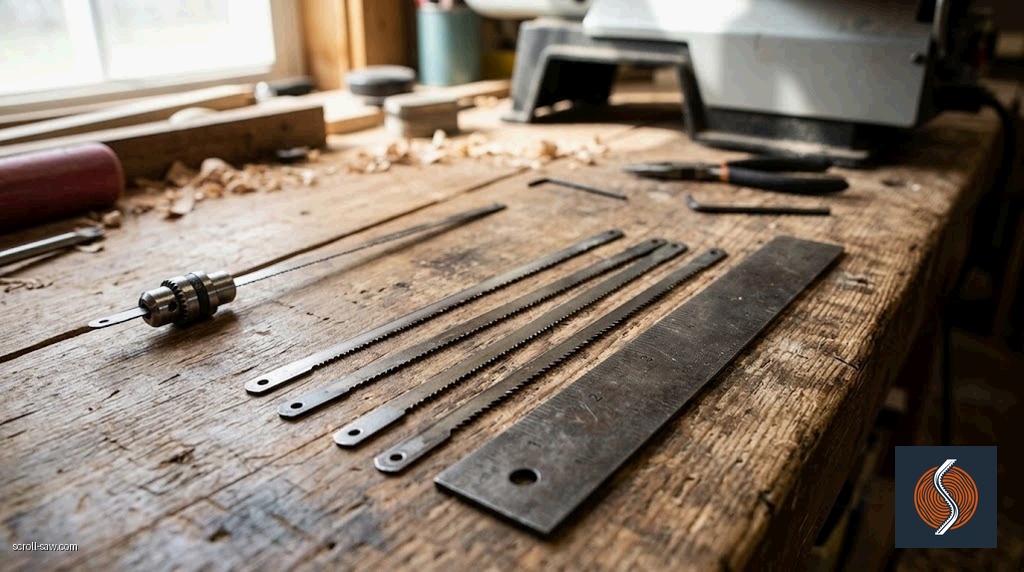
A scroll saw blade converter is another name for the adapter that lets a pin-end saw run plain-end blades. Terminology varies across manufacturers and catalogs (some call it a converter, some an adapter, some a pin-end conversion kit) but the mechanism is the same: a small metal fitting that clamps a plain-end blade and seats in the saw’s pin-end blade clamp as if the plain-end blade were pinned.
Once the converter is installed, your saw can run any size and style of plain-end blade the market makes. Choosing among those options is where the size, tooth geometry, and material match come in.
Size selection
All scroll saw blades follow the same numeric scale from very small (2/0, 3/0) up through #12. Smaller numbers are thinner blades with more teeth per inch. Larger numbers are wider blades with fewer teeth per inch and more aggressive material removal.
Once your saw runs plain-end blades through a converter, you have the full range available. Match to the material:
| Material | Thickness | Blade size |
|---|---|---|
| Basswood | 1/8 in | #3 |
| Basswood | 1/4 in | #5 |
| Baltic birch ply | 1/8 in | #3 |
| Baltic birch ply | 1/4 in | #5 |
| Cherry, walnut | 1/4 in | #5 |
| Cherry, walnut | 1/2 in | #7 |
| Cherry, walnut | 3/4 in | #9 |
| Oak, maple | 1/2 in | #7 |
| Oak, maple | 3/4 in | #9 |
| Pine, spruce | 3/4 in | #9 |
| Fine fretwork | 1/8 to 1/4 in | #1 or #3 |
| Portrait detail | 1/4 in wood | #2/0 or #1 |
| Corian | 1/4 in | #5 at half speed |
Tooth geometry: which style for which job
Skip-tooth. Every other tooth position is skipped, giving good chip clearance and cool cutting. Default for general wood cutting.
Reverse-tooth. Adds upward-facing teeth at the bottom of the blade that clean the underside of the workpiece. Use for plywood signage and any project where the underside will show.
Precision ground. Each tooth is ground after forming for consistent geometry. Cuts cleaner and lasts longer in hardwood. Worth the price for finished work.
Spiral. Teeth wrap 360 degrees around the blade axis. Cuts in any direction without pivoting the workpiece. Ideal for portrait and silhouette scrolling.
Metal-cutting. Very fine teeth designed for brass, aluminum, and thin steel. Requires cutting fluid.
Most hobby scrollers cover their needs with skip-tooth, reverse-tooth, and precision-ground blades in a few common sizes. Spiral is a valuable specialty add-on for portrait work.
Material match specifics
Hardwoods (oak, maple, cherry, walnut, dense exotics). Precision ground blades pay for themselves in blade life and cut quality. Run at moderate speed to prevent burning. Watch for scorching on cherry and maple; both show heat marks early.
Softwoods (pine, spruce, poplar). Any skip-tooth blade cuts well. Run at higher speed for faster material removal. Blade dulls slowly in these species.
Plywoods (Baltic birch, cabinet ply, veneered stock). Reverse-tooth blades prevent underside splintering. Match size to total thickness, not veneer thickness.
Plastics (acrylic, Corian). Skip-tooth blades at low speed to prevent melting. Watch for chip weld along the cut wall.
Metals. Metal-specific blades only. Use cutting fluid to reduce heat.
Exotic hardwoods (ipe, teak, purpleheart). Coated or premium ground blades for extended life. Standard blades dull within 15 to 20 minutes in these species.
Setup after installing the converter
Tension firm. Plain-end blades held in a converter need consistent tension. Pluck for a clear ring. Re-tension after the first minute of active cutting.
Speed appropriate to material. Middle SPM for hardwood, upper middle for softwood, lower for plastics.
Feed light. Guide the wood; do not push. If the blade is not cutting under fingertip pressure plus the blade’s own weight, the blade is too small or the speed is wrong.
Zero-clearance insert. Prevents small offcuts from tipping into the throat and pinching the blade.
Expected blade life with a converter
A converter adds a small extra mass at each blade end, which slightly reduces blade life compared to a native plain-end saw. Expect roughly 10 to 20 percent shorter life. For a scroller who was previously running pinned blades on the same saw, the plain-end blades in a converter will still often outlast the pinned blades, especially in premium ground versions.
Common problems
Blade slips out of the converter under tension. Setscrew is not tight enough. Retighten with the hex key. If slipping persists, roughen the grip surface with fine sandpaper.
Blade breaks at the converter end. Blade sitting at an angle. Loosen, reseat square, and retighten.
Converter loose in the saw’s pin socket. The saw’s socket is worn. Test with a stock pinned blade to confirm.
Reduced feed rate. Plain-end blades in fine sizes cut slower than the larger pinned blades you were used to. Not a problem; slow down and enjoy the finer detail.
Bottom line
A scroll saw blade converter (adapter) opens up plain-end blade sizes on a pinned saw. Match blade number to material using the chart above. Choose tooth geometry based on the job (skip-tooth for general, reverse for plywood, precision ground for hardwood finish work, spiral for portraits). Set up carefully with firm tension and light feed. Expect slightly reduced blade life compared to a native plain-end saw, but access to the full range of scroll saw blade options.
FAQ
What is a scroll saw blade converter? A small fitting that clamps a plain-end blade and seats in a pin-end saw’s blade clamp, letting the saw run plain-end blades. Also called an adapter.
Do I need one converter or two? Two. One upper, one lower.
Which blade size fits the converter? Most converters accept the full range of standard plain-end blades from #2/0 through #12.
Does the converter work with any pin-end saw? Only with saws whose pin socket dimensions match the converter. Check compatibility before ordering.
Does the converter reduce cut quality? Slightly. The extra mechanical joint can vibrate under tension. Difference is small enough that most scrollers do not notice.
What blades should I buy after installing the converter? Bundle of #5 skip-tooth for general work, bundle of #5 reverse-tooth for plywood, bundle of #2/0 or #1 for fine detail.
Should I buy a converter or a new plain-end saw? Converter for a saw in good condition and casual use. New plain-end saw for serious ongoing work or a saw with other issues.
References
-
Sloan’s Woodshop scroll saw converters, sloanswoodshop.com
-
Bear Woods scroll saw adapters, bearwood.com
-
Olson Saw Company plain-end blade catalog, olsonsaw.com
-
Steve Good, Scroll Saw Workshop on converters, scrollsawworkshop.blogspot.com


