
Scroll Saw Blade Guard: What It Does, What It Doesn
Scroll Saw Blade Guard: What It Does, What It Doesn
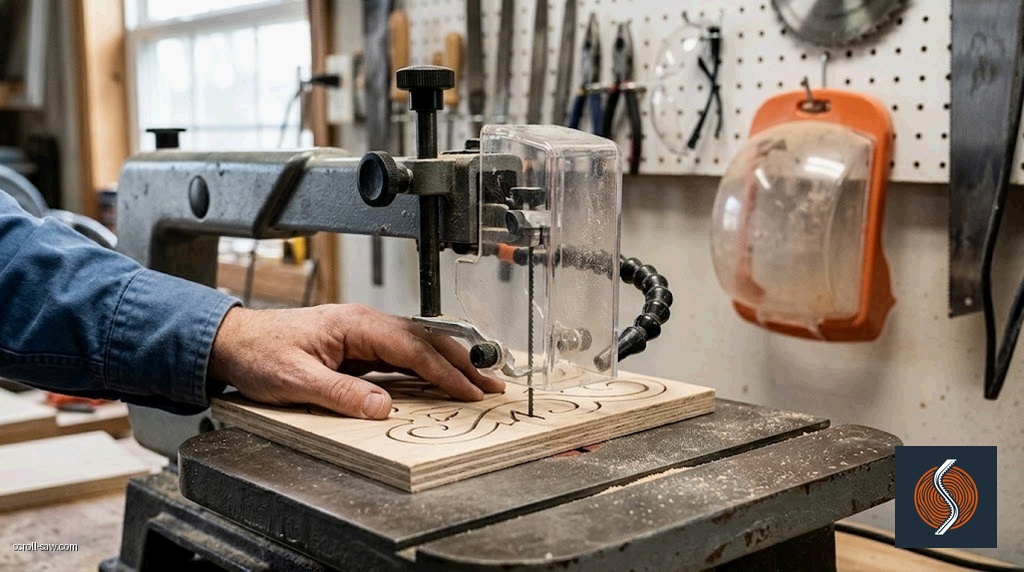
The blade guard on a scroll saw is a small clear or wire shield that sits above the workpiece, near where the blade enters the wood. Its job is to keep fingers and loose material from drifting up into the moving blade. Most scroll saws ship with one; many scrollers remove it within the first hour and never put it back.
That is a mistake. The blade guard does not change cut quality (TPI, kerf, turning radius, and finish come from the blade itself), but it does affect two things that matter: visibility of the cut line and the amount of skin between your fingers and a moving blade at four hundred strokes per minute.
What a blade guard actually is
The standard scroll saw blade guard is a clear plastic or wire hoop mounted above the throat plate, positioned just above the top surface of the workpiece. Two common styles:
Clear plastic shield. A small window of polycarbonate or acrylic that sits over the blade area. Offers physical protection while remaining transparent.
Wire hoop or spring finger. A stiff wire or metal finger that hovers above the workpiece. Less visual obstruction but less physical protection.
Most saws ship with a plastic shield. Aftermarket wire hoops exist for scrollers who find the plastic too cluttering.
Why the blade guard does not change TPI, kerf, or radius
Those numbers all come from the blade itself:
TPI is a property of the blade you loaded. #2/0 has about 32 TPI; #12 has about 6 TPI. The guard has no bearing on tooth count.
Kerf is the width of material the blade removes as it cuts. Determined by blade width. A #5 blade removes about 0.015 inches of material regardless of what guard is or is not in place.
Turning radius is determined by blade width. Smaller blades pivot in tighter arcs. The guard sits above the workpiece and has no contact with the blade’s cutting action.
Finish quality comes from tooth geometry, blade sharpness, tension, speed, and feed. All independent of the guard.
The only indirect effect the guard has on cut quality is through visibility. A guard that blocks your view of the cut line makes it harder to steer accurately, which shows up as wobbly lines. A guard that stays clear of the sight line has zero effect on the cut itself.
Why so many scrollers remove the guard
Three reasons the factory guard often gets stashed in a drawer:
-
It scratches easily. Plastic guards get scratched from sawdust and workpiece contact, and after a few hours of use, the visibility through them drops.
-
It interferes with tall workpieces. Some plastic shields hang too low for 3/4-inch stock, forcing you to cut around them or remove them.
-
It blocks the sight line on fine work. For fretwork on 1/8 inch stock, the guard sits far enough above the workpiece to obstruct your view of a 1/16 inch pilot hole.
All three problems are real. All three are solvable without removing the guard entirely.
Keeping the guard useful
Wipe the shield regularly. A clean plastic shield is transparent enough for almost any cut. Wipe with a microfiber cloth and a drop of window cleaner every hour of use. Do not use paper towels; they scratch.
Adjust the height for the workpiece. The guard should hover about 1/8 to 1/4 inch above the top surface of the wood. Too high and it does not protect; too low and it drags. Most guards have an adjustment thumbscrew.
Consider a smaller aftermarket guard. If the factory shield blocks your view, a wire hoop or smaller acrylic shield lets you see the cut line while still catching fingers and offcuts.
Replace the shield when it wears out. A scratched, cloudy shield is worse than no shield because it lulls you into thinking you can see when you cannot. Replacement shields are cheap through the saw manufacturer or aftermarket suppliers.
When removing the guard makes sense
Some fine fretwork genuinely requires unobstructed vision of a very small cut area. If you are removing the guard for a specific project on a specific saw, at minimum:
-
Remove watches, rings, loose sleeves, and anything that could catch
-
Use a hold-down or spring finger to keep the workpiece flat (many aftermarket guards double as hold-downs)
-
Keep your fingers well away from the blade path
-
Reinstall the guard when the fine work is done
Removing the guard permanently is a decision to accept more risk in exchange for slightly better visibility. Make it deliberately, not by default.
Related accessory: the hold-down
Many scroll saws combine the guard with a spring-loaded hold-down that presses the workpiece against the table. This is different from the guard itself:
-
The guard protects fingers and catches offcuts
-
The hold-down presses the workpiece flat against the table
A hold-down keeps the workpiece from lifting off the table when the blade rises through the cut. Without it, thin stock can flutter and the blade can grab it. Some scrollers keep the hold-down installed and remove only the guard shield above it; others use a small dedicated hold-down without the guard.
Guard alternatives worth naming
Bear Woods finger hoop. A wire hoop that mounts to the saw’s guard bracket and offers minimal visual obstruction. Popular with scrollers who found the factory shield too cluttering.
Pegas quick-release guard. For DeWalt DW788 and similar saws, a smaller guard designed to be raised or lowered quickly for interior cut threading.
Custom shop-built guards. Some scrollers build their own from clear polycarbonate scrap. Simple and cheap; effective if built to the right dimensions.
Bottom line
A blade guard does not change how a specific blade cuts (TPI, kerf, radius, and finish depend on the blade), but it does keep your fingers away from a fast-moving blade. Keep the factory shield clean and adjusted, or replace with a wire hoop for less visual obstruction. Remove entirely only when a specific project requires it, and reinstall afterward. The five seconds it takes to raise the guard for a blade change is worth the protection it offers during hours of cutting.
FAQ
Does the blade guard affect cut quality? Not directly. TPI, kerf, turning radius, and finish come from the blade itself.
Can I remove the blade guard permanently? You can, but you shouldn’t. Keep it clean and adjusted, or switch to a wire hoop for less obstruction.
Why is my blade guard cloudy? Sawdust and workpiece contact scratch plastic shields. Clean regularly; replace when scratches obscure vision.
How high should the blade guard sit above the workpiece? 1/8 to 1/4 inch above the top surface for most work.
Is a wire hoop guard as protective as a plastic shield? Slightly less physical protection but less visual obstruction. Reasonable trade-off for many scrollers.
Do I need a separate hold-down? Many guards include a hold-down. If yours does not and thin stock flutters, add one.
Where do I buy replacement guards? The saw manufacturer’s parts catalog, or aftermarket suppliers like Bear Woods and Sloan’s Woodshop.
References
-
DeWalt DW788 owner’s manual, dewalt.com
-
Bear Woods scroll saw accessories, bearwood.com
-
Sloan’s Woodshop scroll saw guards, sloanswoodshop.com
-
Steve Good, Scroll Saw Workshop on safety accessories, scrollsawworkshop.blogspot.com


