
Scroll Saw Blade Numbering System: Guide
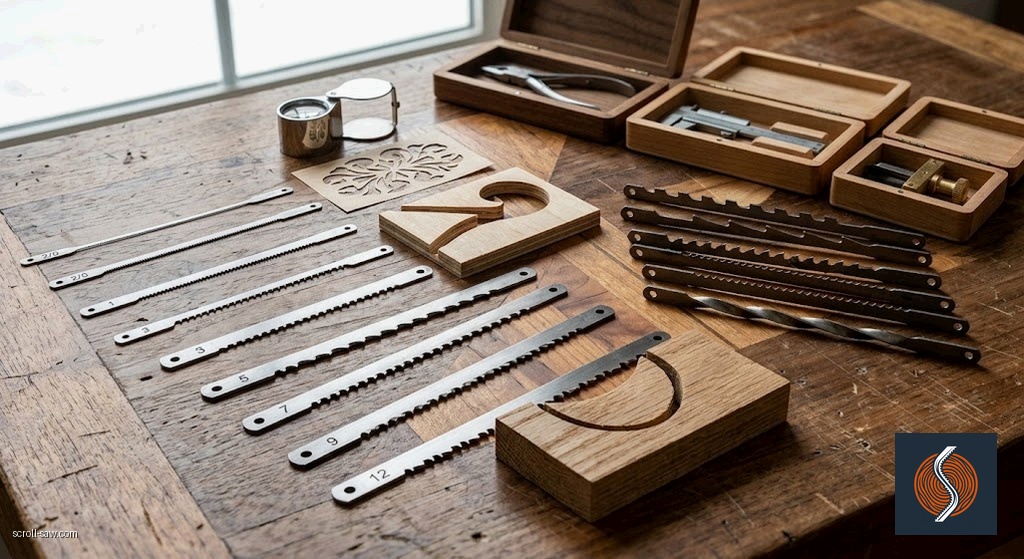
Scroll Saw Blade Numbering System: Guide
Scroll saw blades come with a number stamped on the package: #2/0, #1, #3, #5, #7, #9, #12. That number tells you almost everything about the blade’s cutting characteristics. Understanding the system takes about ten minutes and makes every future blade purchase easier.
Here is what the numbers actually mean, how they map to material and thickness, and how to remember the pattern.
The numbering scale
Scroll saw blades follow a standard numbering scale that is roughly consistent across manufacturers. Some numbers use the ought scale for very small blades: #2/0 means “double ought,” #3/0 means “triple ought,” and so on. Above zero, the numbers go up by odd increments and then even ones: #1, #3, #5, #7, #9, #12.
| Number | Approximate width | Approximate TPI | Approximate turning radius |
|---|---|---|---|
| #3/0 | 0.006 in | 40 | Very tight |
| #2/0 | 0.008 in | 32 | 1/32 in |
| #1 | 0.010 in | 26 | Very tight |
| #3 | 0.012 in | 20 | 1/16 in |
| #5 | 0.015 in | 16 | 1/16 in |
| #7 | 0.017 in | 12 | 3/32 in |
| #9 | 0.020 in | 10 | 1/8 in |
| #12 | 0.024 in | 8 | 3/16 in |
How to remember it
One useful memory rule: the number roughly corresponds to the material thickness in eighths of an inch for outline cuts in hardwood. A #3 handles 3/8 inch. A #5 handles 5/8 inch. A #7 handles 7/8 inch. This is a rough approximation, not a strict rule, but it captures the general trend.
For detail work, size down. Fretwork in 1/4 inch stock uses #1 or #3, not #5, because the smaller blade turns tighter.
Matching numbers to material
| Material | Thickness | Blade number |
|---|---|---|
| Basswood | 1/8 in | #3 |
| Basswood | 1/4 in | #5 |
| Baltic birch ply | 1/8 in | #3 |
| Baltic birch ply | 1/4 in | #5 |
| Cherry, walnut | 1/4 in | #5 |
| Cherry, walnut | 1/2 in | #7 |
| Cherry, walnut | 3/4 in | #9 |
| Oak, maple | 1/2 in | #7 |
| Oak, maple | 3/4 in | #9 |
| Pine, spruce | 3/4 in | #9 |
| Ipe, teak (dense exotics) | 1/2 in | #7 with cutting fluid |
| Fretwork detail | 1/8 to 1/4 in wood | #1 or #3 |
| Portrait scrolling | 1/4 in wood | #2/0 or #1 spiral |
| Corian | 1/4 in | #5 at low speed |
| Acrylic | 1/8 to 1/4 in | #5 at low speed |
| Brass, aluminum 1/16 in | 1/16 in | #3 metal-cutting |
The rule of thumb
Choose the largest blade that still holds the detail your pattern requires.
Larger blades:
-
Track straighter through cuts
-
Break less often
-
Cut faster
-
Handle heavier feed without wandering
Smaller blades:
-
Handle finer detail
-
Turn tighter
-
Break more often
-
Cut slower
Do not size down unless the detail demands it.
Brand variation
Different manufacturers apply the numbering system consistently but with small variations. An Olson #5 skip-tooth is dimensionally very close to a Pegas #5 or a Niqua #5. The tooth geometry and cut characteristics differ slightly, but the size scale is the same.
When switching brands, expect small differences in cut feel: some brands cut slightly more aggressively at the same nominal size; some produce slightly cleaner walls. Number selection remains consistent.
Additional specifications on the blade
Besides the number, scroll saw blade packages list:
Tooth geometry. Skip-tooth, reverse-tooth, precision ground, spiral, double-tooth, crown-tooth. Each serves a specific purpose.
End style. Plain-end for modern saws, pin-end for older or entry-level saws.
Length. 5 inches for essentially all modern saws.
Blade material. Carbon steel is standard; some premium blades use high-carbon or coated steel for longer life in dense stock.
Manufacturer’s product line. Olson has SK, SKR, PGT lines. Flying Dutchman has FD-UR, FD-Ultra. Pegas has Modified and Skip lines. Each line has slightly different characteristics.
Common mistakes with blade numbering
Assuming higher numbers are better. Higher numbers are more aggressive, not “better.” A #12 in 1/8 inch basswood is wrong; the blade will chatter and tear the wood.
Assuming smaller numbers are always finer. Smaller numbers are finer AND weaker AND slower. Use them when you need the fineness, not for every cut.
Ignoring the blade line. A #5 skip-tooth and a #5 precision ground look similar but perform differently in hardwood. Pick the line that matches the material.
Using the same blade for everything. Different sizes and geometries exist because different jobs need different blades. One-size-fits-all cutting sacrifices quality on the projects where blade choice matters most.
Starter blade kit
For a new scroller, one bundle each of these covers most work:
-
#3 skip-tooth for fine detail in thin stock
-
#5 skip-tooth as your workhorse
-
#7 skip-tooth for thicker hardwood
-
#5 reverse-tooth for plywood
-
Optional: #2/0 spiral for portrait work
Budget under twenty dollars for the starter set. Add more sizes and geometries as your projects demand.
Bottom line
The scroll saw blade numbering system is simple: smaller numbers are finer, larger numbers are more aggressive. Match to material and thickness using the chart above. Choose the largest blade that holds the detail your pattern requires. Do not confuse size number with quality; a #12 is not “better” than a #3, just different. Ignore the numbering system at your peril; using it correctly is the single easiest way to improve every cut you make.
FAQ
What does #5 mean on a scroll saw blade? A medium-sized blade, about 0.015 inches wide with 16 teeth per inch. Workhorse size for 1/4 to 3/8 inch hardwood.
Are scroll saw blade numbers standard across brands? Yes, with small variations. A #5 from any major brand is dimensionally similar.
What is a #2/0 blade? A very small blade, about 0.008 inches wide with 32 teeth per inch. For very fine fretwork and portrait scrolling.
Which blade number should I buy first? #5 skip-tooth. It handles most 1/4 to 3/8 inch hardwood work.
How do I know what number blade my project needs? Match to the material and thickness. Use the largest blade that holds the pattern detail.
Can I use a larger blade than the chart recommends? You can, but the cut will be less clean. Larger blades work well only for their intended thickness range.
What is the difference between #5 skip-tooth and #5 precision ground? Same size and TPI. Precision ground has more consistently formed teeth, cutting cleaner and lasting longer.
References
-
Olson Saw Company blade catalog, olsonsaw.com
-
Pegas Scroll Saw blade guide, pegas-swiss.com
-
Flying Dutchman blade documentation, mikesworkshop.com
-
Steve Good, Scroll Saw Workshop on blade selection, scrollsawworkshop.blogspot.com


