
Scroll Saw Blade Selection: Practical Guide
Scroll Saw Blade Selection: Practical Guide
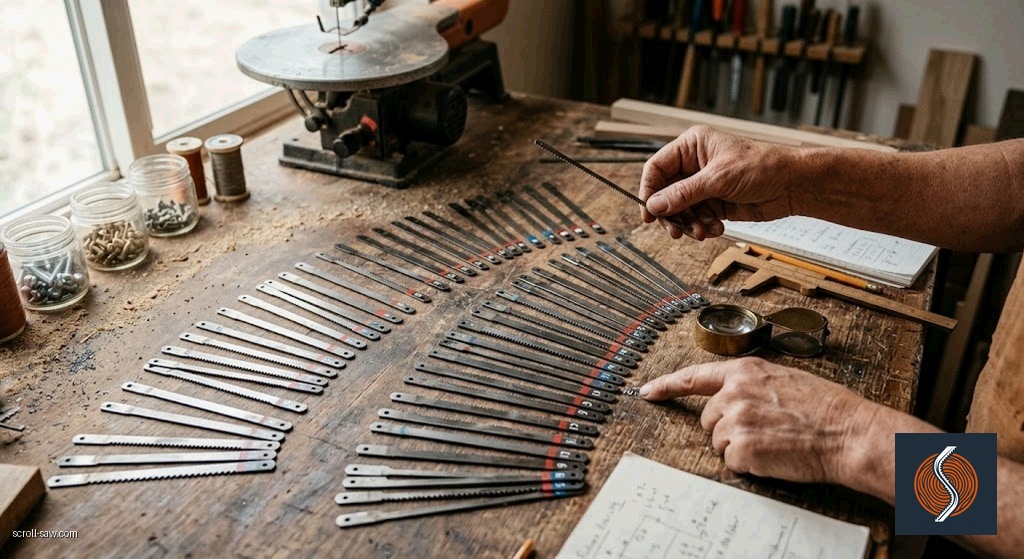
Blade selection is the single decision that has the biggest effect on how your scroll saw cuts. A perfectly tuned saw with a wrong-sized blade produces bad cuts. A modestly tuned saw with the right blade produces clean ones. Learning to pick the right blade for the material and pattern in front of you is the fastest way to jump from beginner-quality cuts to work you can be proud of.
Here is a practical approach to blade selection that covers 95 percent of scroll saw work without turning into a chart-memorization exercise.
The three questions to ask before every blade change
Before loading any blade, answer three questions:
-
What material am I cutting, and how thick is it?
-
How much detail does the pattern require?
-
Will the underside show in the finished piece?
Answers to these three questions narrow the choice to one or two blades from any complete blade collection.
Sizing to material
The first cut is sizing to material. Bigger blades handle thicker or denser wood. Smaller blades handle thinner or softer wood.
| Material | Thickness | Blade size |
|---|---|---|
| Basswood | 1/8 in | #3 |
| Basswood | 1/4 in | #5 |
| Baltic birch ply | 1/8 in | #3 |
| Baltic birch ply | 1/4 in | #5 |
| Cherry, walnut | 1/4 in | #5 |
| Cherry, walnut | 1/2 in | #7 |
| Cherry, walnut | 3/4 in | #9 |
| Oak, maple | 1/2 in | #7 |
| Oak, maple | 3/4 in | #9 |
| Pine, spruce | 3/4 in | #9 |
| Ipe, teak | 1/2 in | #7 with cutting fluid |
Adjusting for detail
If the pattern needs tight curves, small interior cuts, or fretwork bridges under 1/8 inch, size down. A pattern in 1/2 inch cherry with heavy detail might use a #5 instead of the material-recommended #7.
The trade-off: smaller blades wander more and break more often. Accept the extra care in exchange for the detail you need.
For extreme detail (portrait scrolling, fine fretwork), use a #2/0 or #1 in spiral or reverse-tooth geometry.
Choosing the geometry
Skip-tooth for general wood cutting. Cool cut, chips clear well.
Reverse-tooth when the underside will show. Clean back-face.
Precision ground for hardwood and finish-quality cut walls.
Spiral for portrait work with many tight curves.
Double skip-tooth for very cool cutting in dense hardwood.
Metal-cutting for brass, aluminum, thin steel.
Most hobby cutting uses skip-tooth. Add reverse-tooth for plywood signage. Add precision ground for finished pieces in hardwood.
Speed and feed after the blade is loaded
Blade selection is half the equation. Speed and feed do the rest.
Speed roughly at the middle of the saw’s SPM range for hardwood, upper middle for softwood, lower for plastics. Very small blades run at lower speeds; very large blades tolerate higher speeds.
Feed with fingertip pressure only. If you feel yourself pushing, the blade is too small or the speed is wrong. Adjust the setup rather than pushing harder.
Common selection mistakes
Using a #7 for everything. Convenient but wrong for fine detail. Learn the sizing chart.
Using skip-tooth for plywood. The underside splinters. Use reverse-tooth.
Using large blades for tight curves. The blade cannot turn; the cut fights you. Size down for the detail sections and back up for the outlines.
Forgetting to change blades between sections. If a pattern has both rough outline and fine detail, change blades between them rather than compromising for a single blade.
Blade brand as part of selection
Different brands cut slightly differently at the same nominal size:
Olson SK for general purpose at moderate price.
Olson PGT for precision ground hardwood cutting.
Pegas for premium ground blades with the longest life.
Niqua Onyx and Puma for German precision at mid to high price.
Flying Dutchman for wide specialty selection including spirals.
Rockler, Woodcraft house brands for competent mid-tier at hardware store convenience.
Buy a bundle each in your most-used size (#5) from two or three brands and see which suits your feel. Personal preference matters as much as ranking.
When selection is not enough
Sometimes the right blade still cuts badly because:
Blade is under-tensioned. Pluck test rings clearly, or add more tension.
Blade is dull. Sharp blades cut with light pressure; dull blades require heavier feed. If you find yourself pushing, change the blade.
Saw speed is wrong. Fine blades run at lower speeds; large blades at higher.
Feed is wrong. Fingertip pressure only.
Blade is cambered. Roll on a flat surface before installing; return if visibly bent.
Fix these before blaming blade selection.
Bottom line
Blade selection is the highest-leverage decision in every scroll saw cut. Match size to material and thickness. Adjust for detail. Choose geometry based on the job. Buy quality blades in the sizes and geometries you use most. When cut quality is poor, first check blade selection, then check tension, speed, and feed.
FAQ
What is the most important factor in scroll saw blade selection? Matching size to material and thickness. Everything else follows.
Which blade should I use for 1/2 inch hardwood? #7 skip-tooth for general cutting; precision ground for finish-quality walls.
Which blade for fretwork? #1 or #3 reverse-tooth or spiral, sized down from the material’s usual recommendation.
Should I change blades within one project? Yes. Match the blade to each section: larger for outlines, smaller for detail.
How do I know if my blade selection is wrong? Burning, wandering, hard feed, or torn walls all indicate wrong selection or setup.
Can one blade cover most projects? #5 skip-tooth handles the largest share of general work. But no single blade covers everything.
Where can I find a full blade selection chart? Most scroll saw specialty retailers publish one. Olson, Pegas, Flying Dutchman all offer selection guides.
References
-
Olson Saw Company blade selection guide, olsonsaw.com
-
Pegas Scroll Saw blade documentation, pegas-swiss.com
-
Flying Dutchman blade selection, mikesworkshop.com
-
Steve Good, Scroll Saw Workshop on blade choice, scrollsawworkshop.blogspot.com


