
Scroll Saw Blade Thickness: Complete Guide
Scroll Saw Blade Thickness: Complete Guide
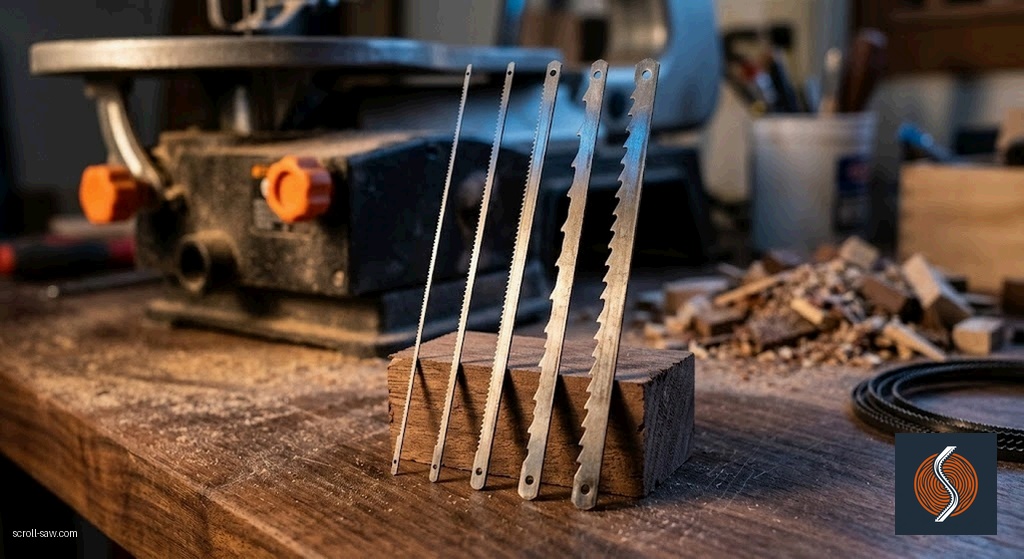
Scroll saw blade thickness (technically the width of the blade steel) is what the size number actually describes. A #2/0 blade is about 0.008 inches thick. A #12 is about 0.024 inches. Every size in between falls on a predictable scale, and thickness is what determines the TPI, kerf, turning radius, and finish characteristics of every blade you load.
Understanding thickness takes ten minutes and makes every future blade choice clearer.
The thickness scale
| Blade size | Thickness (blade width) | TPI |
|---|---|---|
| #3/0 | 0.006 in | ~40 |
| #2/0 | 0.008 in | 32 |
| #1 | 0.010 in | 26 |
| #3 | 0.012 in | 20 |
| #5 | 0.015 in | 16 |
| #7 | 0.017 in | 12 |
| #9 | 0.020 in | 10 |
| #12 | 0.024 in | 8 |
How thickness controls TPI
Thicker blades are physically bigger, so each tooth is bigger, and fewer teeth fit per inch. Thinner blades are smaller, with smaller teeth, and more teeth per inch.
More TPI means:
-
Smoother cut walls
-
Slower material removal
-
Better for thin stock
Fewer TPI means:
-
Rougher cut walls
-
Faster material removal
-
Better for thick stock
TPI is not a separately chosen specification. It follows from the size number, which is set by blade thickness.
How thickness controls kerf
Kerf is the width of material the blade removes as it cuts. Kerf is slightly wider than the blade thickness because the teeth are set (bent alternately left and right) to prevent binding. Rough approximation: kerf equals blade thickness plus about 20 to 30 percent.
A #5 blade at 0.015 inches thick cuts a kerf of about 0.018 inches. A #12 blade at 0.024 inches cuts a kerf of about 0.028 inches.
Kerf matters for joinery, inlay, and puzzle cutting. For most decorative work, kerf is invisible in the finished piece.
How thickness controls turning radius
Thicker blades have more sideways rigidity and cannot bend as much as they enter a tight curve. Thinner blades bend more easily and can pivot in tighter arcs.
| Blade size | Turning radius |
|---|---|
| #2/0 | 1/32 in |
| #3 | 1/16 in |
| #5 | 1/16 in |
| #7 | 3/32 in |
| #9 | 1/8 in |
| #12 | 3/16 in |
How thickness controls finish quality
Thinner blades leave finer tool marks on the cut walls because each individual tooth removes less material per pass. Thicker blades leave heavier tool marks that require more sanding.
But finish quality is not just thickness. Tooth geometry matters too:
-
Skip-tooth leaves visible tool marks even at the finest sizes
-
Precision ground leaves cleaner walls at the same size
-
Reverse-tooth leaves cleaner underside walls
-
Spiral leaves rougher walls than any straight blade
For finish-quality work in hardwood, use precision ground blades in the appropriate size.
Matching thickness to material
| Material | Thickness | Blade size |
|---|---|---|
| Basswood | 1/8 in | #3 |
| Baltic birch ply | 1/4 in | #5 |
| Cherry, walnut | 1/4 to 1/2 in | #5 or #7 |
| Oak, maple | 1/2 to 3/4 in | #7 or #9 |
| Pine, spruce | 3/4 in | #9 |
| Fretwork detail | 1/8 to 1/4 in | #1 or #3 |
| Portrait scrolling | 1/4 in wood | #2/0 or #1 spiral |
The rule of thumb
Use the largest blade thickness that still holds the detail your pattern needs. Larger blades:
-
Track straighter
-
Break less often
-
Cut faster
-
Handle heavier feed
Smaller blades:
-
Handle finer detail
-
Turn tighter
-
Break more often
Do not size down unless the pattern demands it.
How thickness affects blade life
Thicker blades last longer per hour of cutting because each tooth carries more of the load and dulls more slowly. Thinner blades wear out faster because each small tooth removes proportionally more material.
Rough estimates for continuous cutting in hardwood:
-
#2/0: 15 to 30 minutes
-
#5: 30 to 60 minutes
-
#9: 60 to 120 minutes
This varies with material density, blade brand, and cutting speed. Softwoods extend life significantly. Exotic hardwoods reduce it.
How thickness affects blade breakage
Thinner blades break more often for two reasons:
-
Less material to resist bending stress. A #2/0 flexes and eventually snaps under any sideways force.
-
More TPI means smaller teeth that catch and snag more easily. A tooth catching in a tough spot creates a stress point.
For projects with many tight curves and interior cuts, expect to break several small blades before you finish. Buy small blades in larger quantities than large blades for this reason.
When thickness alone is not enough
Sometimes the right thickness still cuts poorly because:
Blade is dull. Sharp thin blades cut cleanly; dull thin blades wander and burn.
Tension is wrong. Under-tensioned blades wander regardless of thickness.
Feed is heavy. Pushing hard bends any blade sideways.
Speed is wrong. Fine thin blades run at lower speeds; thick blades at higher speeds.
Fix these before assuming the thickness choice was wrong.
Bottom line
Blade thickness controls TPI, kerf, turning radius, and finish quality. Size number is a direct proxy for thickness. Match thickness to material: bigger for thicker or denser stock, smaller for thinner or finer detail. Use the largest thickness that still holds the pattern detail. Expect thinner blades to wear and break faster than thicker ones.
FAQ
What thickness is a #5 scroll saw blade? About 0.015 inches wide (thick).
Does thickness affect kerf? Directly. Kerf is about 20 to 30 percent wider than blade thickness.
Do thicker blades last longer? Usually yes, in continuous cutting through the same material.
Which thickness is best for fretwork? #1 or #3 (0.010 to 0.012 inches) for detailed fretwork in 1/8 to 1/4 inch stock.
Does thickness change between brands at the same size? Slightly. Different manufacturers grind blades to slightly different tolerances. Differences are small enough that sizes are cross-compatible in practice.
Can I use a #12 blade for fine detail? No. Thick blades cannot turn tight enough for fine detail. Size down to #3 or smaller for detail work.
How do I know my blade is the right thickness? Match to the material and detail requirement using the chart above. Cut a scrap to confirm the blade tracks straight and cuts cleanly.
References
-
Olson Saw Company blade thickness specifications, olsonsaw.com
-
Pegas Scroll Saw blade guide, pegas-swiss.com
-
Flying Dutchman blade documentation, mikesworkshop.com
-
Steve Good, Scroll Saw Workshop on blade thickness, scrollsawworkshop.blogspot.com


