
Scroll Saw Blades Explained: Complete Guide
Scroll Saw Blades Explained: Complete Guide
Scroll saw blades look simple. Thin strip of steel with teeth. Five inches long, either plain-ended or pinned. But every characteristic of that thin strip (size, tooth geometry, steel grade, tooth set, end style) affects how it cuts, what it cuts well, and how long it lasts.
Here is scroll saw blades explained from first principles, covering what makes one blade different from another and how to translate those differences into better cuts on your workpiece.
Anatomy of a scroll saw blade
A standard scroll saw blade is 5 inches long, made from high-carbon or high-speed steel, with cutting teeth ground or stamped along one edge.
Ends. Plain-end blades have flat ends that clamp between two jaws. Pinned-end blades have a small cross pin that drops into a socket. Plain-end fits nearly every modern saw. Pinned-end fits older or entry-level saws designed for pinned blades.
Body. The main strip of steel between the ends. Width varies from about 0.006 inches (#3/0) to 0.024 inches (#12). This width is what the size number describes.
Teeth. Cut into one edge of the body. Tooth count per inch (TPI) varies with size: small blades have many small teeth (up to 40 TPI), large blades have fewer larger teeth (8 TPI).
Tooth set. Teeth are usually bent alternately left and right so the cut is slightly wider than the blade body. This prevents binding.
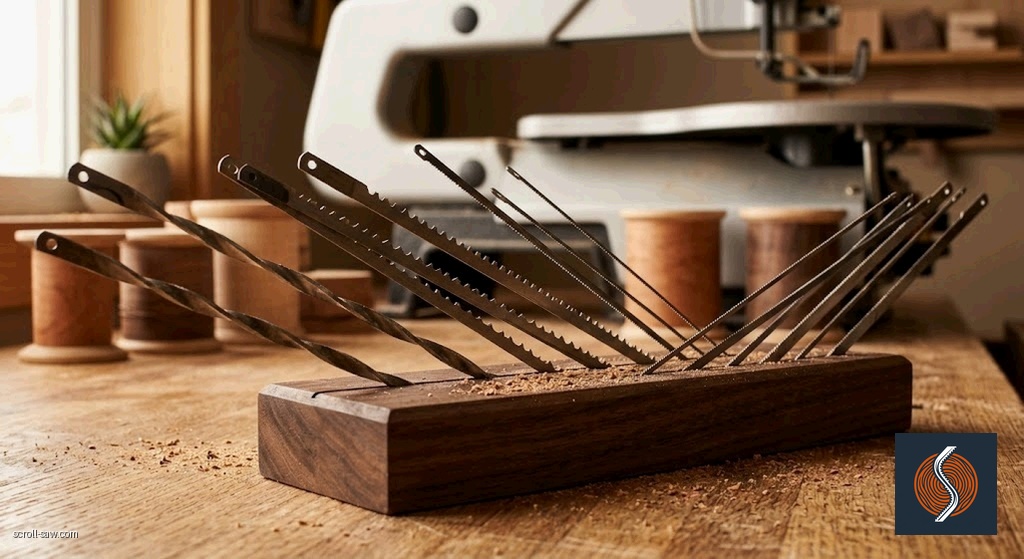
Tooth geometry. How the teeth are shaped and arranged along the blade. Skip-tooth, reverse-tooth, precision ground, spiral, double skip-tooth, crown-tooth, and metal-cutting are the main types.
The size scale
| Size | Width | TPI | Standard use |
|---|---|---|---|
| #2/0 | 0.008 in | 32 | Fine fretwork, portraits |
| #1 | 0.010 in | 26 | Fine detail |
| #3 | 0.012 in | 20 | 1/8 to 1/4 in wood |
| #5 | 0.015 in | 16 | 1/4 to 3/8 in workhorse |
| #7 | 0.017 in | 12 | 1/2 in hardwood |
| #9 | 0.020 in | 10 | 3/4 in hardwood |
| #12 | 0.024 in | 8 | Thick stock, rough shapes |
Tooth geometries
Skip-tooth. Every other tooth position is skipped, creating deeper gullets that clear chips well. Cool cutting. Standard for general wood work.
Reverse-tooth. Most teeth face down; a few at the bottom face up. Cleans the underside of the workpiece as the blade rises. Standard for plywood.
Precision ground. Each tooth ground for consistent geometry. Cleaner walls, longer life. Best for finish-quality hardwood.
Spiral. Teeth wrap 360 degrees. Cuts in any direction. Best for portrait scrolling.
Double skip-tooth. Two skipped positions between teeth for maximum chip clearance. Runs cool in dense material.
Crown-tooth. Teeth alternate up and down. Best for plastics.
Metal-cutting. Very fine teeth for brass, aluminum, and thin steel.
Steel grades
High-carbon steel. Standard for most scroll saw blades. Reasonable life, moderate cost.
High-speed steel (HSS). Longer life, higher cost, more resistant to heat.
Bi-metal. Body of one steel with teeth of harder material welded on. Extended life; used mainly in metal-cutting blades.
For hobby wood cutting, high-carbon steel is almost always sufficient. HSS and bi-metal make sense for production cutting or metal work.
How the characteristics interact
Size sets thickness, TPI, and turning radius. These are not independent. Choose a size and the other three follow.
Tooth geometry sets finish quality and specialization. Skip-tooth for general, reverse for plywood, ground for finish, spiral for portraits.
Steel grade sets life and cost. Higher grade lasts longer at higher cost.
End style sets saw compatibility. Plain-end for modern saws, pinned for older or entry-level.
A #5 skip-tooth plain-end high-carbon blade is the default choice for general wood cutting on a modern saw.
Matching blade to material
| Material | Thickness | Blade type and size |
|---|---|---|
| Basswood | 1/8 in | Skip-tooth #3 |
| Baltic birch ply | 1/4 in | Reverse-tooth #5 |
| Cherry, walnut | 1/2 in | Skip-tooth #7 or ground #7 |
| Oak, maple | 3/4 in | Skip-tooth #9 |
| Fine fretwork | 1/8 to 1/4 in | Reverse-tooth or spiral #1 to #3 |
| Portrait scroll | 1/4 in wood | Spiral #2/0 or #1 |
| Acrylic | 1/8 in | Crown or skip-tooth #5 low speed |
| Brass, aluminum | 1/16 in | Metal-cutting #3 with lubricant |
Setting up the blade for better cuts
Once the right blade is loaded:
Install correctly. Teeth face down and forward. Cut a scrap to verify before committing to the workpiece.
Tension firmly. Pluck the blade for a clear ringing note. Under-tensioned blades wander; over-tensioned blades snap.
Set saw speed appropriate to material. Middle SPM for hardwood, upper middle for softwood, lower for plastics.
Feed with fingertip pressure only. Guide the wood; do not push. Pushing bends the blade and causes wandering.
All four setup factors have to be right for the blade to cut its best.
Blade life expectations
Blades wear out. Rough estimates for continuous cutting:
-
Softwoods. 60 to 120 minutes per blade
-
Hardwoods. 30 to 60 minutes per blade
-
Exotics (ipe, teak). 15 to 30 minutes per blade
-
Plywood. Slightly shorter than solid wood at the same thickness
Signs a blade is done:
-
Feed rate slows even with proper pressure
-
Cut walls become torn or fuzzy
-
Blade drifts off the line
-
Cutting produces smoke or burning
Change blades when any of these appear. Trying to extend blade life beyond its useful window produces bad cuts and stresses the saw.
Where blades commonly break
Blades break for predictable reasons:
Over-tension. Tension beyond spec snaps the blade at the ends.
Bad clamp seating. Blade slips slightly and stresses one end.
Feed pressure too high. Bends the blade sideways until it snaps.
Blade already dulled. Dull blades take more force to feed, more force means more sideways stress.
Manufacturing defect. Rare but happens.
Reduce breakage by loading carefully, tensioning to spec, feeding light, and changing dull blades promptly.
Blade brand matters
Different brands produce noticeably different cut quality at the same nominal size:
Olson. US-made. SK for standard skip-tooth. PGT for precision ground. Widely available.
Pegas. Swiss-made. Premium ground blades with the longest life in independent tests.
Flying Dutchman. Wide specialty selection including spirals. Sold through mikesworkshop.com.
Niqua. German-made. Onyx (standard), Puma (ground), Gold (precision) tiers.
Rockler, Woodcraft house brands. Competent mid-tier at hardware store convenience.
Buy bundles from a couple of brands in your most-used size and see which suits your feel.
Bottom line
Scroll saw blades are simple in construction but rich in specifications. Size, tooth geometry, steel grade, and end style all matter. Match blade to material and pattern; install correctly with proper tension, speed, and feed; change blades before they fully dull. Understand a blade’s specifications and you can predict how it will cut before you turn on the saw.
FAQ
What is a scroll saw blade? A thin strip of high-carbon or high-speed steel, usually 5 inches long, with cutting teeth along one edge, sized for scroll saw work.
What are the main scroll saw blade types? Skip-tooth, reverse-tooth, precision ground, spiral, double skip-tooth, crown-tooth, and metal-cutting.
How long does a scroll saw blade last? 30 to 120 minutes of continuous cutting depending on material and blade type.
Which blade size for general cutting? #5 skip-tooth in high-carbon steel covers most 1/4 to 3/8 inch wood.
Do all scroll saws use the same blades? Most modern saws use plain-end blades in the standard size scale. Some older or entry-level saws use pinned-end blades in the same scale.
Why do blades break? Over-tension, bad clamp seating, heavy feed, worn blades, or manufacturing defects.
Which brand is best? Pegas has the longest life in independent tests. Olson is the standard US brand. Personal preference varies by hand feel.
References
-
Olson Saw Company blade catalog, olsonsaw.com
-
Pegas Scroll Saw documentation, pegas-swiss.com
-
Flying Dutchman blade selection, mikesworkshop.com
-
Steve Good, Scroll Saw Workshop blade guide, scrollsawworkshop.blogspot.com


